
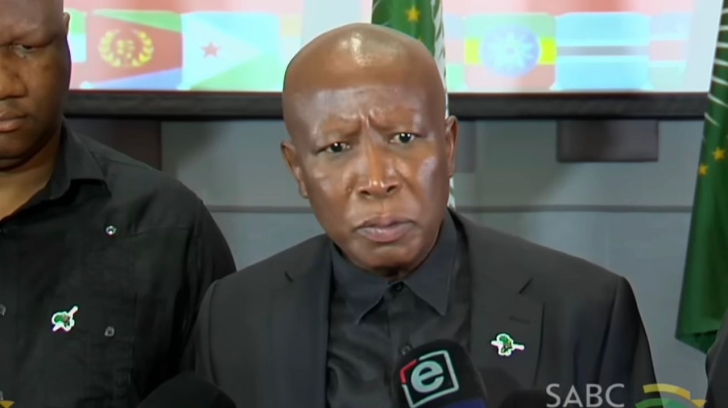
"They [ANC] are all in a cohort to distract us, to fight us in reclaiming the land, the economy, confronting the challenges of unemployment.., the fight for unemployment is exactly what we are being distracted from. [They] tell them [the youth] you are not unemployed because of us [ANC], go to these Africans who are taking your jobs.
Ghanaians, 300 of them have left, someone must tell me, how many South Africans got those jobs that were taken by the Ghanaians", because the Ghanaians are gone now, 300 of them. How many 300 jobs were created after the Ghanaians have left. So it is just a myth, it is a lie, which they are using to further divide us, perpetuate colonial divisions, that were created in the past' - Julius Malema indicated in a jibe towards the South African government and his compatriot South African nationals.
Julius Malema:
— DailyGraphic GraphicOnline (@Graphicgh) May 28, 2026
"We need to pursue the diplomatic engagements with Ghana until we find... we don't think Ghana responded in a manner that really enforces dialogue and diplomatic engagements." https://t.co/Rsta4qBvus pic.twitter.com/HryhAAF0TE
There has been varied reactions following xenophobic attacks on Ghanaians and other African nationals in South Africa.
On Wednesday, the Ghanaian government evacuated 300 Ghanaians from South Africa to Accra.
The 300, according to the Ministry of Foreign Affairs in Ghana is a fraction of the over 800 who have voluntarily registered to be evacuated to Ghana due to reported xenophobic attacks.
Before the departure of the 300 on Wednesday, May 27, 2026, the South African authorities indicated that only 10 of them [Ghanaian evacuees] had legal status in South Africa and that the remaining 290 had either overstayed their visas or did not have any.
- 300 Ghanaians arrive home from South Africa
- First batch of Ghanaian evacuees arrive home from South Africa
- VIDEO: ‘Only 10 were legal’ – South African immigration claim as first batch of 300 Ghanaians head home
"We think the Ghanaian government really overreacted but for them to over react in the way they did is largely dishonest," a South African activist, Jacinta Ngobese-Zuma said at a press conference.
Watch attached video below
Julius Malema's reaction
On his part, Julius Malema, a prominent and highly controversial South African politician who serves as the founder and leader (Commander-in-Chief) of the Economic Freedom Fighters (EFF), South Africa's third-largest political party, who has over the years raised issues with how his fellow compatriots react in relation to xenophobic attacks, stated: "Ghanaians are gone now, 300 of them. How many 300 jobs were created after the Ghanaians left," he indicated in a jibe towards the South African government his compatriot South African nationals.
Julius Malema argued that blaming migrants for job losses deepens colonial divisions and that on the part of Ghana, the response from the government also risks blaming entire societies [in South Africa] for the actions of a few people.
To him, the "Ghana response was not necessary because it now creates the impression that we [South Africans] are all like that when it is a certain section of our society that needs to be contained by law enforcement."
He said the fact that one Ghanaian lady said she was leaving because the problem was that when she was being beaten in front of the police, the police did not do anything, and that if the police can't defend her, then there was a problem."
For Malema, "we think [the Ghanaian government's action] was too quick, we should resolve this. The President of Ghana should have given us some time to really deal with this matter and we will get to the bottom of it, we don't have to respond the same way they did."
"We need to pursue the diplomatic engagements with Ghana until we find... we don't think Ghana responded in a manner that really enforces dialogue and diplomatic engagements," he added.
"Ghanaians are gone now, 300 of them. How many 300 jobs were created after the Ghanaians left."
— News Central TV (@NewsCentralTV) May 28, 2026
Julius Malema says blaming migrants for job losses deepens colonial divisions and that Ghana’s response risks blaming entire societies for the actions of a few people. pic.twitter.com/IsejccA5xH
Writer's email:
Follow @enochfrimpong Follow @Graphicgh
