
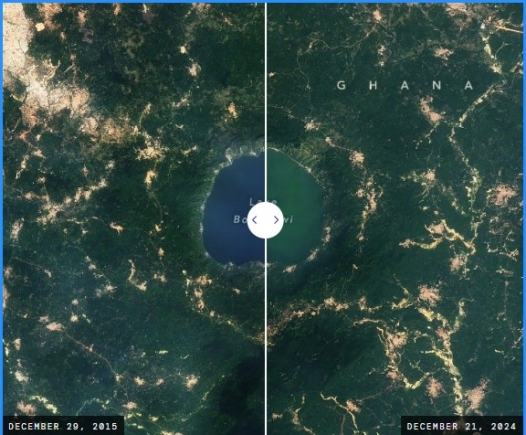
This shimmering satellite image from NASA's Landsat taken on December 21, 2024 shows tendrils of gold surrounding Ghana's sacred "lake of souls," - Lake Bosomtwe, which is said to have been carved out by a devastating asteroid strike around 1 million years ago.
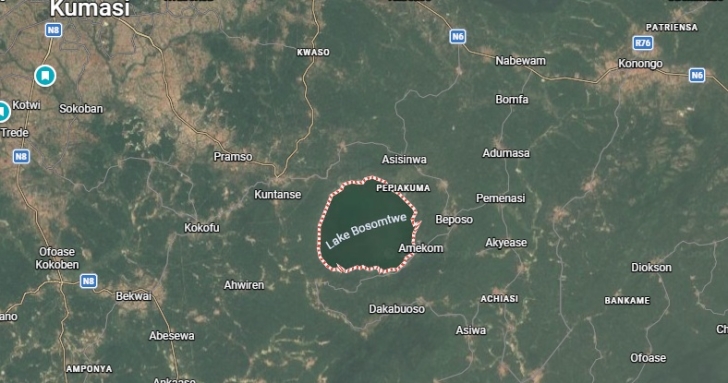
Lake Bosumtwe, a bowl-shaped body of water southeast of the fast-growing city of Kumasi (partially visible in the top left of the photo above), spans 49 square kilometers (19 square miles).
The roughly circular body of water, which is up to 240 feet (70 meters) deep, is Ghana's only natural lake. It is in the Bosomtwe district of the Ashanti Region.
QUICK FACTS
Where is it? Lake Bosomtwe, Ghana [6.498727489, -1.4087398896]
What's in the photo? Ghana's only natural lake, surrounded by exposed veins of gold
Which satellite took the photo? NASA's Landsat 8
When was it taken? Dec 21, 2024
Second photo was taken: Dec. 29, 2015
Oral narrative of how lake was discovered
Anyone who has visited Lake Bosomtwe before, especially at the Abono town side may have heard the famous oral narrative of how the lake was discovered in relation to the hunter called 'Bompe', his dog 'Daakye' and the hunt for an antelope (Otwe).
It is interesting especially hearing the narrative from the children at the Abono side of the lake explaining that the hunter, Bompe was on a hunting spree one night with his dog - Daakye - and they came across an antelope (Otwe). He reportedly fired at the antelope and thought he had hit it, but the wounded antelope fled the scene. The hunter is said to have followed the blood droplets presuming the angle at which, he hit the antelope, it was going to drop dead nearby.
According to the narrative, the hunter followed and saw the antelope resting near a small body of water, but when he made an attempt to approach it, the antelope reportedly jumped into the water and was not seen again. The hunter thinking the pond was too small for the antelope to drown reportedly jumped into the water but did not find it.
Since he could not find it, he reported back to his village/cottage folks who concluded the pond was a sacred site believed to be housing a god [Bosom]. According to the narrative, the small magical body of water rapidly swell into the lake we see today. A combination of the word Bosom in relation to the sacred site for the god [Bosom] and the antelope (Otwe), gave the name Bosomtwe [antelope god - Otwe Bosom otherwise referred to as Bosomtwe]
According to NASA's Earth Observatory, the Lake Bosomtwe area is also considered a "place where souls bid farewell to Earth before entering the afterlife."
The scientific narrative of a meteor slamming into planet earth
In reality, modern-day geologists have a more fiery, explosive explanation for the lake’s origin. Scientific analysis shows that an asteroid about 1 kilometer (0.6 miles) wide slammed into the African rainforest just over 1 million years ago, leaving one of the youngest and best-preserved complex impact craters on Earth.
Meaning, the lake actually formed around 1 million years ago, when a roughly 3,300-foot-wide (1 km) meteor slammed into planet earth, creating "arguably the best-preserved complex young impact structure known on Earth," according to the International Commission on Geoheritage.
The catastrophic collision likely triggered "a blinding flash of light and an immense fireball [that] would have incinerated life for dozens of kilometers," Marian Selorm Sapah, a senior lecturer in the University of Ghana's Department of Earth Science, told the Earth Observatory. If the same event occurred today, it would likely obliterate the city of Kumasi, she added.
According to the geologists, the energy released would have generated a massive shockwave, flattening forests and hurling tons of vaporized rock and debris around the crater.
Meaning, a similar impact in that same location today would result in the complete destruction of everything within a radius of several hundred kilometers, including major cities like Kumasi, according to Sapah. The volume of dust and aerosols injected into the upper atmosphere would also likely block enough sunlight to lead to an “impact winter” with long-term effects on agriculture.
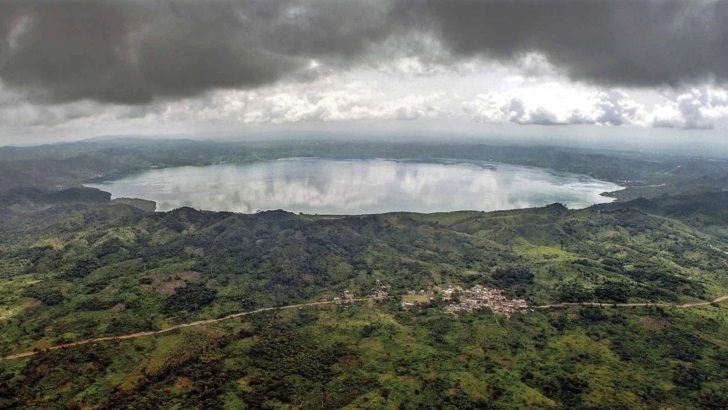
In an article published by Harry Bake on LiveScience and Yahoo News on May 26, 2026, it was stated that remote sensing analysis has revealed that the material blasted out of the impact settled in a raised, lobed pattern known as a "rampart" crater. This suggests the area was covered in a layer of groundwater when the collision occurred, according to the Earth Observatory.
Rampart craters are rare on Earth but are more common throughout the solar system, including on Mars, as well as on smaller bodies, such as Ganymede, Dione, Tethys and Charon. As a result, studying Lake Bosumtwe could provide insight into how these extraterrestrial craters formed, Sapah said.
The impact also fractured Earth's crust and allowed mineral-rich magma to rise to Earth's surface, forming shallow veins of gold and other valuable elements that have been mined for generations. This activity has resulted in the golden flecks and lines visible in this satellite image.
The rate of gold mining has accelerated in recent years due to advances in technology. Another satellite photo taken in 2024 (see below) shows much more visible gold, which has been exposed by this increased activity. (The lake also appears green in the newer photo due to higher concentrations of phytoplankton in its waters.)
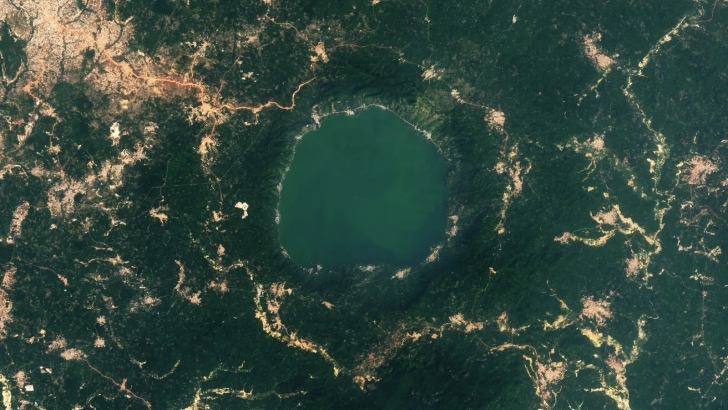
"The stark visual evidence of anthropogenic [human-caused] change juxtaposed with a million-year-old geological landmark is striking," Sapah said.
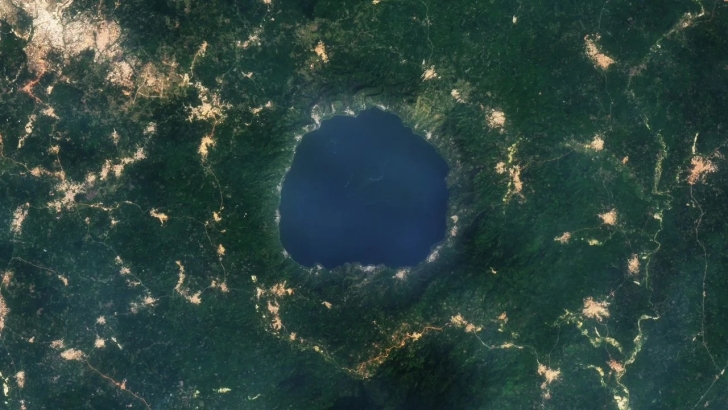
A report on science.nasa.gov on the explosive beginning for Lake Bosomtwe states that the exotic geology has drawn attention to the crater for economic reasons as well. When the asteroid struck, the shockwave fractured the crust around the crater, creating an extensive network of faults and cracks that allowed hot fluids to circulate. The event helped concentrate gold and other minerals from a gold-bearing rock layer called the Birimian Supergroup near the surface and primed the area around the crater to become a target of small-scale gold mining, locally referred to as galamsey (gather and sell).
The OLI (Operational Land Imager) on Landsat 8 captured December 21, 2024 image of Bosumtwe. The other image captured on December 29, 2015 shows the same area in December 2015. These images, along with a separate analysis by remote sensing experts, show a marked expansion of mining, particularly southwest of the lake, as well as rapid expansion of farmland and villages around the lake in recent decades.
The greener water in 2024 is likely due to the lake having a higher concentration of some types of phytoplankton. Phytoplankton in the lake varies seasonally due to changing environmental conditions. Some research suggests that land use change near the lake may be contributing to increased loads of nutrients and making certain types of phytoplankton more abundant.
A team of NASA-funded scientists developed an app that uses Landsat images to track the expansion of gold mining in this region and helps distinguish between artisanal and industrial-scale mines. While industrial-scale mining typically occurs within large open pits, artisanal mining is usually more superficial; however, it often leaves swathes of deforested land and mercury-contaminated waterways. Most of the new mining seen around the lake was classified as artisanal.
“The stark visual evidence of anthropogenic change juxtaposed with a million-year-old geological landmark is striking,” Sapah said. “The clear encroachment of settlements, agriculture, and mining activities right up to the lake’s steep crater rim is a testament to both the image resolution and the scale of the change.”
QUICK FACTS
Where is it? Lake Bosumtwe, Ghana [6.498727489, -1.4087398896]
What's in the photo? Ghana's only natural lake, surrounded by exposed veins of gold
Which satellite took the photo? Landsat 8
When was it taken? Dec. 29, 2015
credit: Harry Bake/ LiveScience
Writer's email:
Follow @enochfrimpong Follow @Graphicgh
