
The Minority in Parliament has accused the government of attempting to reintroduce the controversial Electronic Transfer Levy (E-Levy) through what it describes as a “backdoor arrangement” involving a proposed 0.75 per cent charge on Mobile Money wallet-to-bank transactions.
The allegation follows a recent announcement by mobile network operator MTN that beginning June 1, 2026, it was going to introduce the charge.
The move has since been suspended by the Bank of Ghana with the explanation that it calls for broader stakeholder consultations.
- Related articles
- MTN MoMo to bank transfers will attract charges from June 1, 2026
- Bank of Ghana suspends proposed MTN MoMo-to-bank transfer fee
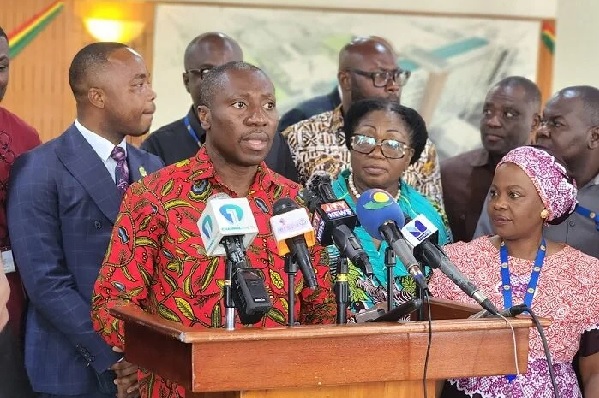
At a press conference in Parliament on Tuesday [May 26, 2026], the Minority Leader and Member of Parliament for Effutu, Alexander Kwamena Afenyo-Markin, described the move as insincere, arguing that the National Democratic Congress (NDC) had strongly opposed the E-Levy while in opposition but was now attempting to impose a similar charge through indirect means.
“When they were in opposition, they criticised the E-Levy and promised to abolish it. Ghanaians applauded them. But today, what do we see? Just after repealing the E-Levy, they are introducing what they call the Dumsor Levy and now attempting to bring back the E-Levy through the backdoor,” he stated.
Mr Afenyo-Markin alleged that, unlike the previous E-Levy introduced under the administration of former President Nana Addo Dankwa Akufo-Addo through parliamentary approval, the current government was seeking to impose the charge without legislative backing.
“The NDC government, through the backdoor, has reintroduced the E-Levy. This time, not even through Parliament,” he stressed.
According to him, the government was allegedly using the Bank of Ghana and a private fintech platform as instruments to implement the charges.
“These were politicians who criticised charges on mobile money transactions. They said it was a bad way of generating revenue for the state,” he remarked.
The Minority Leader questioned the government’s explanation that the suspension of the charge was intended to allow for further consultations.
“What is further consultation in this context? Were they not the same people who insisted there must be broad stakeholder engagement before introducing such policies?” he asked.
He called on the Finance Minister, Dr Cassiel Ato Forson to appear before Parliament to explain the circumstances surrounding the proposed charges.
“We are not interested in the suspension. We are interested in how, but for the public outcry, they were going to spring this surprise on Ghanaians,” he said.
Beyond the proposed mobile money charges, the Minority also accused the government of failing to fulfil several campaign promises.
Mr Afenyo-Markin cited issues relating to youth unemployment, recruitment into the security services, cocoa pricing, agriculture, and utility tariff increases as evidence of what he described as policy inconsistencies and unfulfilled promises.
“They promised one job, three shifts. As we speak, they have failed on that promise,” he claimed.
He further alleged that, despite promises to support farmers and unemployed youth, many Ghanaians were still struggling with economic hardship.
“They promised cocoa farmers better prices, promised support for rice farmers, and jobs for the youth, but today many are disappointed,” he added.
Meanwhile, speaking on the floor of Parliament earlier, the Finance Minister, Dr Cassiel Ato Forson announced that Ghana had achieved a Moderate Risk of Debt Distress status for the first time in 13 years, describing it as a major milestone in the country’s economic recovery efforts.
