
A new vaccine to tackle Ebola will now be tested on people after the UK regulator gave permission for trials to take place.
Scientists at the University of Oxford started developing the vaccine eight weeks ago when a public health emergency was declared on 17 May.
It is the first - out of four vaccines under development - to enter clinical trials.
Volunteers are being recruited, with the first doses expected to be given to healthy adults in the UK "within weeks".
The Ebola epidemic, centred on the Democratic Republic of the Congo has killed 625 people with 1,792 laboratory confirmed cases.
It is caused by the Bundibugyo species of Ebola, which has started two outbreaks before.
The six different species of Ebola are known as "sisters rather than twins" because while they are similar, they need separate treatments and vaccines. It means there are no approved drugs or vaccines this time.
The outbreak is still not under control and is taking place in a conflict zone with very mobile populations – heightening the need for a vaccine to help stop the spread of disease.
Dr Katrina Pollock, the chief investigator of the trial based at the University of Oxford, told the BBC: "We're doing phase one (early stage) trials of new vaccines all of the time, precisely to be ready for exactly this kind of outbreak."
The trial will be on 50 healthy adults aged 18-55. Researchers are also working with partners in Uganda to prepare for trials in Africa.
Volunteers will be monitored for a year, but scientists should know quickly whether the vaccine is producing the right kind of immune response or any unexpected side effects.
The Oxford team have been able to develop their vaccine in a matter of weeks because they are using the same technology that shot to fame during the Covid pandemic and was used in the Oxford/AstraZeneca Covid vaccine.
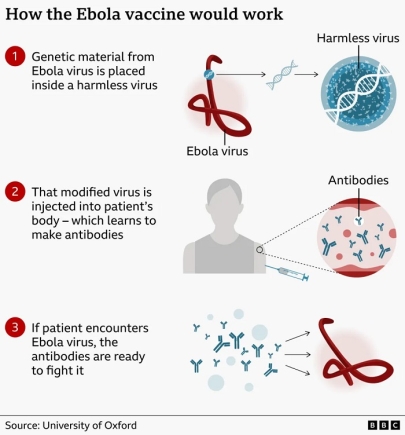
It uses a common cold virus that infects chimpanzees that has been genetically modified to make it safe.
This acts like an envelope and all the researchers need to do is change the letter inside before posting it into the body.
In Covid, the letter being delivered was a snippet of genetic code from the Covid virus.
This time it's a snippet from the Bundibugyo species of Ebola.
The vaccine does not cause an infection, but the piece of the genetic code starts producing one viral protein from Ebola inside the body.
This is enough to trigger the immune system to recognise a threat and mount an immune response.
That means the body should already have a head start if it encounters Ebolavirus for real.
The vaccine has been developed, tested on mice and macaque monkeys, and is being manufactured to a clinical standard by the Serum Institute of India. It has manufactured and stockpiled around 620,000 doses.
Based on that data, the UK's Medicines and Healthcare Products Regulatory Agency has given the go-ahead for human trials.
Vaccine researcher Alex Sampson told the BBC: "As soon as we heard there was an outbreak, we were able to scale up really, really quickly."
Vaccines can normally take up to a decade to research, develop and prove effective. But Sampson says no corners are being cut.
"We're doing all the same tests that we would normally do, just we're able to do them in parallel, so it means a lot of teams working in lots of different places around the clock, but we're still doing everything that we would normally," he added.
The Oxford Covid vaccine was estimated to have saved six million lives in the first year it was used around the world and hundreds of millions of doses have been taken.
However, the vaccine was also restricted for use in some countries because of rare blood clots which affected up to one in 100,000 people.
It is possible this vaccine carries the same risk, although this is much lower than the threat from the Bundibugyo species of Ebola which kills around a third of those infected.
Pollock said severe side effects are "very rare" and they thought "very deeply" about the implications for trials on healthy people, and that any risk would be communicated to volunteers.
"I want to stress that the Covid AstraZeneca vaccine was given to millions of people safely," she added.
There are three other vaccines being developed for the Bundibugyo species of Ebola.
These include one from biotechnology company Moderna using their mRNA vaccine technology. The International Aids Vaccine Initiative and Public Health Vaccines, based out of the US, are using the same technique that has been proven to work for another species of Ebola, but is slower to manufacture.
