Election petition: Participants give mixed responses to outcome
The petitioners are Nana Addo-Dankwa Akufo-Addo, the New Patriotic Party presidential candidate for the 2012 elections, his running mate, Dr Mahamudu Bawumia, and the NPP chairperson, Mr Jake Otanka Obetsebi Lamptey.

The workshop, which was to discuss the Presidential (Transition) Act, was on the theme ”A review of the implementation of the Presidential (Transition) Act: Lessons and the way forward”.

The workshop, organised by the IEA in collaboration with the Netherlands Institute for Multi Party Democracy (NIMD), brought together the political parties, parliamentarians, security personnel, the media and other stakeholders.

According to Mr Joe Ghartey, Second Deputy Speaker of Parliament and MP for Essikado-Ketan, if the petition succeeds, the incoming President would have to serve a four year mandate as spelt out by the Constitution.

Quoting Article 66 (1) of the Constitution to buttress his point, Mr Ghartey said there was no justification for the incoming president not to serve his full four-year term.

Article 66 (1) states “A person elected as President shall, subject to clause (3) of this article, hold office for a term of four years beginning from the date on which he is sworn in a President.”

However, Mr Ghartey said it was a begging issue which ultimately must be interpreted by the Supreme Court.

This position was supported by the Chairman of the Peoples National Convention, Alhaji Ramadan, who posited that since the president declared must serve his full term, he must be given the opportunity to do so.

This stand was, however, opposed by Mr Cletus Avoka, the former Majority Leader of Parliament and MP for Zebilla, and the Attorney General, Mrs Marieta Brew-Opong.

Mr Avoka said the new president should by the provisions of the Constitution serve the remaining term of the current president.

“In the unlikely event of the Supreme Court making a change, the new president will serve the remaining term,” Mr Avoka declared.

He quoted Article 64 (2) of the Constitution, which states “A declaration by the Supreme Court that the election of the President is not valid shall be without prejudice to anything done by the President before the declaration.”

For her part, Ms Brew-Opong said since everything done by the president from January 7, 2013 was valid, it was natural for anybody declared president by the court to continue the remaining term of office.

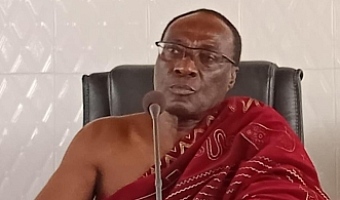
Prof. Mike Ocquaye, a former Second Deputy Speaker and former MP for Dome-Kwabenya, who took a different stance altogether  posed a question: Since it is deemed that whatever the president does is valid, does it not follow that a new president declared under the current situation must necessarily continue from where the president left off.

Welcoming the participants, Dr John Kwakye, a Senior Fellow of the IEA, said the Presidential (Transition) Act represents a collective will to improve Ghana’s system of governance for the benefit of all.

“It is our belief that we will muster the same collective will to deliberate on how the Act can be made beneficial to future generations,” he told the participants.

As a young democracy, Dr Kwakye said that Ghana must continually examine and improve its political processes and systems.

By so doing, he said that lessons could be learnt from past mistakes and the necessary corrective actions taken.

Prof Ocquaye who was the chairman for the day-long workshop, said Ghana was not used to transitions, arguing that Ghana had what he called “handing over syndrome” since the 1966 coup detat.

He commended the IEA and all parties in Parliament under the Fourth Republican Constitution for creating the awareness and fashioning the Presidential (Transition) Act which Parliament unanimously endorsed on March 16, 2012.

The Act is intended to ensure a smooth transfer of power from one administration to the other and further enhance the country’s democratic system.

Prior to this bill, Ghana had an unenviable record with political transitions. In both 2001 and 2009, the absence of a transition blueprint contributed to the resulting confusion that lingered on well after the event.

With the passage of the Act, ten months to the 2012 Elections, Ghanaians are hopeful that the new legislation will curtail the acrimony and administrative lapses which characterised past transitions.

Story by Kobby Asmah


Connect With Us : 0242202447 | 0551484843 | 0266361755 | 059 199 7513 |