
When Dr Mahama Tiah Abdul-Kabiru walked into Parliament as the New Patriotic Party (NPP) Member of Parliament (MP) for the Walewale Constituency on January 7, 2025, he was carrying more baggage than most first-time parliamentarians would have had to deal with.
His journey to Parliament had been characterised by political chaos, a bitterly contested party primary and a legal battle that threatened to derail his bid to represent the constituency.
It started with the NPP's parliamentary primary in January 2024, when Dr Abdul-Kabiru narrowly defeated the sitting MP, Hajia Lariba Zuweira Abudu, by seven votes.
Hajia Lariba challenged the result in court, setting off a legal battle that eventually led to the annulment of the primary and an order for a rerun.
Dr Abdul-Kabiru won the rerun and, after Hajia Lariba subsequently withdrew from the contest, he was confirmed as the NPP's parliamentary candidate for the 2024 general election.
He went on to win the December 2024 parliamentary election with 36,700 votes as against 31,401 votes obtained by his main opponent.
However, his predicament compounded when the NPP lost the 2024 general election, returning to opposition after eight years in government.
Nearly 20 months into his first term, the Daily Graphic’s checks revealed that the MP has rolled out many interventions in education, health, agriculture, women's economic empowerment and youth development across the constituency over the past month.
Interventions
In 2025, the MP rolled out a GH¢400,000 fund aimed at providing scholarships to brilliant, needy students, with about 149 students benefiting from the intervention so far.
He has also renovated and built teachers’ bungalows, classroom blocks, and health facilities in communities such as Boamasa, Nasia and Janga, among others.
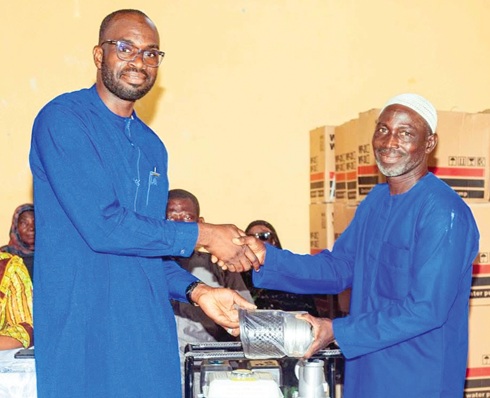
On agriculture, Dr Abdul-Kabiru has distributed more than 100 pump machines to farmers in his constituency to boost agricultural productivity, particularly during the dry season.
Also, two tractors and a combine harvester have been procured to set up a mini agriculture mechanisation centre to help improve access to machinery services.
He has also set up a recording studio under an Art and Creativity initiative which is expected to be commissioned on September 5, 2026.
The facility is intended to provide young musicians, filmmakers and other creative talents with a place to develop their skills and pursue opportunities in the creative sector.
For women engaged in petty trading and small businesses, the MP has rolled out a GH¢1 million “Faako” Fund aimed at providing interest-free financial support for widows, petty traders and small-scale entrepreneurs.
Launching the initiative, Dr Abdul-Kabiru indicated that more than 100 women were expected to benefit from the first phase, with plans to extend the initiative to additional beneficiaries, adding: “There are plans to scale it up to support more than 300 beneficiaries in the next phases”.
He said since assuming office, he had remained committed to delivering on his promises to the constituents with particular attention to education, health care, agriculture, women’s economic empowerment and youth development.
Visibility
Beyond self-projects, the MP has also been active on the floor of Parliament, where he has emerged as one of the stronger voices on the opposition side.
Rather than limiting his role to constituency matters, Dr Abdul-Kabiru has regularly contributed to parliamentary debates and raised issues he considers important to his constituents and the country at large.
For instance, barely a month after taking his seat in Parliament, he drew attention to frequent attacks on motorists along the Bolgatanga-Walewale-Tamale highway, prompting authorities to beef up security in the area.
A constituent, Adam Yussif, said the MP had been visible and responsive since taking office, particularly in areas such as education, agriculture and support for vulnerable groups.
“We appreciate what he has done so far, but the roads remain a major concern.
We want him to use his position to push strongly for the construction and rehabilitation of the roads, particularly those linking the farming communities to the major towns,” he said.
