
Ghana’s political scene in 2025: A year of reform and reflection
The year 2025 stands out as a pivotal period in Ghana’s political history, marked by leadership renewal, ambitious governance reforms, parliamentary tensions and moments of profound national grief.
It was also a year that tested institutions, reshaped policy direction and deepened conversations about the future of Ghana’s democracy.
JM return
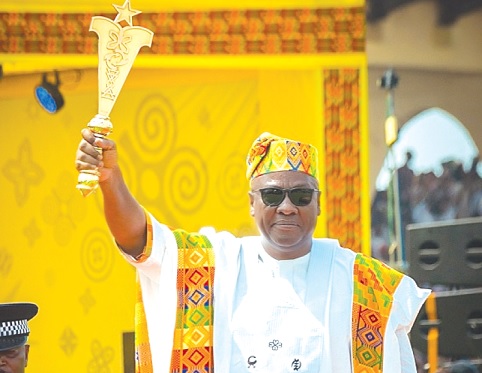
At the centre of Ghana’s political narrative in 2025 was the return of John Dramani Mahama to the presidency, following his victory in the 2024 general election.
Sworn into office on January 7, 2025, after securing 56.6 per cent of the presidential vote, President Mahama recorded one of the most remarkable political comebacks in the Fourth Republic.
His victory over then-Vice-President Dr Mahamudu Bawumia represented the widest electoral margin in over two decades and reaffirmed Ghana’s tradition of peaceful democratic alternation.
The National Democratic Congress (NDC) also secured a commanding parliamentary majority, winning 184 of the 276 seats, compared to 88 seats for the New Patriotic Party (NPP), with four seats going to independent candidates.
The NDC’s numbers later increased by two, following a by-election in Akwatia, which annexed the seat previously held by the late Ernest Yaw Kumi and the rerun of the Ablekuma North Constituency election. This strong legislative backing gave the new administration significant leverage to pursue its policy agenda.
Government Formation
President Mahama moved swiftly to constitute his government, appointing an initial 56 ministers and deputy ministers, with plans to reach a lean cap of 60 appointees.
By January 21, 2025, Parliament had approved the first batch of nominees, filling key portfolios in Finance, Justice, Energy, Education, Food and Agriculture, and Roads and Highways.
The pace of appointments signalled urgency in addressing economic challenges and restoring confidence in governance.
Parliamentary Tensions
Despite the renewed optimism, Parliament experienced intense partisan confrontations during the year, particularly during ministerial vetting sessions.
Speaker Alban Sumana Kingsford Bagbin suspended four Members of Parliament for disorderly conduct and established a special committee to investigate violent clashes in the House.
The four MPs were the Majority Chief Whip and MP for South Dayi, Rockson Nelson Dafeamakpor; the Minority Chief Whip and MP for Nsawam-Adoagyiri, Frank Annor-Dompreh; the MP for Gushiegu, Alhassan Sulemana Tampuli; and the MP for Weija-Gbawe, Jerry Ahmed Shaib.
The suspension has since been lifted.
The developments reignited national debate on parliamentary discipline, political tolerance and the robustness of Ghana’s democratic institutions.
Economic reset and legislative reforms
A defining feature of President Mahama’s first year was a strong push to ease the cost of living.
The President assented to several amended tax laws, abolishing the Electronic Transfer Levy (E-Levy), betting tax, Emissions Levy and the COVID-19 Health Recovery Levy, fulfilling key campaign promises and winning broad public approval.
He also signed the Gold Board Bill, 2025, establishing the Ghana Gold Board (GOLDBOD) to regulate gold production and trade, improve transparency and strengthen foreign exchange inflows.
In December 2025, Parliament passed the Road Traffic Amendment Bill, 2025, legalising the commercial use of motorcycles (Okada), tricycles (Pragia), and quadracycles—a move praised for job creation but criticised over road safety concerns.
Constitution review
In January 2025, President Mahama inaugurated an eight-member Constitution Review Committee, chaired by Prof. H. Kwasi Prempeh, to revisit unresolved governance challenges and review earlier reform proposals.
The other members included Mrs Charlotte Osei, Dr Godwin Djokoto, Ibrahim Tanko Amidu and Dr Esi Ansah, with Dr Rainer Akumperigeya serving as Secretary.
In December 2025, the committee submitted its final report, which the President directed to be published for public debate. Key recommendations included extending the presidential term from four to five years, electing Metropolitan, Municipal and District Chief Executives, and integrating traditional authorities into local governance structures.
The proposals sparked nationwide discussion on accountability, efficiency and democratic balance.
NPP Reorganisation
Outside government, the opposition New Patriotic Party (NPP) spent much of 2025 reorganising after its 2024 electoral defeat.
The party embarked on a nationwide “Thank You Tour”, opened nominations for its 2028 presidential primary, and adopted constitutional amendments aimed at expanding its electoral college and strengthening internal democracy.
The confirmed candidates for the flagbearer election scheduled for January 31 include Kwabena Agyei Agyepong, Kennedy Ohene Agyapong, Dr Bryan Acheampong, Dr Mahamudu Bawumia and Dr Yaw Osei Adutwum.
August Tragedy: a nation in Mourning
The political year took a tragic turn in August 2025, when a military helicopter crashed in the Adansi Akrofuom District of the Ashanti Region, killing eight people, including senior government officials and military personnel. Among the victims were Dr Edward Omane Boamah, Minister for Defence, and Alhaji Dr Ibrahim Murtala Mohammed, Minister for Environment, Science and Technology and Member of Parliament for Tamale Central.
The tragedy plunged the nation into mourning and raised renewed concerns about aviation safety, national security, logistics and the risks faced by public servants.
Beyond the helicopter crash, Ghana mourned the passing of several influential political figures.
The death of Nana Konadu Agyeman-Rawlings, former First Lady and founder of the 31st December Women’s Movement, marked the end of an era.
Other notable losses included Ernest Yaw Kumi, MP for Akwatia; Joseph Kobina Ade Coker, veteran NDC strategist; Cecilia Johnson, former Chairperson of the Council of State, and Ambassador Sam Pee Yalley, a lawyer, diplomat and statesman.
Conclusion
In retrospect, 2025 was a year of recalibration for Ghana’s political landscape, defined by leadership renewal, ambitious reforms, institutional stress tests and profound national loss.
As debates over constitutional amendment and economic direction continue, the events of the year have laid foundations that would shape Ghana’s democratic future for years to come.
Writer's email:
