
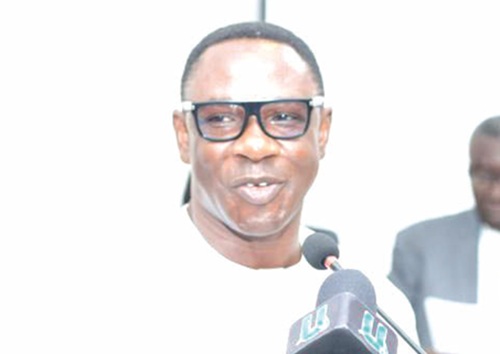
The Head of the Department of Political Science Education, UEW, Professor Gabriel Botchwey, has called for greater transparency in political party financing.
That, he said, should include requiring donors to declare the sources of funds and strengthening regulations governing contributions to political parties.
Speaking at the 4th annual colloquium of the Department of Political Science Education, University of Education, Winneba (UEW) on the theme: “Politics, the Environment, and Our Common Future: Ghana at a Crossroad,” Prof. Botchwey also identified a link between illegal mining and political party financing.
He said research had shown that key players in illegal mining were connected to political parties.
Traditional authorities
Prof. Botchwey stressed the need for traditional authorities to be made key partners in efforts to combat illegal mining.
He said research conducted on small-scale mining since 2009 had consistently shown the destruction of forests, water bodies, farmlands and agricultural activities.
He said chiefs, as custodians of the land, were often aware of mining activities within their traditional areas and, therefore, should not be excluded from efforts to address illegal mining.
Science, technology
A former Minister of Environment, Science, Technology and Innovation, Prof. Kwabena Frimpong-Boateng, who delivered the keynote address, stressed the need for the country to place science and technology at the centre of national development.
He said science and technology provided the capacity to solve challenges in agriculture, medicine, energy, sanitation, transportation and natural-resource management.
He, therefore, described the poverty gap as a “technology gap”, saying Ghana could not achieve any meaningful independence if it was unable to develop the machines, processes and technologies required to meet its own needs.
Prof. Frimpong-Boateng, therefore, challenged Ghana’s description of itself as being at a “crossroads”, saying the country was already on the wrong path in managing its environment.
He said Ghana had for decades produced research, policies and legislation identifying environmental problems, particularly illegal mining, yet had repeatedly failed to translate that knowledge into sustained action.
“We are not at a crossroads.
We are on the wrong path,” he stated.
He said the country’s environmental problems were not scientific mysteries but largely the result of decisions and failures to monitor and act.
Prof. Frimpong-Boateng, who served as a minister from 2017 to 2021, also recounted measures introduced during his tenure to tackle illegal mining, including the mapping and identification of small-scale mining concessions, the registration of mining equipment, the use of electronic tracking devices and the training of drone operators to monitor mining activities.
He said those interventions demonstrated that Ghana could implement effective systems when there was the political will to do so.
Political choice
The Pro-Vice-Chancellor of UEW, Prof. Esther Yeboah Danso-Wiredu, who represented the Vice-Chancellor, said environmental governance was inseparable from politics because decisions on forests, mining, waste, energy and climate change were influenced by public policy.
She said environmental protection was central to Ghana’s economy, health, food security, livelihoods and national survival.
The Chief of Akyem Esaase (Apapam), Baffour Kwaku Sono Sikabede, urged the government and state agencies to consult and resource traditional authorities before granting concessions on stool lands.
He also called on chiefs to ensure that the interests of future generations were not sacrificed for royalties from mining activities.
He said rivers, forests and other natural resources were traditionally protected through taboos and restrictions, adding that such practices recognised the environment as something to be respected rather than exhausted.
