
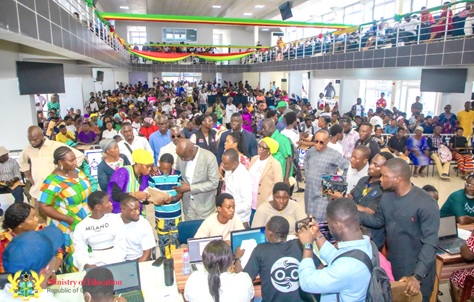
The images of frustrated parents and students, the sentiments expressed in interviews and the discussions unfolding on social media in response to the crisis converge on one point of agreement: there are challenges in Ghana's education sector that must be addressed.
There is also a point of divergence — the politics of who has failed the system, parents and children and who is better placed to fix it.
If the world were perfect, figuring out how best to fix this immediate headache — the lack of placement for over 50 students — would be devoid of politics.
But the world is imperfect and in a democracy with two major political parties regularly competing for power, it is difficult to imagine a world in which public policy is a wholly apolitical activity.
The politics of public policy can be useful if it sharpens the debate over how best to fix a problem and forces consensus-building on appropriate solutions.
The politics of public policy is less useful when it is driven purely by political point-scoring. Do not get me wrong — when policymakers get it "wrong," they must be held accountable and sometimes that accountability is political, delivered through the ballot box.
Free SHS Programme
After intense electoral debates in 2012 and 2016, the Akufo-Addo administration made good on its electoral promise and proceeded to implement the Free Senior High School (Free SHS) programme in 2017.
The policy objective — lowering or completely removing the access barrier to secondary education — was, and remains, noble.
What the Akufo-Addo administration identified as the key access barrier was financial, which explains the various costs the government absorbed in implementing the programme.
Free SHS was litigated in the lead-up to the 2024 election, where the National Democratic Congress (NDC) and their promise to reform the programme were characterised by their main political rivals, the New Patriotic Party (NPP), as intended cancellation once power is won.
A bill giving legislative backing to the programme did not materialise as promised before the NPP left office.
Nonetheless, the programme remains in place — which suggests to me that cancellation is not a policy option for any government.
Moreover, for all its imperfections, Ghanaians are fully in support of the programme.
In Afrobarometer Round 10 (2024), nine out of 10 (86 per cent) Ghanaians expressed support for Free SHS.
This was at a time when dissatisfaction with the NPP government was high, which led to the party’s defeat in that year’s election.
This is clearly an indication of how much Ghanaians have come to embrace the programme.
There is no doubt that the implementation of the programme has come with its own challenges and a nation committed to educating its people must take steps to address them.
The question is: how best do we address these challenges to reduce such pinch points to a bare minimum?
I have three key questions for consideration, which have emerged following public conversations on the issue.
Three questions
The first question is: how do we eliminate financial access barriers without compromising student preparedness for senior high school education?
I ask because overall cut-off points, as well as failing scores in Mathematics and English, have been flagged as contributing to automatic placement challenges.
Be that as it may, is there merit in considering strict enforcement of some of the rules governing automatic placement, while providing support for students to improve their preparedness for secondary education?
The second question is: how do we continue to expand access to secondary education without compromising students' ability to progress to post-secondary education?
I ask this in relation to cut-off points and failing grades in Mathematics and English.
A senior high school may well be able to transform an underprepared student into a high-performing one, so that progressing to post-secondary education does not become more difficult.
But how often does this happen and how prepared are we to provide the resource support schools need to transform underprepared students into high-performing ones?
The third question is: how do we provide greater guidance to parents, guardians and students in the school selection process?
I ask because of reports of greater demand for certain categories of schools that the system can't accommodate.
The idea of "results first, school selection after” I had assumed would help, but it appears that may not be the case.
Final Thoughts
The administrative issues with the computerised placement system must be fixed.
And students who are unable to find placement must not be left to their own fate.
At the end of the day, it is the country that stands to benefit when our students are well prepared for life beyond secondary education.
That is why we must continue reforming the education system to address multiple policy objectives while minimising the politics.
The writer is the Project Director, Democracy Project
