In the wake of a fiercely contested presidential primary that tested the mettle of the New Patriotic Party (NPP), Dr Mahamudu Bawumia emerged as the undisputed frontrunner, securing a commanding victory that underscored his enduring appeal within the party's delegates.
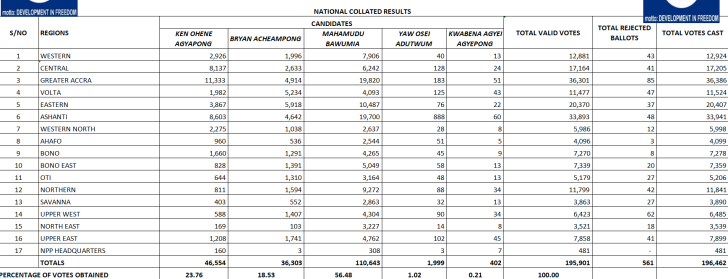
The January 31, 2026, primary, marked by seven months of gruelling campaigns traversing 276 constituencies, culminated in a decisive mandate for the former Vice-President, who polled 110,643 votes, equivalent to 56.48 per cent of the total valid ballots cast.
This triumph not only reaffirmed Bawumia's stature within the party but also highlighted stark regional variations in voter preferences, with the economist-turned-politician dominating 14 of Ghana's 16 regions, alongside a resounding win at the NPP headquarters in Accra.
The national collation, drawn from over 190,000 delegates who voted at 333 polling centres, painted a picture of Bawumia's broad-based support, particularly in the northern and western heartlands where his economic policies and party loyalty resonated deeply.
In the Northern Region, for instance, Bawumia amassed 9,272 votes, dwarfing his closest rival, Bryan Acheampong, who garnered 1,594, and Kennedy Ohene Agyapong's 811. This translated to a staggering lead in a region pivotal to the NPP's historical base, with total valid votes reaching 11,799 amid a turnout that saw only 42 rejected ballots.
Similarly, in the North East, Bawumia's 3,227 votes—out of 3,521 valid—left little room for competition, as Acheampong managed just 103 and Agyapong 169, reflecting a near-monolithic endorsement in this emerging electoral stronghold. Bawumia's dominance extended southward and westward, where he clinched victories in regions like Western (7,906 votes out of 12,881 valid), Western North (2,637 out of 5,986), Ahafo (2,544 out of 4,096), and Bono (4,265 out of 7,270).
These wins were characterised by comfortable margins, often exceeding double the votes of his nearest challengers.
In Western North, for example, his tally surpassed Agyapong's 2,275 by a notable gap, while rejected ballots remained minimal at 12, underscoring the smooth conduct of the polls.
The Upper West and Upper East regions further bolstered his tally, with Bawumia securing 4,304 votes in Upper West (out of 6,423 valid) and 4,762 in Upper East (out of 7,858), where Acheampong's strong showings of 1,407 and 1,741 respectively could not overturn the tide.
Even in Oti, a region with 5,179 valid votes, Bawumia's 3,164 edged out Acheampong's 1,310, despite the latter's regional ties.
The Ashanti Region, the NPP's traditional powerhouse, delivered one of Bawumia's most emphatic endorsements, with 19,700 votes out of 33,893 valid, far outpacing Agyapong's 8,603 and Acheampong's 4,642. This victory in the heart of the party's founding ethos was symbolic, given the region's 33,941 total votes cast and mere 48 rejections, signalling robust internal cohesion.
Eastern Region followed suit, awarding Bawumia 10,487 votes from 20,370 valid, ahead of Acheampong's 5,918. Greater Accra, the bustling capital region with the highest turnout at 36,301 valid votes, saw Bawumia claim 19,820, nearly double Agyapong's 11,333, in a contest that highlighted urban delegate preferences for continuity.
Yet, the primaries were not without surprises, as Bawumia failed to sweep all regions, conceding two to his rivals in outcomes that revealed pockets of discontent or alternative visions.
In the Central Region, Kennedy Ohene Agyapong, the outspoken former MP for Assin Central, triumphed with 8,137 votes out of 17,164 valid, surpassing Bawumia's 6,242 in his home region where his fiery rhetoric on accountability evidently struck a chord.
This win, amid 41 rejected ballots, positioned Agyapong as a formidable second-place finisher nationally with 46,554 votes (23.76 per cent), though his regional successes were limited.
Meanwhile, in Volta—a region often seen as an NPP outlier—Bryan Acheampong, the MP for Abetifi and former Agriculture Minister, pulled off an upset with 5,234 votes from 11,477 valid, edging Bawumia's 4,093. Acheampong's agricultural credentials likely played a role here, contributing to his overall third-place tally of 36,303 votes (18.53 per cent).
The remaining candidates, Dr Yaw Osei Adutwum and Kwabena Agyei Agyepong, struggled to gain traction, with Adutwum securing 1,999 votes (1.02 per cent) and Agyei Agyepong 402 (0.21 per cent) nationally, neither winning any region. Adutwum's highest showing came in Ashanti with 888 votes, while Agyei Agyepong peaked at 60 there, reflecting their niche appeals that failed to translate into broader support.
At the NPP headquarters, a microcosm of the party's core, Bawumia won convincingly with 308 out of 481 valid votes, a clean sweep with zero rejections that mirrored the national mood.
This regional mosaic came amid a backdrop of reconciliation, as the primaries concluded peacefully under tight security, devoid of violence or major disruptions.
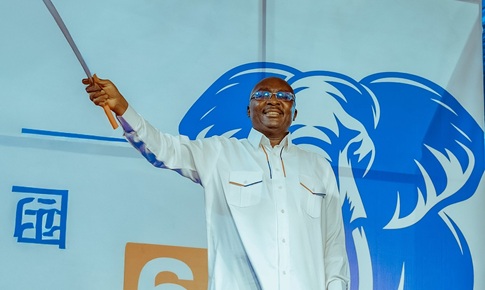
At a frenzied mini rally at the party headquarters, Bawumia, his voice strained from the campaign trail, delivered a 15-minute victory speech urging unity. “After competition comes cooperation,” he said to wild cheers. “Our expectation is that all party members will apply themselves to this principle,” he added. He pledged targeted engagements with aggrieved elders, stressing that “every voice matters, every opinion is worth considering, and every suggestion is vital to building a formidable strategy,” while warning against indiscipline: “An army that lacks discipline will struggle to win its battles. The NPP needs to step up discipline internally, discipline in our operations, discipline in our communications, and discipline in the conduct of our members.”
His rivals echoed this sentiment, with Agyapong advising supporters: “I want to thank my supporters and advise you that in an election, you can win or lose. So, if you lose, you need to accept it in good faith.” Acheampong accepted with humility: “The outcome is not what I had hoped for, but I accept the results with humility, and my resolve remains strong. The NPP must stand as one united family, and our collective responsibility is to rebuild trust among Ghanaians, strengthen our structures and prepare decisively for victory in 2028.” Adutwum called for hard work: “We will definitely secure victory in 2028, but that calls for unity and hard work.”
Agyei Agyepong emphasised tradition: “Our tradition has been the sustenance of democracy in this country, and together, we will unite and work hard right from the polling station to the top to earn the trust and confidence of Ghanaians to win back power.”
Former President Nana Addo Dankwa Akufo-Addo praised Bawumia's character: “I know his mind, and I know his character. He is loyal to party principles.”
General Secretary Justin Kodua Frimpong highlighted inclusivity, while Chairperson Joseph Osei-Owusu recommended consolidating electoral rules for stronger democracy.
Acting Chairman Danquah Buttey Smith urged unity for 2028.As the NPP shifts from the “blistering battle” to recapturing power, Bawumia's regional stronghold—winning 14 regions plus headquarters—positions him as a unifying force, though the concessions in Central and Volta serve as reminders of the need for broader outreach in the quest for electoral redemption.