
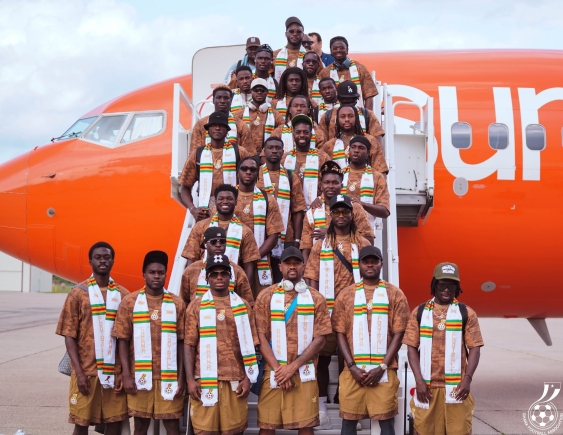
Almost seven decades after Ghana won its independence from British colonial rule, the Black Stars will face England on the biggest stage in world football in a FIFA World Cup showdown rich in symbolism and significance -- a meeting of former colony and colonial power on football's grandest stage.
Of the many compelling storylines the 2026 FIFA World Cup will produce, few carry the historical weight, emotional complexity and sporting significance of the Black Stars vs Three Lions showdown on June 23 at the Boston Stadium in Foxborough, Massachusetts.
With Croatia and Panama also lurking in a highly competitive group, the result could shape the fortunes of both nations.
But this is an encounter that stretches far beyond the pursuit of three points; it is also a fixture loaded with divided loyalties, with players of Ghanaian heritage expected to line up on both sides of one of the most anticipated matches of the group phase.
The timing adds further symbolism. In March this year, Ghana sponsored a motion at the United Nations declaring colonialism and the transatlantic slave trade the greatest crimes against humanity, a resolution overwhelmingly approved in Washington DC, USA.
On football’s grandest stage, however, the former colony and former colonial power now meet as equals, reflecting a narrowing global divide, where so-called emerging football nations increasingly challenge the established order at the highest level of the game.
Ghana and England share a long history. The country officially became a British Crown colony in 1874. After decades of colonial ties and economic exchange, Ghana achieved independence on March 6, 1957, later maintaining robust diplomatic and cultural relations.
Last week, President John Dramani Mahama visited the United Kingdom, holding talks with British Prime Minister Keir Starmer at 10 Downing Street before meeting King Charles III at Buckingham Palace. Diplomatic ties remain strong, yet on the football field, the relationship between Ghana and Britain has been fiercely competitive and long evolved beyond politics and diplomacy.
Sporting equals
England may remain one of football's traditional powers, but Ghana's achievements on the international stage ensure the Black Stars approach the contest with genuine pedigree.
The country's triumphs at the FIFA Under-17 World Cup in 1991 and 1995, bronze at the Barcelona Olympic Games in 1992, silver medals at the FIFA Under-20 World Cups of 1993 and 2001 and the famous Under-20 world title in 2009 were statements that brought global recognition and established Ghana as one of world football's most respected talent factories.
At senior level, the Black Stars announced themselves on the world stage with an impressive debut at the 2006 World Cup in Germany, defeating then-fancied Czech Republic and the United States before succumbing to Brazil in the second round. Four years later in South Africa, Ghana came within a whisker of a historic semi-final place, a campaign that eclipsed what England’s Three Lions produced at the tournament.
Despite England’s only World Cup triumph in 1966, its enduring appeal in world football remains undiminished, a status sustained in large part by the global pull of the English Premier League.
Widely regarded as the most competitive league in Europe — and arguably the world — the EPL continues to attract elite talent from every continent, while commanding a television reach unmatched by any other domestic competition.
Semenyo, Mainoo battle for identity
The modern relationship between Ghana and England is perhaps best illustrated through football's increasingly complex questions of nationality and identity. At the centre of Ghana's hopes stands Antoine Semenyo.
Born in England to Ghanaian parents, Semenyo chose to represent the Black Stars over his country of birth and has since emerged as the face of Ghana’s new generation after a standout season in English football.
On the other side, England manager Thomas Tuchel could call upon Kobbie Mainoo and Jarrell Quansah — both players with strong Ghanaian heritage who ultimately committed their international futures to England.
Semenyo once stood at a similar crossroads. But his decision to commit to Ghana before the 2022 World Cup means he will now spearhead the Black Stars' attack against players who made the opposite choice.
Before Semenyo, the English Premier League witnessed the exploits of Ghanaian stars such as Anthony Yeboah of Leeds United, Alex Nyarko of Everton, Nii Odartey Lamptey of Coventry City, Michael Essien of Chelsea, John Paintsil of Fulham, Sulley Muntari of Portsmouth, Asamoah Gyan and John Mensah of Sunderland, Andre Ayew Swansea, Jordan Ayew of Crystal Palace, Richard Kingson of Blackpool,Thomas Partey of Arsenal, who left lasting impressions on the hallowed grounds of England's top flight.
David versus Goliath
England possess one of the most valuable squads in world football, including names such as Jude Bellingham, Bukayo Saka and Declan Rice. On the other hand, Ghana's squad may lack similar star power, but World Cups have rarely been decided by reputations alone.
For Ghana, this will look like another David-versus-Goliath affair, one likely to be defined by organisation, courage and ambition rather than market value of big-name stars.
Queiroz card
Then there is the Carlos Queiroz factor. Ghana's decision to hand the reins to the vastly experienced Portuguese coach has added a fresh dimension to the campaign and the June 23 clash.
Few coaches understand English football better than Queiroz who earned enormous respect during two spells as Sir Alex Ferguson's trusted assistant at Manchester United, helping to build a dominant era with three league titles and the club's 2008 UEFA Champions League triumph.
More importantly for Ghana, the respected Portuguese understands England's football culture, mentality and tactical DNA better than most coaches in international football -- knowledge could become a decisive weapon when the two nations collide in Massachusetts.
History offers hope
Previous meetings suggest Ghana will not be intimidated on June 23.
The only senior international between the countries ended in a memorable 1-1 draw at Wembley on March 29, 2011.
Before 80,102 spectators, Asamoah Gyan produced a dramatic stoppage-time equaliser to cancel Andy Carroll’s opener.
Ghana's most famous victory over England came even earlier. At the 1993 FIFA World Youth Championship in Sydney, the Black Satellites stunned England 2-1 in the semi-finals on their way to a silver-medal finish.
Those memories will offer encouragement as another historic encounter approaches.
