


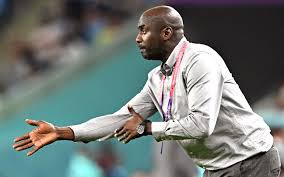
GHA faces costly hunt for elite coach to rescue Ghana’s World Cup campaign
The sacking of Otto Addo as head coach of the Black Stars last week was never a question of “if” but “when”. What caught many off guard, however, was the timing.
With barely two months to the 2026 FIFA World Cup, Ghana have effectively chosen to reset their technical direction at the most delicate point of the competitive cycle.
From a purely footballing lens, the decision is defensible. Since the failure to qualify for the 2025 Africa Cup of Nations, Addo had been operating under sustained pressure.
The humiliating 5–1 defeat to Austria in Vienna did not just expose tactical deficiencies; it amplified concerns about the team’s mental resilience and structural coherence.
By the time Ghana faced Germany three days later, the decision had already been taken internally.
The final whistle and Ghana’s 1-2 loss to the Germans at the MHP Arena merely formalised the inevitable for the under-fire coach who qualified Ghana to back-to-back World Cup tournaments, after leading the team to a first-round exit at the 2022 tournament in Qatar.
Yet, governance is about timing as much as judgment, and here the Ghana Football Association (GFA) have assumed a significant execution risk.
In effect, they have compressed a managerial transition that typically spans months into a matter of two weeks.
There is no remaining international window for experimentation, no runway to build tactical automatisms, and no margin for error in player assessment. The incoming coach inherits a World Cup-bound squad without the luxury of calibration.
The incoming coach will be tasked with naming a 26-man squad by late May, with minimal direct interaction with players. Ghana’s opening fixture against Panama on June 17 will arrive before any meaningful system can be embedded.
Matches against England and Croatia will follow in rapid succession. This is not a rebuild; it is crisis management at scale.
Financial implications
Financial considerations further complicate the equation. Otto Addo’s reported $50,000 monthly salary placed him within a relatively modest compensation bracket.
Any move for elite, proven managers will require a step-change in financial commitment.
Coaches of the calibre of Morocco’s Walid Regragui and Saudi Arabia coach Hervé Renard, both named in the Ghanaian media as top of Ghana’s shopping list, are understood to command packages roughly three times that figure.
For a football federation operating within constrained fiscal parameters—even with anticipated World Cup revenues—this is not a trivial escalation.
It raises a fundamental strategic question of whether Ghana should invest in proven pedigree at a premium, or prioritise contextual familiarity and cost efficiency.
Regragui sits at the top end of the market. His credentials are elite. He led Morocco to a historic semi-final finish at the 2022 World Cup and followed it with a flawless qualifying campaign for 2026.
His teams are tactically organised, defensively compact and psychologically resilient, attributes Ghana have lacked in recent outings. However, his lack of direct exposure to Ghana’s football ecosystem introduces risk.
Dressing room dynamics, federation politics and cultural nuances are variables that typically require time to decode. In a two-month window, that learning curve could prove costly.
Renard, by contrast, offers a hybrid proposition of having a global pedigree with African fluency. His track record—Africa Cup of Nations titles with Zambia and Cote d’Ivoire —cements his reputation as a tournament specialist.
More importantly, his historical connection to Ghana, dating back to his stint as assistant coach in 2008, provides a layer of contextual familiarity.
Yet Renard’s candidacy has consistently been undermined by economics. His salary expectations have historically exceeded what both the GFA and the Ministry of Sports and Recreation have been willing to sanction.
Even when he emerged as a preferred candidate in previous cycles, negotiations stalled at the financial hurdle.
That constraint remains largely unchanged, raising doubts about the feasibility of a deal despite renewed discussions.
Available options
If both Regragui and Renard represent high-cost, high-ceiling options, Kwesi Appiah offers a low-friction, high-familiarity alternative.
His institutional knowledge is unmatched. A former Black Stars coach, he has led Ghana to a World Cup and multiple AFCON tournaments.
More recently, his work with Sudan—where he successfully qualified for AFCON ahead of Ghana—demonstrates both tactical relevance and up-to-date intelligence on the current player pool.
From a cost perspective, Appiah is the most efficient option. From a readiness standpoint, he is arguably the most immediately deployable.
There would be no acclimatisation curve, no cultural onboarding and minimal disruption to existing player relationships.
Yet his candidacy is complicated by governance factors. He is a member of the GFA’s decision-making Executive Council that appoints national team coaches, so there could be issues of a conflict of interest.
In addition, his contract with Sudan, reportedly extended to 2028, introduces a buyout variable.
Ultimately, the GFA’s decision will hinge on a trade-off between immediacy, cost and ceiling.
Do they prioritise a coach who can stabilise quickly, or one who can potentially elevate performance but requires adaptation? Do they allocate scarce financial resources to coaching, or preserve them for broader tournament logistics and player incentives?