


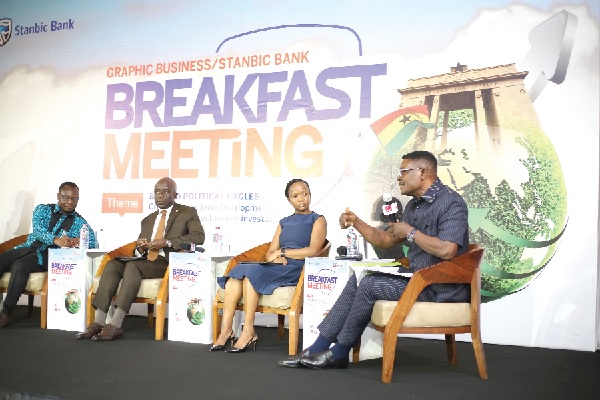
Graphic Business-Stanbic Bank Breakfast Meeting: Experts call for policies to shield economy from political shifts
PANELLISTS at the Graphic Business/ Stanbic Bank Breakfast Meeting have stressed the need for Ghana to adopt a more consistent, long-term approach to national policy implementation.
This, they said, would safeguard the economy from political cycle disruptions.
The experts were contributing to the Graphic Business/Stanbic Bank Breakfast Meeting panel discussion, which was on the theme: "Beyond Political Cycles: Creating long-term development pathways for sustainable investor confidence.”
The panellists explained that frequent shifts in policy direction, often driven by changes in government, continue to impact stable economic progress, weaken investor confidence, and slow the country’s development.
The panellists were the Executive Director of the Institute for Democratic Governance (IDEG), Dr Emmanuel Akwetey; the Director of Research and Innovation at the NDPC, Richard Tweneboah-Koduah; the Head of Investment Banking at Stanbic Bank Ghana, Kobby Bentsi-Enchill; and a Deals Partner at PwC, Clara Amarteifio-Taylor.
Political interference
Dr Akwettey emphasised the need to insulate the National Development Planning Commission (NDPC) from political interference to make it more focused on sustaining the country’s development trajectory.
He explained that the continuous political interference in the affairs of the NDPC had affected the effective implementation of a long-term development plan for sustainable development.
He further said the consistent change in leadership at the NDPC, as a consequence of the cyclical change in government, had proven inimical to continuity in the implementation of priority projects that could propel national development.
Tax systems
The former Director of the Institute of Statistical, Social, and Economic Research (ISSER), Professor Peter Quartey, who chaired the event, said the consistent changes to Ghana’s tax system by successive governments were a disincentive to the investor community.
He explained that the frequent changes to tax policies created an unpredictable environment, which could deter long-term investment, noting that some investors chose to invest in countries based on their tax policies or regimes; therefore, when those policies were altered, it became a disincentive to long-term investors.
For instance, he cited the abolishment of the 10 per cent withholding tax on bet winnings, the Electronic Transfer Levy (E-Levy), the Emissions Levy, among others, introduced by the Nana Addo Dankwa Akufo-Addo-led government and reversed by the current administration when it took office.
That, he said, caused revenue loss, policy inconsistency, and negative social impact on the Ghanaian economy.
Investor confidence
Ms Amarteifio-Taylor emphasised that investor confidence in Ghana depended on long-term policy consistency, not political cycles.
She advised that Ghana must demonstrate credible long-term growth potential through clear, transparent and predictable policy frameworks that focus on medium- to long-term development rather than short-term decisions.
She added that political will should not be left solely to politicians’ discretion. Instead, she proposed that a legal framework should back the national development plan, creating obligations for successive governments to follow it.
According to her, if leaders deviate from the plan without justification, it should amount to financial loss to the state, attracting possible prosecution.
Such a mechanism, she said, would compel or encourage consistent adherence to long-term development priorities, ultimately strengthening investor confidence.
Economic vision
The Managing Director of Graphic Communications Group Ltd challenged Ghanaians to define a home-grown economic vision that transcends political cycles and external prescriptions as the country prepares to exit its 17th IMF programme by the end of 2026.
He warned against perpetual reliance on what he described as “new imperial structures and neoliberal constructs” to dictate Ghana’s destiny, nearly 70 years after independence.
“For almost seven decades, we have proven we are capable of defining our own affairs. Must we still be talking about people who were here 70 years ago and left? Or should we finally be talking about ourselves and how we choose to do things?” he quizzed.
He said “we must advise our political actors, the political elite, economists and all who manage our economic structures to rethink how we move forward from here.Only then can we establish an agenda that truly takes us into 2026, 2027 and beyond — an agenda that is authentically Ghanaian.”
Long term plan
The Chief Executive of Stanbic Bank Ghana, Kwamina Asomaning, stated that Ghana needed a long-term national development plan approved by Parliament to prevent constant policy shifts.
When national projects remain intact after elections, he said, people built trust in the development process and see the government as a reliable partner.
He added that investor confidence was also closely tied to predictability such that investors, wanted assurance that commitments made today would be honoured tomorrow, regardless of political changes.