
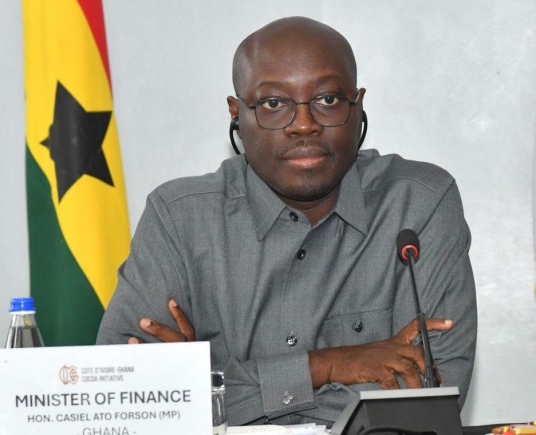
On Thursday the Finance Minister will present the mid-year budget review. He is also expected to unveil what government sources call the New Economic Policy, the framework meant to carry us from stabilisation to growth, though nothing official confirms it yet. What strikes me about the tenure of this Finance Minister is that he has always had to choose between an easy, popular option and a harder but correct one, with fundamentally different policy implications. But each time, he has chosen the harder but correct option.
The first choice was in November 2025. When he presented the 2026 budget, he put GH¢30 billion behind the Big Push, more than double the year before, and still held the primary surplus. Those two do not sit together easily. Funding the party’s flagship promise at that scale without letting the deficit widen meant finding the money through restraint elsewhere. I wrote at the time that choosing stability first was the right call, and I still think so. The pressure he resisted was never to fund the Big Push. It was to front-load it and spend the political dividend now.
The second choice was gold. Here is how the old system worked. The state bought gold from miners at forex bureau rates, but when the Bank of Ghana put that gold on its books it valued it at the interbank rate. Those two rates are not the same, so the difference became a loss on every single purchase. So, in February he took the Ghana Accelerated National Reserve Accumulation Policy to Parliament, and Parliament passed it. It moved the conversion onto the interbank rate, which closed the leak, and set a target: 8.6 months of import cover by year end and to 15 months by 2028, from under 6 per cent today. That needs about three tonnes of gold a week, most of it from small-scale miners and the rest from the large mines through pre-emption rights. Reserves bought with our own gold are cheaper than reserves borrowed in dollars. Last year GoldBod earned about US$10 billion in foreign exchange at a cost of US$214 million. GoldBod added the other half of the reform in July, with one official gold price taken from the London benchmark and binding on every licensed buyer. That is market integrity rather than reserve policy, but it is what makes the reserve policy work. The gold only reaches licensed channels if the official price tracks the world price. Price it below London and it leaves through Togo instead.
The tough part is the pre-emption. Taking a mandated allocation first, at the state’s price, before the mine sells to anyone else, is in plain terms an obligation on the sector. Right now, the mines can absorb it as world gold prices are high and margins are wide. When the price falls, the same obligation cuts into far thinner margins. The usual objection is that foreign miners will move their exploration budgets elsewhere. I am less troubled by that, as Ghanaian companies are showing real appetite for large-scale mining. What still worries me is that we have tied a large component of our reserve strategy to one commodity, at one point in its price cycle, by mandate rather than agreement. So the minister traded something countable against something he could not but the direction is right, since the forex we earn beats forex we buy.
The rest of the record supports his choices. Ghana reached staff-level agreement on the final review of the IMF’s Extended Credit Facility in May and leave on schedule, three years after restructuring our debt. Inflation fell from 23.8 per cent at the end of 2024 to 3.7 per cent by May, and the cedi closed last year up nearly 41 per cent, the best-performing currency in the world.
What still worries me
Inflation has risen three months in a row, reaching 5.3 per cent in June. Most of that is imported. When the strikes on Iran began and traffic through the Strait of Hormuz collapsed, Brent crude ran to nearly $120. Our petrol prices rose 17.2 per cent between March and April, and since road transport carries over 90 per cent of our goods and people, that fed straight into fares, then rents and school fees. Every oil-importing country is living through this.
Energy. The World Bank has downgraded our Energy Sector Recovery Programme to Unsatisfactory, and ECG’s collection efficiency has slipped below where it started. The 2026 budget set aside GH¢15 billion for this year’s shortfall assuming collections would improve. But they have not. This is the hole in the budget, the largest source of demand for dollars pressing on the cedi, and through tariffs it pushes inflation up again.
This is why Thursday is another hard choice. When the IMF programme closes in August we move to a Policy Coordination Instrument, which carries no money. For six years our discipline has been enforced by an anchor with IMF funds behind it. From August, nothing is withheld if we stray. We have an election in 2028, and we know what happens to spending in the year before one. So whatever he unveils will be growth-friendly fiscal adjustment.
Ato Forson has made several hard calls since assuming office. The question on Thursday is whether what he announces contains a rule that binds him to that discipline.
By Salim Nuhu, Ph.D
