
Around the early nineteen-seventies, when revival and spiritual awakening were gaining ground in the northern and upper regions, a question popped up among us about salvation, the Christian’s birthright.
The question was: “Can a Christian lose his or her salvation or birthright?”
Opponents who held the view that a Christian could lose his or her salvation maintained that if a born-again Christian were to desert their faith in pursuit of other interests, they could lose their salvation.
This school of thought cited apostasy as grounds for such a loss.
Apostasy is the abandonment of one’s faith.
Supposing a believer forsakes Christ and becomes an atheist, would they still be saved? The opponents said emphatically, “No.”
Moreover, they argued, only those who endure the trials of the Christian life to the end will be saved (Matthew 24:13).
This view was supported by 2 Timothy 2:12, which says, “If we endure, we will also reign with him. If we disown him, he will also disown us.”
The opponents cited several other Bible passages warning believers to be careful or else lose their faith.
Proponents
On the other hand, proponents of the “once saved, forever saved” concept contend that just as a child can never cease to be his or her parents’ offspring, so a born-again Christian can never cease to be a child of God.
They reasoned that once a person is saved and their name enters the Book of Life, their status as a new creation is sealed by the Holy Spirit, and they remain a child of God.
Moreover, they said that because the Holy Spirit lives in the Christian, they cannot fall into apostasy or denounce their faith.
Those who held this view advanced overwhelming evidence that once a person genuinely believes in Jesus, repents from their sins, and invites Christ into their life, they have salvation and would not lose it.
They even believed that a “Christian” who loses their “salvation” did not have salvation in the first place.
Such people would someday knock on the heavenly door, and Jesus would tell them, “Go away, for I never knew you!”
My goal
As a young believer in those days, this debate used to annoy me.
I saw no point in the argument.
If your salvation means so much to you and you value it beyond everything else, why discuss the loss of it?
Why not discuss its preservation? Why not rejoice in your salvation and enjoy your journey to heaven?
Just don’t do anything to make you lose it, I maintained.
Therefore, I did not align with either of these two schools of thought.
My goal was to hold on firmly to my salvation. I must not sell my birthright or lose it in any way.
Birthright loss
How might a Christian sell their birthright and thus lose it?
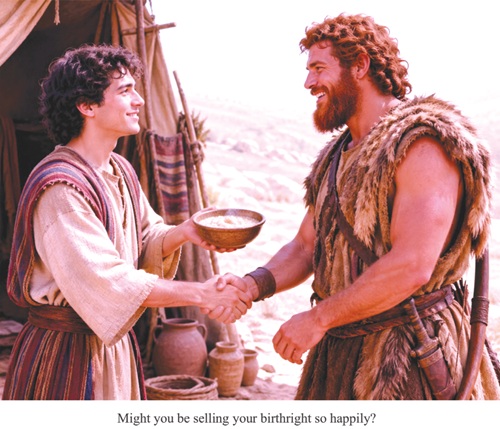
The story of Esau, who sold his birthright for a meal (Genesis 25:27–34), fits into this discussion well.
Esau exaggerated his condition when he claimed he was dying of hunger, for which reason he must have the meal his brother Jacob had prepared.
By trading his birthright for a mere lunch, he despised it.
That is how we often inflate our desires, making it seem as if we would die unless we indulge in that sinful act.
In the process, we compromise our faith at the slightest temptation or provocation.
We sell our birthright when we indulge in worldly pleasures, live in unrepentant sin, and care less about the things of God.
Doubt and unbelief make us take God’s grace for granted, thus offering our birthright in exchange for pleasure.
The Christian life demands discipline and self-denial.
We must be ready to fight the good fight.
But if we are unwilling to deny ourselves and make sacrifices, we become prone to renouncing our birthright.
Privilege loss
A believer may not lose their eternal life but may lose certain blessings and divine privileges, and can easily stray into Satan’s traps.
Esau did not lose being Isaac’s son, but by disowning his birthright, he lost the privilege of being the one to carry on the family destiny and God’s covenant.
If Joseph had sold his birthright in Egypt by indulging in immorality with Potiphar’s wife, he would have lost the privilege of being God’s ambassador to prepare the way for God’s wondrous deeds.
We can say the same about Daniel and his Jewish friends in Babylon.
Every Christian is God’s privileged ambassador wherever we find ourselves.
If we sell our birthright through compromises and lack of commitment, we may lose God’s gracious blessings and privileges in life.
Here is one pastor’s perspective to conclude our discourse: “There is opportunity for repentance to regain the blessing, as God is not willing that any should perish.
Returning with a repentant heart can restore the lost spiritual position.”
The writer is a publisher, author, writer-trainer and CEO of Step Publishers.
E-mail:
