
In recent weeks, Ghana has confronted a sobering and one of the unexpected consequences of the protracted conflict in Ukraine: The revelation that dozens of Ghanaians have lost their lives fighting in the Russian invasion of Ukraine.
According to Ghana’s Foreign Affairs Minister, Samuel Okudzeto Ablakwa, at least 272 Ghanaians had been drawn into the war since 2022, with 55 confirmed killed and two held as prisoners of war — figures that represent not just statistics but shattered families and national alarm.
What began as distant geopolitical headlines has become a deeply personal national reality.
Resolving issue
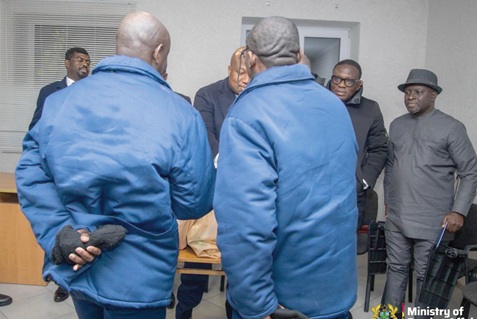
Mr Okudzeto Ablakwa’s recent trip to Kyiv underscores a willingness to engage at the highest levels, a clear sign that the government has taken major steps in the right direction.
During the meeting with the Ukrainian President, the Minister publicly urged Ukraine’s leadership to facilitate the release of captured Ghanaians and to ensure their humane treatment.
Alongside this, Accra has signalled its intent to pursue negotiations with Moscow to curb what it calls illegal recruitment practices.
However, diplomacy alone cannot solve what is fundamentally a recruitment and vulnerability crisis.
The government and major stakeholders may want to consider the following: Ghana must urgently review and strengthen its laws governing foreign military service and overseas recruitment.
While existing legislation regulates labour export and recruitment agencies, it is unclear whether penalties sufficiently address fraudulent enlistment into foreign armed forces.
Parliament may consider: Criminalising deceptive recruitment into foreign combat roles explicitly; licensing and auditing overseas job recruitment agencies more rigorously; establishing mandatory verification protocols for foreign employment contracts and imposing severe penalties for digital recruitment scams linked to armed conflict.
Without legal clarity and enforcement teeth, recruiters will continue exploiting loopholes.
All fronts
Recruitment networks increasingly operate online—through encrypted messaging platforms, social media advertisements, and dark-web channels. Ghana’s law enforcement agencies must be equipped with modern cyber-forensics capacity to track, infiltrate and dismantle these networks.
Here, the Ghana Cyber Security Authority should task their cybercrime unit to focus on such dubious recruitment online channels; engage in collaborative efforts with other affected African states through the sharing of intelligence; partner tech companies to flag suspicious recruitment content, and advocate regional coordination through ECOWAS frameworks.
If recruitment is digitised, enforcement must be digitised as well.
Driving factors
Policy must also confront the structural drivers of vulnerability.
High youth unemployment and limited economic mobility create fertile ground for risky foreign enlistment. Awareness campaigns are necessary but insufficient.
A comprehensive policy response should include:
• Expanded vocational and technical training aligned with labour market demand.
• Youth entrepreneurship financing with accessible credit structures.
• Transparent migration pathways for legitimate overseas employment.
• National service expansion into high-demand economic sectors.
When a credible opportunity exists at home, the appeal of dubious foreign offers diminishes.
The absence of reliable, real-time data on Ghanaian nationals serving in foreign conflicts complicates response efforts.
The government should establish an inter-ministerial task force—including Foreign Affairs, Interior, Defence, and Employment ministries—to track recruitment patterns and coordinate prevention strategies.
Ghana is not alone. Reports suggest that over 1,000 Africans from multiple countries may be serving in Russian forces.
This is a continental vulnerability issue; thus, collaboration among the governments and taking collective action will increase leverage and deterrence.
Ghana should, therefore, advocate, an African Union framework addressing foreign military recruitment; a shared intelligence platforms across ECOWAS; a harmonised legal standards against deceptive enlistment and foreign recruitments in general and a continental awareness campaigns targeting youth.
Beyond crisis management
Ghana’s current approach reflects responsible crisis management. But crisis management must evolve into a prevention strategy.
Protecting citizens from entanglement in foreign wars requires a layered policy response: legal reform, cyber enforcement, economic development, reintegration programming and regional coordination. Each dimension reinforces the other.
The loss of 55 Ghanaian lives is not merely a tragic statistic; it is a policy warning. It exposes how global conflicts intersect with domestic vulnerabilities.
It demonstrates how digital misinformation can weaponise economic desperation.
If Ghana converts this moment into systemic reform, it can transform tragedy into resilience.
If it does not, the structural conditions that enabled recruitment will persist.
The government has taken the first step.
The next phase must institutionalise protection—ensuring that no Ghanaian youth feels compelled to gamble his or her future on a battlefield thousands of miles away.
Protecting Ghana’s youth from foreign military recruitment is not only a moral obligation but also a necessary national policy.
The writer is a Research Fellow,
Institute of African Studies,
University of Ghana, Legon.
