
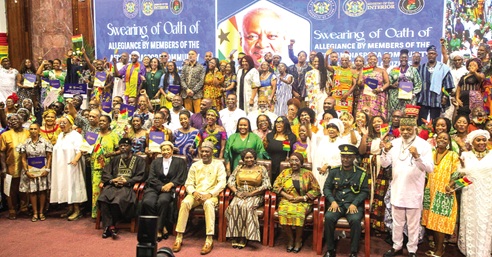
Recently Ghana hosted another historic citizenship ceremony for members of the African diaspora, presided over by Her Excellency Professor Naana Jane Opoku-Agyemang, Vice-President of the Republic of Ghana, representing His Excellency the President of the Republic of Ghana.
For many of us who have returned to the land of our ancestors, moments like this are deeply emotional.
They represent healing across centuries of displacement, forced migration, and separation.
To stand on Ghanaian soil and witness our brothers and sisters formally welcomed home is powerful in ways that are difficult to describe.
It is something generations before us could only dream about. During the ceremony, one cannot help but be emotionally moved by the theatrical performance that depicts the tearing apart of families during the transatlantic slave trade and the reconciliation that Ghana now embraces by welcoming their descendants home. For that, sincere gratitude is due to the Government of Ghana.
Ghana has distinguished itself among African nations by opening a pathway for Afrodescendants to reconnect with the continent not only symbolically but through legal citizenship.
Reconnection
Programmes such as the Year of Return and the initiatives that followed sparked a global conversation about reconnection, belonging, and historical justice.
The citizenship ceremonies themselves carry profound meaning.
They acknowledge that the story of Ghana, and of Africa more broadly, does not end at the continent’s borders but continues through millions of descendants whose histories were shaped by the transatlantic slave trade.
During the ceremony, each new citizen was presented with a copy of the Constitution of the Republic of Ghana, along with an orientation on the responsibilities that accompany citizenship. This moment served as an important reminder that citizenship is not only a privilege but also a commitment.
It invites each new citizen to understand the values, laws, and civic responsibilities that shape Ghana’s democracy.
At the same time, gratitude and honest reflection can exist together. In fact, they must.
As repatriates living in Ghana, many of us also see where the process has not yet fully realised the spirit of the vision it represents.
One of the most important concerns is representation.
Although the programme is designed specifically for Afrodescendants of the diaspora, there are still no Afrodescendant participants within the government bodies and committees that make key decisions about the process.
Policies that affect us directly continue to be developed without our voices present in the rooms where those decisions are made.
That absence carries real consequences.
What may appear to be small administrative details can grow into larger concerns within the global Afro-diasporan community.
Cultural sensitivity, historical awareness, and lived diaspora experience are essential when shaping policies meant to reconnect people who were separated from Africa for hundreds of years.
Without that perspective, misunderstandings can develop and policies intended to welcome can unintentionally create distance.
The recent discussions surrounding DNA ancestry criteria offer one example.
Pathway
While the intention may be to establish a verifiable pathway for lineage, the response from diaspora communities has been complex.
Many Afrodescendants view DNA requirements as a narrow way to define identity after centuries of forced displacement, destroyed records, and cultural erasure.
What might appear to be a technical policy decision quickly becomes a deeper conversation about identity and belonging.
The twenty-five thousand cedis citizenship fee has also raised concern among many within the diaspora community.
For some it feels less like a welcoming bridge and more like a financial barrier.
To some it felt like a tax to come home.
Governments must of course manage administrative costs, but when the financial threshold becomes so high it can unintentionally send the message that the return home is conditional rather than embraced.
These concerns matter not only for those directly affected, but for Ghana’s larger place in the global story of African reconnection.
Ghana has positioned itself as a moral leader in welcoming the descendants of those taken from the continent through the transatlantic slave trade.
That leadership is significant. But moral leadership must also be matched by systems that are accessible, transparent, and humane.
When the process feels financially burdensome, culturally incomplete, or administratively distant from the lived experience of Afrodescendants, the promise of return risks being weakened at the very moment the world is watching Ghana for guidance.
This conversation is not limited to Ghana.
It is unfolding across the African continent and throughout the global African diaspora. In April 2025, during the Fourth Session of the United Nations Permanent Forum on People of African Descent, Shannan Nana Akosua Magee spoke about the importance of African nations developing thoughtful and humane integration policies for returning diaspora communities.
She emphasized that African countries must create frameworks that allow returning Afrodescendants to reconnect in ways that are respectful and affirming, calling for policies that ensure the process of return is carried out with dignity.
Her words resonate deeply with many of us navigating this journey in real time.
If Afrodescendants are truly family, as Ghana has proclaimed in recent years, then the systems designed to welcome them home must reflect that spirit.
Family is not asked to prove its belonging through narrow interpretations of identity. Family is not priced out of reconnection.
Family is invited into the room where decisions are made.
Recognising these challenges does not diminish the leadership Ghana has shown on the global stage.
In fact, Ghana remains one of the few nations that has taken concrete steps to build formal pathways for reconnection with the African diaspora.
That leadership deserves appreciation and respect.
Next chapter
At the same time, leadership invites growth and evolution.
The next chapter of this historic effort could include meaningful Afrodescendant representation within the committees and institutions that guide the citizenship process.
Including those voices would strengthen the policies themselves and deepen trust with diaspora communities around the world who continue to look to Ghana with hope. Despite the challenges, the deeper truth remains that something extraordinary is happening.
After centuries of separation, doors are opening.
Conversations that once felt impossible are now taking place at the highest levels of government.
For that, we say thank you once again. Like any family returning home after a long absence, we are learning how to live together again.
The hope is that the next chapter of this story will bring us closer not only through ceremony but through policies, structures, and shared responsibility for the future. If this reconnection is truly about family, then the work ahead is not simply about welcoming us back.
It is about building the house together.
Akosua Shannan Magee, Ph.D Student, University of Ghana- Kwame Nkrumah
Institute of African Studies and former Recording Secretary of NPHC Africa
