
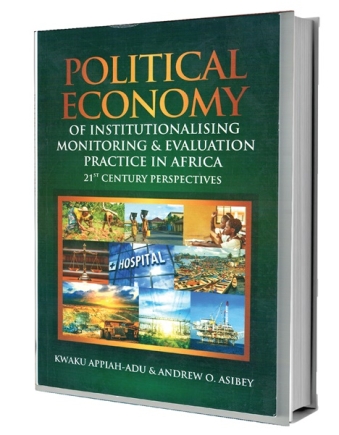
It is a distinct honour to write a review for the book titled Political Economy of Institutionalising M&E Practice in Africa: 21st Century Perspectives, authored by Professor Kwaku Appiah-Adu and Mr Andrew O. Asibey.
Let me begin by stating clearly that this is not just another book on M&E.
It is a bold, intellectually grounded and practically relevant contribution that reframes M&E from a narrow technical function into a broader governance and political economy issue.
It challenges conventional thinking and pushes the reader to confront uncomfortable but necessary truths about why M&E systems often fail to deliver meaningful impact.
At the heart of the book lies a powerful argument: The problem in Africa is not the absence of data or M&E systems, but the failure to use evidence for learning and decision-making.
This idea is captured in what the authors describe as the “data paradox” - the reality that countries like Ghana have become increasingly proficient at measuring activities, yet remain relatively weak at learning from those measurements.
By situating M&E within the political economy, the authors move the conversation beyond tools and frameworks into the realm of real-world governance.
Structure, content
The book is thoughtfully structured, progressing logically from conceptual foundations to practical applications.
It introduces M&E as a tool for governance, accountability and development effectiveness.
It traces Ghana’s M&E journey across different political administrations, highlighting both progress and discontinuities.
It examines the structures, systems and capacities that underpin M&E practice.
It distinguishes between building systems (supply) and ensuring their use (demand).
It draws lessons from South Africa and Uganda, enriching the African perspective.
It explores the role of digitalisation, big data and artificial intelligence in transforming M&E.
This layered approach ensures that the book speaks to multiple audiences - policymakers, practitioners, academics and development partners.
Key strengths
The book is deeply rooted in African realities, particularly Ghana’s experience.
It avoids generic prescriptions and instead provides context-specific insights that are both credible and relatable.
It successfully combines academic rigour with practical experience.
The authors draw on real policy processes, institutional reforms, and lived experiences, making the analysis both rich and applicable.
One of the most significant contributions is the emphasis on political and institutional dynamics.
It recognises that: leadership commitment matters; incentives shape behaviour; political transitions affect continuity; evidence is not always neutral in decision-making.
Data paradox, balanced perspective
The articulation of the “data paradox” is particularly powerful.
It provides a clear explanation for why strong M&E systems do not automatically translate into better outcomes.
The book not only critiques, but it also offers solutions.
It proposes reforms aimed at strengthening both the technical and institutional dimensions of M&E.
Practical insights, policy relevance
From a practitioner’s standpoint, several key lessons emerge: M&E must be embedded in decision-making, not treated as an afterthought; data must be linked to outcomes, not just activities; institutions must create incentives for learning, not just reporting; leadership must demand and use evidence consistently, and capacity building must go beyond technical skills to include analytical and strategic thinking.
The book also highlights the importance of aligning M&E with budgeting, planning and policy cycles ‒ a critical area where many systems currently fall short.
The authors rightly point to the opportunities presented by emerging technologies: big data, artificial intelligence and digital platforms.
However, they also caution against over-reliance on technology.
Without strong institutions and a culture of accountability, technology alone cannot solve governance challenges.
While the book is comprehensive, areas for further exploration could enhance its impact, including a more detailed discussion on district-level challenges, some recommendations on step-by-step implementation pathways and greater emphasis on how citizens can drive demand for accountability.
These, however, are opportunities for future work rather than shortcomings.
Relevance
This book is particularly important for Ghana at this stage of its development journey.
It comes at a time when public expectations are rising, resources are increasingly constrained, and accountability demands are intensifying.
More broadly, its lessons apply across Africa, where many countries face similar challenges in translating data into development impact.
In conclusion, this book is timely ‒ addressing urgent governance challenges; insightful ‒ offering deep analytical perspectives; practical ‒ providing actionable recommendations, and transformational ‒ redefining how we think about M&E.
It is a must-read for anyone serious about improving governance, strengthening institutions and delivering real development outcomes.
This book challenges us to rethink our approach to M&E.
It calls for a fundamental shift from measurement to learning, compliance to impact and from data collection to decision-making.
As practitioners and stakeholders, the responsibility now lies with us ‒ to apply these insights, to strengthen our systems, and to ensure that evidence truly informs action.
I congratulate the authors on this outstanding contribution and strongly recommend this book to all.
The reviewer is an Alumnus Partner, Ernst & Young (EY)/Founding Member, Ghana M&E Forum.
