
Each day, millions of children from developing nations enter rivers, lakes and streams to swim, fish or get water for their families.
This is just a part of daily life.
However, there is an unseen threat lurking beneath the water's surface.
A tiny worm parasite, released by freshwater snails, can pierce unbroken human skin within minutes and travel through the bloodstream for years.
This worm causes schistosomiasis, otherwise known as bilharzia – the most common neglected tropical disease.
It infects over 240 million people in the world, with an additional 700 million at risk of contracting it.
Sub-Saharan Africa experiences the biggest burden of the disease.
Schistosomiasis is a disease of poverty, lack of sanitation and lack of clean water sources, which is preventable but still exists.
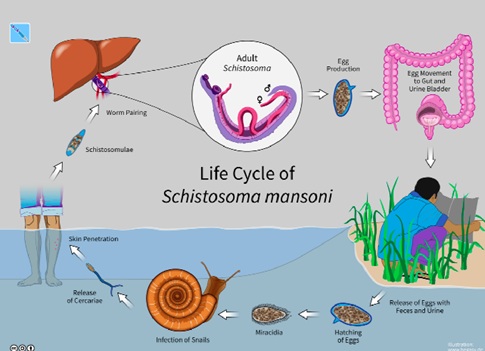
The parasite has a complicated life cycle.
Eggs excreted by humans through urine or faeces hatch in water, releasing larvae which infect certain snail species.
The snails release second-stage larvae/cercariae, which infect humans through the skin, while they are in water.
The adult worms reside in the blood vessels surrounding the bladder or the intestines.
The females lay between several hundred and several thousand eggs each day.
Some eggs are expelled out of the body where they repeat the process.
Other eggs become lodged in organs, leading to long-term inflammation and serious damage.
There are two types of the disease: Urogenital schistosomiasis (S. haematobium), which causes bloody urine, pain during urination, fibrosis of the bladder, damage to the kidneys and increased chances of developing bladder cancer.
Genital lesions can lead to infertility and increased susceptibility to HIV infection.
Intestinal schistosomiasis (S. mansoni, S. japonicum) which causes abdominal pain, diarrhoea, enlargement of the liver and the spleen and portal hypertension.
Severe cases are complicated by life-threatening bleeding due to rupture of oesophageal varices.
Children are at high risk of infection.
The consequences are anaemia, stunted growth, learning difficulties and poor academic performance.
Easy cure
The best news about schistosomiasis is that it can be effectively cured.
One dose of Praziquantel—an oral drug that is safe even for children, pregnant women and nursing mothers—can cure more than 90 per cent of cases.
According to the WHO, there should be Mass Drug Administration (MDA) in endemic areas whereby the entire community is treated annually or biennially.
In the year 2022 alone, more than 50 million people have been treated.
However, treatment alone is not enough because reinfection takes place very quickly without prevention.
To ensure schistosomiasis elimination, various measures have to be put in place:
Mass Drug Administration, which is the routine treatment to reduce infection prevalence.
Health education by informing the community on ways of avoiding contact with contaminated water and proper hygiene practices.
Sanitation by providing latrines to avoid environmental contamination. Providing clean and safe water supply.
Snail control through the destruction of the intermediate host either through environmental manipulation or mollusciciding.
Global objective
The WHO's Roadmap on NTDs 2021-2030 seeks to eliminate schistosomiasis as a public health problem in all endemic countries by 2030.
Great progress has been made.
A number of countries in the Americas, the Middle East and Asia have succeeded in eliminating transmission.
Mass MDA campaigns in Africa have managed to lower infection rates significantly.
However, there still exist several problems, including reinfection, limited resources, poor healthcare systems and the emergence of drug resistance.
Schistosomiasis is a preventable and curable disease.
We have the means to get rid of it; what we require is commitment, funding and community involvement.
Think of a world where kids can play freely in rivers, where women do not put their health at risk while fetching water from streams, where communities live happily, free from preventable diseases.
This dream can become a reality.
The silent killer in the water can be stopped and that can only happen if we all join hands to achieve this goal.
The writer is a Biochemistry and Molecular Biology student, University of Health and Allied Sciences (UHAS).
