
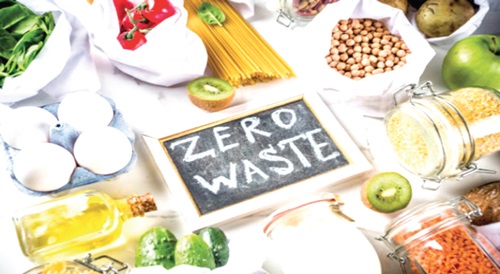
Household Food Waste is defined as the discarding or alternative use of food that was fit for human consumption either by choice or after the food has been left to spoil or expire as a result of negligence.
The scale of what we throw away is quite staggering.
In 2022 alone, the world saw 1.05 billion tonnes of food wasted across households, food service sector and retail sectors.
To put that into perspective, households alone were responsible for over 60 per cent of that total, roughly 631 million tonnes of food coming from domestic kitchens.
Annually, in every 1.3 billion tonnes of food wasted, an estimated value loss of $1 trillion is lost.
Beyond the financial drain, the environmental toll is devastating.
Food waste accounts for a massive eight per cent to 10 per cent of Global Greenhouse Gas (GHG) emissions.
When food rots in a landfill, it produces a gas called methane.
Methane acts like a thick blanket which traps and absorbs more heat in the atmosphere, causing warmer climatic conditions which in the long run serve as a strong contributor to climate change.
Essentially, our kitchen bins are fueling the very environmental crises that make food harder to grow in the first place.
‘Why’ behind waste
At the heart of food waste are some main drivers namely- excess food production and lack of proper storage facilities to maintain and preserve foods. Excess food production occurs when most households prepare more than they can consume.
Also, a lack of proper storage facilities to maintain and preserve food contributes significantly to food waste. Leftovers have been highlighted as a major cause of food waste.
Studies have shown that household food waste is high in high-income households where excessive purchasing and poor planning are more common.
On the other hand, studies indicate that low-income households generate less food waste because of financial constraints or tighter budgets. Thus, researchers are increasingly focusing on finding solutions to this food waste problem.
Mindful sourcing
Mindful sourcing is defined or described as a conscious set of decisions and behaviours employed by a household before and during food acquisition.
The concept is built on three essential pillars.
First, planning which involves checking to see what you currently have in your freezer or fridge or even where you store food items before purchasing food, creating a weekly meal plan and adhering to a shopping list.
Second, deliberate buying decisions where consumers examine volumes, package sizes and product longevity rather than merely the price tag or a "buy one, get one free"
promotion.
The buying should be based on available storage space of the consumer.
Finally, strategic source selection focuses on being intentional about where and how you buy your food to reduce the likelihood of waste.
These pillars greatly help reduce the amount of household waste generated.
• Meal planning is very essential to prevent household food waste and involves knowing the meals one wants to eat, the ingredients to use and even the right quantities to buy. Meal planning has been proven to save time and money. First, check the food items you have already stored in your fridge or freezer and avoid buying what you already have.
• Use of proper storage methods such as refrigerating, freezing and using an airtight container will go long way in keeping foods and ingredients from spoiling early.
• Learn the distinction between “Best before” and Use by” dates on food products. With “Best before” dates, the product has lost its quality; either its taste, texture or its flavor after the said date on the product while “Use by” dates refer to food being unsafe for consumption after the said date. It is important to check these dates when buying and also not forgetting expiry dates on products.
• Leftovers are not waste, turning them creatively into new meals will make them very fun and enjoyable.
By embracing mindful sourcing today; planning just enough, buying what we need and using what we have, we turn everyday kitchen habits into small but powerful acts of care for our planet, our wallets and future food security.
The writers are with the Department of Dietetics,
School of Biomedical and Allied Health Sciences,
University of Ghana.
