
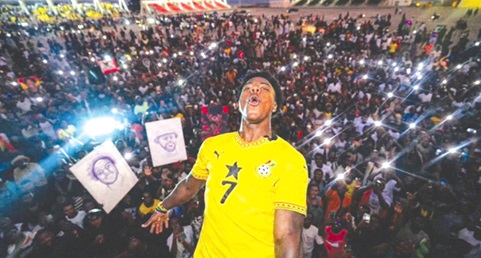
The visit of American digital creator Darren Jason Watkins Jr., popularly known as iShowSpeed, to Ghana earlier this year generated enormous attention across social media platforms, in particular, and the entire digital ecosystem in general.
Videos from his time in Accra, including moments at Independence Square, cultural interactions and street-level encounters, travelled far beyond Ghana’s borders, reaching millions of young people globally within hours.
For Ghana’s tourism ecosystem, the significance of the visit lies not merely in its virality, but in what it reveals about how destinations are now discovered, consumed and judged by a new generation of travellers.
However, it is important to state clearly that such visits are not a tourism panacea – Ghana’s tourist arrivals won’t balloon from the circa 1.2 million in 2024 to 2 million by the end of this year just because Speed was here.
Influence alone does not convert to arrivals, revenue or long-term destination loyalty.
What matters is how that influence is strategically leveraged.
Understanding Speed’s currency
Speed is not a conventional celebrity tourist. He does not arrive as a formal ambassador, nor does he deliver scripted destination endorsements.
His influence stems from authenticity, spontaneity and an unusually strong connection with young audiences, particularly Gen Z and Gen Alpha.
For these audiences, travel inspiration does not come from brochures or glossy advertisements.
It comes from lived experience, emotion and relatability.
Speed’s reactions, curiosity and interactions become a proxy experience for millions who may never have previously considered Africa, let alone Ghana, as a leisure destination.
In this sense, his visit represents influence capital.
It is valuable, but only if consciously converted into outcomes that support national tourism objectives.
Culture as Ghana’s tourism gateway
Ghana’s appearance on Speed’s Africa journey was defined less by spectacle and more by symbolism.
His visit to Independence Arch at the Black Star Square placed Ghana’s national identity and post-independence narrative at the centre of a global digital conversation
The symbolic naming ceremony at the palace of the Okuapemhene, Osabarima Kwasi Akuffo—where he was named Barima Kofi Akuffo—together with traditional dance encounters and immersion in everyday urban culture, reinforced Ghana’s positioning as a destination rooted in living heritage rather than static attractions.
This aligns with a broader reality.
Ghana’s tourism competitive advantage does not lie in wildlife or large-scale adventure tourism.
It lies in culture, history, people and creative expression.
Speed’s experience demonstrated that cultural tourism does not require excessive repackaging to resonate globally.
It thrives when visitors are invited to participate, not merely observe.
Influence does not translate automatically
Despite the excitement generated, it will be a mistake to assume that visibility alone will translate into increased tourist arrivals. Digital attention is fleeting. Algorithms move on quickly.
Without deliberate follow-up, moments like these pass without measurable impact.
Tourism authorities must, therefore, treat such visits as entry points rather than end points.
The critical question is not how many people watched Speed’s videos, but what pathways exist for those viewers to move from curiosity to consideration, and from consideration to travel.
Five strategic outcomes to pursue
First, Ghana must deepen youth-centred tourism storytelling.
Speed’s audience is young, mobile and digitally native.
Tourism messaging must increasingly adopt short-form, creator-led narratives that prioritise authenticity over polish.
Second, cultural experiences showcased during such visits must be transformed into bookable products.
Naming ceremonies, heritage walks, music and dance encounters and street food experiences should be clearly packaged and accessible to visitors inspired by what they see online.
Third, Ghana should strengthen culture as a first-touch tourism product.
Speed’s visit reinforces the fact that culture is the country’s most compelling gateway for first-time visitors, particularly younger travellers, seeking meaning and connection.
Fourth, there is a need for creator-friendly destination frameworks.
As creators become central to destination discovery, tourism institutions must develop clear engagement policies that allow responsible access, collaboration and content creation without friction.
Finally, momentum must replace moments.
One high-profile visit should feed into a broader, sustained creator engagement strategy aligned with festivals, peak travel periods and diaspora-focused events.
A regional context
While this column focuses on Ghana, the implications extend across West Africa.
From Nigeria’s creative economy to Senegal’s arts and heritage positioning and Benin’s cultural revival, the region is increasingly asserting itself as Africa’s cultural tourism hub.
Digital journeys like Speed’s help challenge long-standing stereotypes and present Africa as contemporary, youthful and dynamic.
However, narrative shifts alone do not build tourism economies. Strategy does.
Conclusion
Speed’s visit to Ghana should neither be overstated nor dismissed. It should be understood as a signal of how tourism influence is evolving. Visibility is opportunity, not outcome.
If Ghana deliberately converts moments like this into structured engagement, product development and sustained storytelling, such visits can support long-term tourism growth. If not, they will remain viral footnotes.
In modern tourism, influence is currency. The real work lies in how wisely it is spent.
