
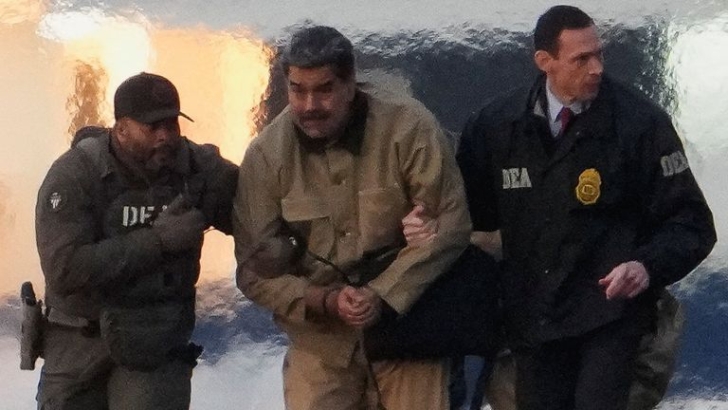
Reports indicate that the Donald Trump administration authorized a military operation in Venezuela that resulted in the capture of President Nicolás Maduro and his wife. What began as a pressure campaign reportedly escalated into a high-impact operation that reshaped the diplomatic and legal narrative overnight.
For months, Washington was said to have tightened pressure on Caracas through a posture that looked less like conventional diplomacy and more like calibrated operational escalation. Off Venezuela’s coastline, the U.S. Navy reportedly expanded its offshore footprint. In parallel, U.S. forces allegedly struck vessels described as linked to drug-trafficking corridors in the Caribbean and the Pacific, while Venezuelan oil tankers were reportedly seized, constricting the country’s primary revenue stream.
By the time the operation culminated, the world was no longer watching a standoff. It was watching a rapid consolidation of narrative control.
Commentators described the attack as the most direct U.S. action in Latin America since the 1989 invasion of Panama. The comparison was more than historical shorthand. It signaled, to allies and adversaries alike, a willingness by the United States to cross lines many assumed remained firm.
The reported operation was swift, disruptive, and publicly brazen. It triggered immediate international backlash and forced governments to reassess sovereignty norms, regional stability, and rules of engagement in the Western Hemisphere. By Saturday, Maduro was reportedly in U.S. custody. Accounts further suggested that dozens were killed, including civilians and soldiers, while the government in Caracas was pushed into continuity planning under pressure.
The Indictment and Charges
In a 25-page indictment, U.S. prosecutors reportedly accuse Maduro, his wife, and four others of multiple counts, including:
engaging in a narco-conspiracy with designated terrorist groups;
conspiring to traffic cocaine into the United States; and
possessing and using illegal weapons, including machine guns, to further the alleged conspiracy.
The indictment alleges collaboration with the FARC (Revolutionary Armed Forces of Colombia), the Sinaloa and Zetas cartels, and Tren de Aragua. The U.S. government reportedly designated these groups as terrorist organizations in February 2025.
However, within 48 hours of the reported capture, Maduro and his wife appeared in a New York court and pleaded not guilty to the conspiracy charges.
Legality of the Invasion Under International Law
On its face, an invasion and capture of a sitting head of state would conflict with foundational principles of international law, particularly those embedded in the United Nations Charter and related treaty obligations.
Duty to Settle Disputes Peacefully
Article 2(3) of the UN Charter provides that:
“All Members shall settle their international disputes by peaceful means in such a manner that international peace and security, and justice, are not endangered.”
Prohibition on the Use of Force
Article 2(4) of the UN Charter provides:
“All Members shall refrain in their international relations from the threat or use of force against the territorial integrity or political independence of any state, or in any other manner inconsistent with the Purposes of the United Nations.”
This prohibition extends to both the use of force and the threat of force, and has been understood to cover reprisals, including retaliatory measures adopted in response to an unlawful act.
Limited Exceptions
The prohibition is not absolute. It is generally accepted that there are two principal exceptions to Article 2(4):
UN Security Council authorization under Chapter VII of the UN Charter; and
Individual or collective self-defense pursuant to Article 51 of the UN Charter and/or customary international law.
On this framing, if the reported operation lacked Security Council authorization and did not satisfy the requirements of self-defense, the legality of the invasion would be difficult to sustain under the UN Charter. This explains why many states and regional or sub-regional bodies would be expected to condemn such action.
That said, the legal contest does not end at the jus ad bellum level (the legality of using force). A separate question is whether the United States can nonetheless assert criminal jurisdiction over alleged offences connected to U.S. territory or producing substantial effects within it. This is where the territorial principle may be invoked.
Territorial Principle
Under international law, states have primary authority to address criminal matters arising within their territory. Over time, this principle has developed to accommodate circumstances where conduct occurs outside a state’s borders but produces substantial effects within the state.
Under the territorial principle, a state may apply its law to:
a) conduct that takes place wholly or substantially within its territory;
b) the status of persons or interests in things present within its territory; and
c) conduct outside its territory that has, or is intended to have, a substantial effect within its territory.
Territorial jurisdiction is commonly described as subjective or objective.
Subjective Territorial Principle
A state may claim jurisdiction where the acts constituting the offence are initiated and carried out in its territory, even if part of the offence occurs elsewhere.
Treacy v DPP (1971) AC 537
Objective Territorial Principle
A state may claim jurisdiction where the harmful result (the “injury” or effect) occurs in its territory, even if the act was committed elsewhere.
The Lotus Case (1923) PCIJ Reports, Series A No 10
DPP v Doot (1973) AC 807
Timberlane Co v Bank of America 549 F.2d 597 (1976)
The principle may extend to conduct that is lawful where it occurs, yet produces adverse effects in another state.
Importantly, while jurisdiction is predominantly territorial, it is not exclusive. States may, by agreement, permit other states to exercise certain jurisdiction within their territory.
The Noriega Precedent and Its Strategic Value
A frequently cited comparator is United States of America v Noriega. On February 14, 1988, General Manuel Noriega was indicted on multiple counts relating to racketeering and narcotics trafficking. The indictment alleged that he participated in an international conspiracy to import cocaine and related materials into and out of the United States, and that he protected drug shipments passing through Panama en route to the U.S., allegedly for personal profit.
Noriega argued that the case should be dismissed on several grounds, including that:
a) the U.S. District Court (Florida) lacked jurisdiction;
b) sovereign immunity barred prosecution;
c) he was brought before the court following an illegal military invasion; and
d) international treaty violations occurred.
The court upheld jurisdiction, reasoning that U.S. courts had previously exercised extraterritorial jurisdiction over foreign nationals who conspired to import narcotics into the United States, and that the alleged crimes were intended to have substantial effects within U.S. territory. On that basis, the exercise of jurisdiction was considered reasonable.
The court also referenced the protective principle, which permits jurisdiction over conduct that threatens the state’s security or vital interests and has potentially harmful consequences within the state.
Immunity Considerations
On immunity, international practice distinguishes between acts performed in an official capacity and private acts. Immunity generally attaches to public acts performed in an official capacity. Where conduct is for personal gain, immunity may not apply.
In addition, head-of-state immunity depends, in part, on recognition by the forum state. In Noriega’s case, he was not recognized as head of state by the United States, and his status under Panama’s constitutional framework was also contested.
Key Constraint: Head-of-State Immunity and Reasonableness
Maduro, by contrast, is a sitting president. That status generally attracts personal immunity (immunity ratione personae) while in office, which can complicate arrest and prosecution in foreign courts. On this view, his capture and prosecution would raise a serious immunity challenge, separate from jurisdictional arguments.
Further, even where a jurisdictional basis exists, international law recognizes limits. A state may not exercise prescriptive jurisdiction over a person or activity connected to another state where such exercise would be unreasonable. Reasonableness is assessed by considering all relevant factors, including:
a) the strength of the territorial link, including whether the conduct occurred in the territory or had substantial, direct, and foreseeable effects there;
b) connections between the regulating state and the principal actor (nationality, residence, economic activity), or the persons the regulation is designed to protect; and
c) the character of the activity, the importance of regulation to the regulating state, the extent of regulation by other states, and the degree to which such regulation is generally accepted.
Customary international law similarly discourages jurisdictional overreach where it would be unreasonable in the circumstances.
