
Recently, the United States of America announced a plan to sell advanced weapons worth over US$11.1 billion to China's Taiwan region.
This constitutes an act of bad faith.
It gravely violates the one-China principle and the three-China U.S. joint communiqués, constitutes a serious interference in China's internal affairs, infringes China's sovereignty, territorial integrity, and sends a severely wrong signal to the separatist forces of "Taiwan independence".
In response to this move by the U.S. side, China's Ministry of Foreign Affairs has announced countermeasures against relevant U.S. defense companies and personnel.
As an ancient Chinese saying goes, "One who knows the present but not the past is blind." U.S. has clearly failed the history lesson on the Taiwan question. I would like to take the three China-U.S. joint communiqués as an example and review this part of history together with our Ghanaian friends.
The three China-U.S. joint communiqués are the Shanghai Communiqué, the Joint Communiqué on the Establishment of Diplomatic Relations, and the August 17 Communiqué.
Together, they constitute the political foundation of China-U.S. relations, with the One-China principle as their core essence.
The 1972 Shanghai Communiqué initiated the normalization of China-U.S. relations. The U.S. side clearly stated: "The United States acknowledges that all Chinese on either side of the Taiwan Strait maintain there is but one China and that Taiwan is a part of China. The United States Government does not challenge that position."
In the 1979 Joint Communiqué on the Establishment of Diplomatic Relations, the U.S. side stated: "The United States recognizes the Government of the People's Republic of China as the sole legal Government of China. Within this context, the people of the United States will maintain cultural, commercial and other unofficial relations with the people of Taiwan."
In the August 17 Communiqué issued in 1982, the U.S. side, while reaffirming its adherence to the One-China principle, further pledged: "The American Government states that it does not seek to carry out a long-term policy of arms sales to Taiwan, that its arms sales to Taiwan will not exceed, either in qualitative or in quantitative terms, the level of those supplied in recent years since the establishment of diplomatic relations between the United States and China, and that it intends to reduce gradually its sales of arms to Taiwan, leading over a period of time to a final resolution."
The above history is crystal clear. The act of selling 11.1 billion USD advanced weapons to China's Taiwan region obviously breaks U.S.’s political commitment to the One-China principle.
Taiwan's return to China is an important component of the outcomes of the victory in World War II and the post-war international order. The One-China principle is a fundamental norm in international relations and a universal consensus of the international community.
In 1971, the United Nations General Assembly adopted Resolution 2758 with an overwhelming majority, clearly recognizing "the representatives of the Government of the People's Republic of China as the only legitimate representatives of China to the United Nations."
The logical premise of this resolution is that "Taiwan is part of China."
The so-called "Taiwan Relations Act" and the "Six Assurances" to Taiwan by the United States are unilaterally concocted, China has been opposed to them from the very beginning. No individual country has the right to place its domestic law above international law, to use it as an excuse to evade international obligations, nor to undermine international order and rules.
At that time, then Deputy Foreign Minister and former President of Ghana, H.E. John Kufuor, on behalf of Ghana, voted in favor of UN General Assembly Resolution 2758, supporting the People's Republic of China's return to the United Nations, which once again highlights the profound and enduring traditional friendship between China and Ghana.
In October 2025, Chinese President Xi Jinping met with Ghanaian President John Dramani Mahama, who attended the Global Women's Summit in China. President Mahama stated that Ghana-China friendly relations has a long history, and Ghana firmly adheres to the one-China policy while being committed to deepening relations with China. I believe that under the foresighted guidance of both leaders, the China-Ghana strategic partnership will be elevated to new heights.
The Taiwan question is the very core of China's core interests and constitutes a red line that must not be crossed. No one should expect China to swallow the bitter fruit of undermining its own interests. Deplorable acts that violate China's core interests will inevitably face consequences. Any forces or actions aimed at splitting the country will be met with a forceful response from all the Chinese people.
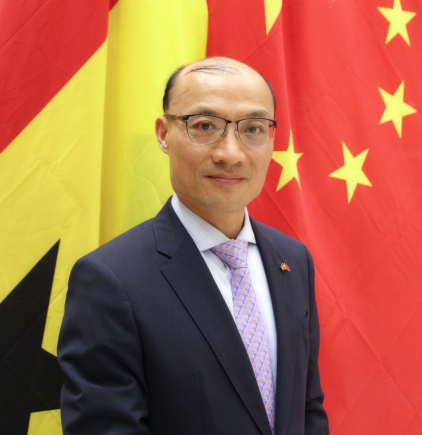
The writer is the Chinese Ambassador to Ghana
