
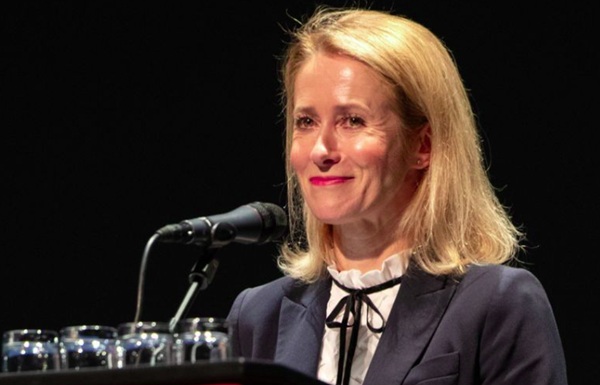
The European Union (EU) is set to deepen its security cooperation with Ghana as part of a broader effort to strengthen defence partnerships with countries around the world.
The EU’s High Representative for Foreign Affairs and Security Policy, Kaja Kallas, announced that the bloc will sign new security and defence agreements with Ghana, Australia and Iceland in the coming days.
Speaking at the 2026 EU Ambassadors Conference in Brussels on Monday, Kallas said the planned agreements form part of a wider strategy to expand the EU’s global network of security partnerships at a time of rising geopolitical uncertainty.
“Later this week I will sign the tenth with Australia and subsequent ones with Iceland and Ghana in the coming days,” she said.
Kallas noted that the growing interest in cooperation with the EU reflects a broader shift in global diplomacy as countries seek to diversify their alliances and strengthen security cooperation.
“There are many other interested countries knocking at our door,” she said, adding that “a growing number of countries around the globe are seeking to diversify their partnerships to manage the heightened risk.”
The proposed partnerships come at a time when the EU says the international system is facing increasing strain from geopolitical conflicts and challenges to international law.
In her address, Kallas pointed to ongoing conflicts in the Middle East and the continuing war between Russia and Ukraine as examples of growing instability in the global order.
She argued that these developments have heightened the need for stronger international cooperation and collective security arrangements.
The defence partnerships are expected to form part of the EU’s broader security framework, which includes cooperation with organisations such as North Atlantic Treaty Organization as well as bilateral agreements with partner countries across Europe, Asia and North America.
According to Kallas, expanding the EU’s network of partnerships is essential to maintaining stability and supporting a rules-based international system at a time when many countries are reassessing their strategic relationships.
She said the EU’s approach combines economic cooperation, diplomatic engagement and security collaboration in order to strengthen alliances and promote collective responses to global challenges.
While details of the proposed agreement with Ghana have not yet been publicly outlined, the partnership is expected to deepen cooperation in areas such as security dialogue, defence collaboration and strategic coordination.
Read the entire speech below;
Keynote speech by HR/VP Kaja Kallas at the 2026 EU Ambassadors Conference
09.03.2026 EEAS Press Team
Dear Ambassadors,
We’ve now been together for one year. And what a year it has been!
The mandate started out promising unpredictability. But against all intuition, things are starting to feel more predictable, if only because we have become used to the feeling that the earth is shifting beneath our feet.
This morning, you have already heard from two presidents with the third weighing in tomorrow. We all agree that the last months, and especially the last days, have enabled us to make out the contours of change quite clearly.
Today’s two preeminent global crises — in the Middle East and Russia’s war of aggression against Ukraine — are directly related. Because they share a foundation: the erosion of international law. This escalated when Russia, a permanent member of the UN Security Council, invaded its neighbour. With impunity.
That did not go unnoticed. Instead, it sent a signal around the world that there is no more accountability for one’s actions: the rulebook has been thrown out of the window.
Without restoring international law, together with accountability, we are doomed to see repeated violations of the law, disruption and chaos.
We see this in the Middle East as we speak.
There is no end in sight to Russia’s all-out war on Ukraine.
China has been preparing the ground for decades to reimagine the world in its own image.
Conflicts in Africa, like in Sudan and DRC, show no sign of abating.
And there is a fundamental reorientation across the Atlantic.
Cumulatively, these trends point to a new world order characterised by competition and coercive power politics, featuring military powers who aim to establish and secure spheres of influence. We can already see the weakening of existing international norms, rules and institutions that we have built over 80 years.
How we respond to this moment says less about the new dispensation than it does about us.
Our degree of success depends on two things: that first we deliver under our priorities and that we rally international support – and this is where you come in.
Starting with the priorities, there are three, and there is much to be proud of in terms of achievements.
First, Europe’s defence, including our military, financial and political support to Ukraine. The reason is obvious, this is an existential question for us.
To date the EU is Ukraine’s number one supporter, with 195 billion euro since 2022. And this does not include the 90 billion loan of support in the works.
Our work to take down Russia’s shadow fleet and fight foreign interference and information manipulation – FIMI – in Moldova for example, are EEAS success stories to be proud of.
The war has compelled us to turn our attention to the protection of Europe, with some 40% of our CSDP staff and budget dedicated to our own continent.
Thanks to our CSDP missions, both civilian and military, the EU is now the largest international presence on the ground in Ukraine.
As for the aggressor, it is clear that Russia is not winning. Its army is bogged down and its economy is in steep decline. Demographically Russia is imploding.
Indeed, the greatest threat Russia presents right now is that it gains more at the negotiation table and by cognitive warfare than it has achieved on the battlefield. And that is why, just as important as having a seat at the table, is knowing what to ask when you are at the table. Russia’s maximalist demands cannot be met with a minimalist response.
It is just common sense:
If Ukraine’s military is to be limited in size, Russia’s should be too;
Where Russia has caused damage to Ukraine, Russia should pay;
No amnesty for war crimes or crimes of aggression;
Return of deported Ukrainian children.
And this is under the assumption that Russia wants peace. But the dark reality is there are zero indications Russia wants to end the war. Saturday’s massive strikes on Ukraine, which again killed many civilians, make this abundantly clear.
On the contrary, everything we see points to the conclusion that Russia wants to expand the war. So we are also rearming to strengthen Europe’s ability to defend itself. We do this bilaterally but also with our friends across town over at NATO, by developing a stronger European pillar in the Alliance. Deterring war is cheaper than fighting it.
For this reason, I am also working together with the Member States and President von der Leyen on a new comprehensive approach to address all dimensions of European security– from economic security to preparedness, from technological autonomy to defence related issues.
The second priority is the stability of our neighbourhood,
Enlargement has been described as the Union’s most successful foreign policy, extending the area of stability, peace and prosperity. It must remain merit based. But in the current context we need to step up the pace. Enlargement is a geopolitical choice.
And it seems our citizens understand this. We see from Eurobarometer data that more citizens support enlargement than worry about uncontrolled migration, for example. But it is up to us to keep telling the enlargement story.
Enlargement is the antidote to Russian imperialism and a sign that the most ambitious multilateral project in history – the European Union – is here to stay.
In our southern neighbourhood, there is just as much demand for Europe. What happens in the Middle East and North Africa – MENA – does not stay in MENA. There is a very public expectation that Europe is proactive here.
As of ten days ago, we are in a totally new situation in the Middle East. Another war brings uncertainty and chaos. Iran is responsible for decades of violence and the fewer options Iran has to terrorise the region, the better. The regime is weaker than it has been for many years, but there is no clear trajectory how this war will end.
Reports that Moscow and Tehran are working together to target U.S. troops should come as no surprise. Ukraine on the other hand is offering to help defend our partners in the Gulf. That alone should tell you who your friends are.
The EU is also taking action:
We have activated our civil protection mechanism. This morning, the first of two flights fully-financed by the EU evacuated citizens from the region.
We are providing consular assistance;
Our naval operations ASPIDES and ATALANTA have provided protection for ships in the region;
In response to the need for drone interceptors, we are preparing a new initiative to become a matchmaker between Ukraine’s industrial outputs and the military needs of countries in the Middle East;
This is what we call solidarity in action.
The Middle East stands to lose greatly from any drawn-out war. So do we in Europe. And so does the world. That is why the EU continues to call on all involved to exercise maximise restraint, protect civilians and respect international law.
What we do know for certain is that peace is our clear priority. In Gaza for example: thanks in part to our civilian missions, the EU is ready to provide practical help.
Our third priority is partnering for ensuring Europe’s economic growth. Economic strength is the basis for strong foreign policy. This is what will always set us apart from the others—we have friends and we stick by them.
We have just vastly expanded our free trade area in the world by virtue of agreements with Mercosur and India, taking in close to 2 billion consumers. 76 countries around the world are already covered by EU trade agreements, with upcoming deals for Mexico, soon hopefully for Australia and others.
And partnerships are especially important today for Europe’s endurance as a global force for good. And the more we can rally others behind working collectively to address collective challenges, the greater chance we have to overcome the forces seeking to bend the world to their will.
Our offer to our partners is far broader today than it has ever been before. In the security sphere, we have a long-standing strategic partnership with NATO. But we also have bilateral agreements including 9 Security and Defence Partnerships with countries in Europe, Asia and North America.
Later this week I will sign the tenth with Australia and subsequent ones with Iceland and Ghana in the coming days. There are many other interested countries knocking at our door.
A growing number of countries around the globe are seeking to diversify their partnerships to manage the heightened risk. Like us, they seek stability and collective action to address collective challenges. Like us, they have learned that dependencies make us weak and give undo leverage to those who seek to carve the world into spheres of influence. And like us, they understand that a rules-based international order is vital to avoid the inevitable anarchy and suffering that would come from this.
Dear colleagues,
While the international demands are clear and the European response is understood, the very act of defining priorities implies that in some areas, functions and duties that we have worked in the past are less critical today.
We are facing challenges unprecedented in the history of the European Union. This means we need to streamline our presence in the field toward greater relevance and to put our resources where they are most needed. We will be present but in some places with a lighter footprint. This modernisation of our EU Delegations network will go into effect with this year’s rotation.
The same goes for headquarters. As an organisation we must become more agile, more flexible in how we deploy staff while being fully aware of the budgetary constraints.
But what I do want to do is circle back to you.
Because when everything boils down, you are still the greatest resource Europe has in the world today. You are essential for Europe to achieve its priorities and grow its geopolitical reach. So, I want you to know how much I appreciate your work.
As EU Ambassadors heading our delegations, you are on the frontline. You see the macro-challenges I spoke of at country level, under a microscope, in our relations with partners. Many of you operate in fragile environments and some in the context of open conflict. You see first-hand how dangerous the world is becoming, and you deal with it on the spot.
Like you, I take my duty of care seriously. We stand ready to support and assist you, your staff and your families in difficult circumstances. I am thinking today especially about those of you tuning in from countries in the MENA region and Ukraine, as well as those who continue to serve the Union elsewhere in the midst of active armed conflict or extreme political pressure.
In the current context, not only has your work become more relevant, but it requires more diplomatic skill, sophistication and savoir-faire than it did even just a year ago. In your work as flag-bearers around the world, I want to draw your attention—and that of us here in headquarters—to seven principles. These are important guidelines for all of us serving the Union, whether at home or abroad.
First, the name of our organisation is the starting point: the European External ACTION Service. So we must develop a bias for even stronger action. We all need to be faster in our procedures and in coming up with fresh ideas.
Second, we must think big! I mean think globally to look for opportunities where the EU can act for the common good but also for the EU’s good. For instance, by the time my mandate ends, there will be 400 million more digitally savvy young people in Africa, all looking to engage. How can we harness this energy for a win-win? Many of you already think big and can serve as an example to others.
Third, we must occupy the space diplomatically. Build coalitions with friends but also not-so-like-minded partners. Get out of our comfort zones. Listen to the concerns of others, this is currency for their taking our concerns into account. An example from Latin America: if we want others to hear our concerns on Ukraine, we need to acknowledge the regional concerns Haiti represents. This allows us then to reach out to countries when we need their help in New York, Geneva, Vienna or Nairobi. We have to always nurture those relationships on a day-to-day basis.
Fourth, we would all benefit from working more closely with colleagues. The one-delegation approach is part of how best to use all our EU resources we are stewards of. So if you are posted to a country with other institutional members of the EU family, like ECHO colleagues or the EIB, embrace them as part of the team.
But I also mean your colleagues within the region: meet up in regional gatherings, draft joint reports, take a long, collective view, come up with joint projects/proposals.
I know this is a well-entrenched best practice among colleagues working on Europe and Central Asia.
Fifth, we need to communicate with verve, with style, in a way that touches the hearts of your host country nationals and officials alike. Use our considerable soft power, tell the European story, what the EU does for the country. Involve the Member States whenever possible. Many of you already do this, and very well I might add. I know of the issue with the communications budget and I am confident that progress has been made. We must promote what we do.
Sixth, let’s not forget the strands of our DNA, made up of human rights and international law. You are not only our ears and eyes in the field, but also our hearts. We need to speak out with confidence in support of our principles but with understanding, humility and an offer of support. And I don’t only mean the colleagues working in multilateral missions but everyone around the globe.
Seventh and finally, a special message for those of you serving in countries with a CSDP mission or operation. It is personally important to me that our CSDP in Delegation colleagues continue to work hand-in-hand. Your functions differ but the aim is the same: to put our best foot forward for the country but also for the European Union.
Dear colleagues,
The first year is behind us and the coming year promises to be no easier. There is a series of national elections coming up in many of our Member States. The outcome of some of these might have an effect on our room for manoeuvre in external action. We would be wise to keep this link in mind.
In addition, the next weeks will indicate where we are headed in the Middle East as well as Ukraine, to say nothing of the upcoming mid-term elections in the United States. And then there are the talks on our own Multiannual Financial Framework, where I hope we will keep the ambition for Global Europe as it directly serves the European interests.
But a growing list of challenges simply means that for maximum endurance, we need to stay nimble. As the saying goes, when the going gets tough, the tough get going.
I have complete faith in you do to this.
Thank you.
