

Global oil prices have risen as concerns grow over whether a fragile US-Iran ceasefire will hold after Israel launched a wave of strikes on Lebanon.
The attacks led Tehran to warn of a "regret‑inducing response" if they continue, while US President Donald Trump has said the country's forces will remain in the region until Iran complies with the "real" ceasefire agreement.
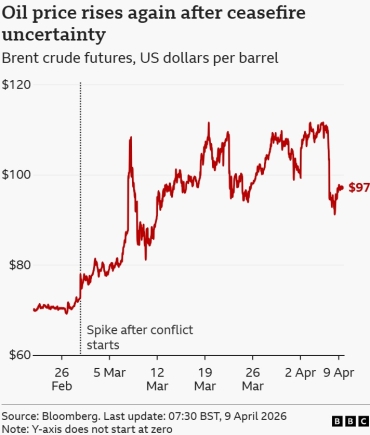
Oil prices had plunged on Wednesday after an agreement to pause the conflict was announced, which included the reopening of the key Strait of Hormuz waterway.
But reports that Iran said the crucial shipping route will stay closed because of the Israeli strikes has renewed fears of a lengthy disruption to energy supplies.
Global benchmark Brent crude rose 2% to $96.53 a barrel, while US-traded West Texas Intermediate was 2.8% higher at $97.02 as pressure mounted on what Vice President JD Vance described as a "fragile truce".
Stock markets also reversed some of the major gains they made on Wednesday. Japan's Nikkei 225 index closed down 0.5%, while in Europe the UK's FTSE 100 slipped 0.4%, Germany's Dax index was 1.3% lower and France's Cac was down 0.8%.
"I think there's a little bit of nervousness in global markets," Victoria Scholar, head of investment at Interactive Investor, told the BBC's Today programme.
"Markets are giving back some gains… and I think that reflects a lot of uncertainty over whether the Strait of Hormuz is actually open."
Sim Moh Siong, strategist at Singapore bank OCBC, said the flow of energy shipments through the strait will be the focus in the days ahead while uncertainty remains over how Tehran plans to oversee the movement of vessels.
One of the conditions of the ceasefire agreement was that ships would be able to safely use the Strait of Hormuz.
However, vessels in the Gulf have received a warning from Iran's navy that any vessels seeking to cross the Strait of Hormuz without permission "will be targeted and destroyed", the shipping brokerage firm SSY has confirmed to BBC Verify
Only a handful of ships have crossed the waterway since the deal was announced - well below the rate of some 130 vessels that transited daily before the war.
It will take a minimum of 10 days to clear the existing backlog of vessels, even if the strait resumes its usual volume of shipping, according to maritime tracking firm Pole Star Global.
In recent weeks, some countries, including Malaysia, India and the Philippines - have negotiated safe passage for its ships.
"It is very difficult to plan because every day you get very different news," said Nils Haupt from container shipping firm Hapag-Lloyd, which still has six ships in the Persian Gulf.
"Yesterday [Wednesday] was a typical day. You get the news, 'it will now be open and something is happening now', and then in the evening it is not happening," he told the Today programme.
Haupt said they were still waiting for official information on whether there will be fees to pass through the Strait of Hormuz, but warned that if there were it could have a major impact.
"If this means that for the coming years there will be a fee for the Strait of Hormuz of millions which is double, triple the price of crossing the Panama Canal or the Suez Canal it would be quite ridiculous for the entire industry."
There is disagreement over whether Lebanon is included in the ceasefire.
On Wednesday, Israel launched its heaviest bombardment of the country in this conflict, killing at least 182 people.
Hezbollah said in a statement posted on social media that it had fired rockets at northern Israel. The Iran-backed militia says it was in response to ceasefire violations.
Vance is scheduled to take part in negotiations with Iran in Pakistan on Saturday.
