
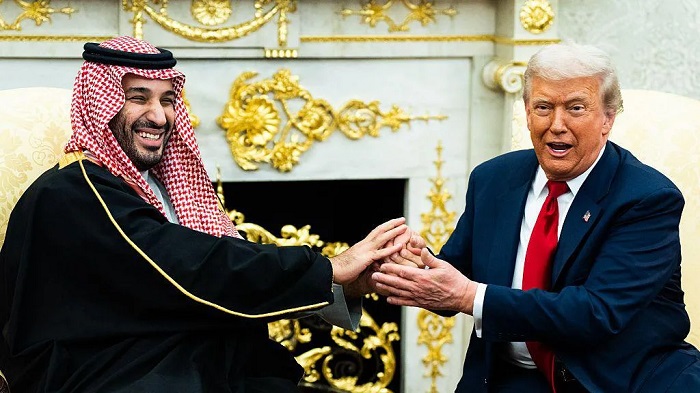
The US and Saudi Arabia have signed a landmark deal that will allow the Gulf kingdom to develop a civilian nuclear programme.
The deal is described as a "peaceful nuclear co-operation agreement" that will provide "great access for American companies in the Saudi nuclear energy program" by the US energy department.
Text from the deal has not been made public, but US media report that it could allow Saudi Arabia to enrich uranium in the future - which can be used as fuel for power plants, but also to make nuclear bombs.
Experts say that would mark a first for the US and could run the risk of future nuclear proliferation in an already unstable region.
The US Department of Energy said a "bilateral safeguards agreement" had been signed along with the co-operation deal.
"Together, these two agreements lay the legal foundation for a decades-long, multi-billion-dollar partnership that advances several priority economic and strategic objectives, including nuclear nonproliferation," the statement said.
The Saudi government also released a statement saying the deal "represents an extension of existing co-operation between the two countries in the energy sector", noting that it comes after the Saudi leader visited Washington last November.
The nuclear issue has been at the centre of the months-long US-Israeli conflict with Iran. The two nations say one of the reasons they attacked Iran in February was to prevent the country from ever developing a nuclear weapon - something that Tehran denies planning to do.
Saudi Arabia's de facto ruler, Crown Prince Mohammed bin Salman, told CBS News in 2018 that his own nation was not planning to acquire a nuclear weapon, but that "without a doubt if Iran developed a nuclear bomb, we will follow suit as soon as possible".
Wednesday's announcement came as fighting escalates between the US and Iran. Saudi Arabia, a longtime US ally, hosts several US bases that have been targeted by Iranian attacks. It also comes two days after Iran's allies in Yemen, the Houthis, announced a "maritime blockade" against the kingdom.
Specific details of the nuclear deal have not been given but earlier media reports suggested that, after undertaking a joint study with the US, Saudi Arabia may be allowed to enrich uranium on its soil to produce fuel at a US-built enrichment facility, instead of relying on imported fuel.
This could be worth billions of dollars to the US, whose companies could be involved in building a facility to produce enriched uranium, which can be used as fuel for power plants but also to make nuclear bombs.
"Rest assured, these agreements uphold the highest standards of nuclear safety and nonproliferation, while relying on the world's best nuclear technology and scientists, designed right here in the United States," US Secretary of Energy Chris Wright said.
The energy department said the deal would advance both "US and regional security", and would strengthen America's "competitive edge in civil nuclear technology".
Nuclear experts and former officials in Israel - the US's top ally in the Middle East - have voiced concern that the plan could ultimately lead to Saudi Arabia being able to develop a nuclear weapon - though other experts say that path would likely take decades and spark pushback from the international community.
Israeli Economy Minister Nir Barkat said his country "can manage it" if Saudi Arabia had nuclear power for peaceful means.
Israel itself is widely believed to have nuclear weapons, but it neither confirms nor denies that this is the case.
Rosemary Kelanic, the director of the Middle East programme at the US-based Defense Priorities think tank, said it would be "quite shocking" if the US were to allow Saudi Arabia uranium enrichment facilities.
"The US has never done that before. We have never helped another country enrich on their own soil," she said, adding that this was because "if you can produce your own nuclear fuel, you become a much bigger risk" for building nuclear weapons.
The agreement will now be sent to the US Congress for review.
Some lawmakers on both sides of the political aisle are expected to oppose the deal, though Trump's Republican Party controls both the upper and lower chambers and opponents of the deal do not appear to have the votes needed to block it.
US Secretary of State Marco Rubio rebuffed concerns that it could advance Saudi Arabia's ability to develop nuclear arms.
"The US is not going to reach any agreement with any country in the world that leads to the risk of proliferation," Rubio told reporters.
Several Democrats opposed to the deal pointed out that, during his time as a senator, Rubio had endorsed a law - the "No Nuclear Weapons for Saudi Arabia Act" - which required Congressional approval of any nuclear deal.
Massachusetts Democratic Senator Edward Markey condemned Rubio and Trump as "allowing Saudi Arabia, a belligerent and authoritarian nation, to develop nuclear weapons technologies while starting a war with Iran under the guise of preventing an Iranian nuclear bomb", adding that their "hypocrisy is matched only by their recklessness".
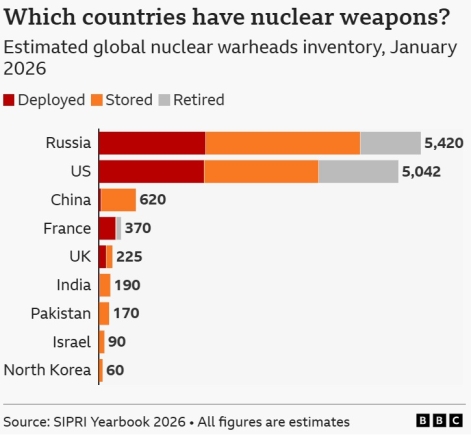
If an enrichment provision is included, it would distinguish this agreement from another one struck by the US with the United Arab Emirates in 2009, under which the UAE does not produce its own fuel and accepts a host of other restrictions.
For that reason, the agreement is also expected to attract concern from nuclear non-proliferation campaigners, whose ultimate aim is to prevent an increase in the number of nuclear weapons worldwide.
But energy sector expert Bob McNally, a former member of US President George W Bush's National Security Council, suggested the US was not creating a "great" security risk.
"I think we have a good record of working with countries to responsibly develop their nuclear sectors," he told the BBC.
Saudi Arabia has been lobbying for such a deal for years, but Washington had held out on the proviso that it recognises Israel, a key US ally, and normalises diplomatic and economic relations with it.
But that demand appears to have now been dropped, according to US media reports.
Trump has worked to cultivate a closer relationship with Saudi Arabia during his time in the White House.
Along with the strategic and commercial gains likely to come with this deal, one possible reason for this agreement happening now is that Russia and China have reportedly been in discussions to strike a similar deal and the US might not have wanted to miss out.
The deal marks a major victory for Saudi Arabia, and it has the potential to reshape power dynamics in the Middle East - though not in the immediate future.
