

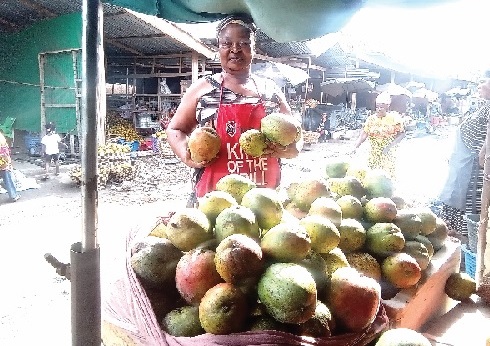
Mango traders at the CMB Market, Kwahu Station, in Accra, have appealed to the government to support mango farmers with resources to properly manage and spray their farms.
They said poor farm management is contributing to the rapid deterioration of mangoes reaching the market.
The traders are also calling for agricultural officers to be deployed to markets to educate them on the safe and proper use of approved substances for ripening fruits.
One of the traders, Madam Cynthia Afornyeku, popularly known as Daavi, said mango trees needed regular spraying to ensure that the fruits remained healthy and lasted longer after harvesting.
“The mango plant needs frequent spraying of chemicals. If not, when we go for the fruits, they spoil easily. Now farmers don't spray as much as they should and because of that, many of the mangoes go bad,” she said.
She said some farmers had told traders that they lacked the money to spray their farms, resulting in losses for both farmers and traders.
“Right now, our main problem is that our mango farmers need help because it is costing our business,” she said.
Madam Afornyeku said traders often received consignments without knowing whether the farms had been adequately treated, only to discover after a few days that large quantities of the fruits were deteriorating.
“When you set your wares, you are psychologically getting a headache, especially when goods come in, because you do not know the amount that will go bad the next day,” she said.
She said the business had also become more expensive because traders now relied on agents to source mangoes directly from farms.
“In the past, we traders would travel to the farms and, while you were there, other farmers would come to you asking you to buy their mangoes. But now, when you go, you won't even find the farmers,” she said.
According to her, traders now engage agents who harvest and package mangoes and arrange their transportation to Accra at a fee.
She said traders could pay about GH¢2,000 to an agent for harvesting and arranging a consignment, while transportation from Somanya in the Eastern Region to Accra could cost between GH¢1,000 and GH¢1,200.
She put transportation costs from Kintampo in the Bono East Region to Accra at about GH¢8,000 and from Techiman in the Bono East Region at about GH¢7,000.
The additional costs, she said, meant traders stood to lose heavily when fruits deteriorated before they could be sold.
Chemical ripening
The traders' concerns come amid growing public discussion about the alleged use of chemicals to artificially ripen fruits.
Madam Afornyeku said she had only seen videos of chemical ripening on social media, where fruits appeared to be dipped into a water-based solution.
She said traders needed practical education from agricultural officers on which products were approved and how they should be used safely.
“If there is any effect, then they should teach us how to use it the right way. Other foreign countries use it, so the way they use it, they must teach us so we will know that first we were making a mistake and now we use it right,” she said.
Another fruit trader, Nana Ampomah, said authorities should engage traders directly rather than make sweeping accusations against them.
“They should come to the market and teach us. They shouldn't sit on radio and insult us. Not all of us use these chemicals,” he said.
Natural methods
Daavi, who is the first mango trader at the CMB Kwahu Station for more than a decade, said there were traditional methods of ripening some fruits without chemicals.
She said mangoes could be treated with salt water and left for about five to six days to soften, although the process was slower than artificial methods.
For pears and avocados, she said traders could sprinkle clean water on fruits stored in baskets or leave them exposed to rainwater, after which some would ripen within a few days.
She said such practices were sometimes wrongly interpreted by consumers as the application of chemicals.
“The thing about many people who come to the market is that as soon as they see you sprinkling water on the pear, they assume you are using some chemical, and soon they are on social media saying all kinds of things,” she said.
She said she had recently seen social media discussions, particularly on TikTok, accusing fruit traders of using chemicals to ripen fruits such as watermelon, pineapple and oranges.
Changing mango trade
The traders said mango supplies to the Accra market varied according to the season.
Mangoes from Kintampo generally dominated the market from May to September, while mangoes from Somanya supplied the market from September to December, sometimes overlapping with supplies from Togo.
They said mangoes from Togo were usually available between March and April.
Another mango seller, Madam Kafui Agbeti, said growing public awareness of the health benefits of eating fruits had increased demand for the produce.
“These days, many doctors, including health professionals, propagate the benefits of fruit consumption, and so the business is going up unlike years ago,” she said.
The traders said support for farmers and practical training for traders would help reduce post-harvest losses, improve the quality of fruits on the market and protect their livelihoods.
Writer’s email address:
