

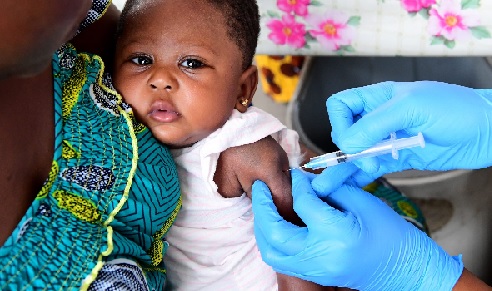
Twenty-week-old Grayson easily could have become one of the tens of thousands of British babies left unvaccinated against polio.
His mother, Lily, agrees with the principle of immunisation. But overwhelmed by the early weeks of motherhood, and suffering from post-partum depression after a traumatic birth, she was daunted by the prospect of a long journey to a doctor's surgery.
"I've been through the trenches, awake all night. You don't want to leave the house, or go to a different town."
Weeks ticked by, and eventually Grayson missed the polio and diphtheria jabs he was supposed to get at eight weeks old. By that point he was officially classed by the NHS as "overdue" for vaccination; effectively, he was on his GP's naughty list.
Then Lily realised there was a clinic practically on her doorstep - at a location she hadn't expected.
That clinic - in Keighley, west Yorkshire - runs from a vacant retail unit at the Airedale shopping centre, a 1960s-era precinct that locals say has fallen on hard times in recent years, with plenty of empty, boarded-up units.
The staff who created the clinic thought: why not use one of those vacant units to administer vaccines?
"This was an empty shop; there was nothing here, the windows were all blacked out," Flora Jennings, a local charity coordinator, tells me over the sound of a baby's laughter, on the morning I visit the clinic.
It's an imaginative solution to a national problem. Over the last 15 years, childhood vaccination rates have fallen across Britain.
The share of five-year-olds in England who have received a four-in-one jab (which protects against viruses like polio and tetanus) is now 81 per cent, down from 89 per cent in 2014.
About 84 per cent have received both of their recommended MMR (measles, mumps and rubella) jabs, down from 88 per cent a decade ago.
"If you just look at the generalised population, the decline doesn't look horrific," says Prof Dan Hungerford, an epidemiologist at the University of Liverpool who gave evidence to Parliament on this topic. "But if you compare us to other nations, particularly our European neighbours, we are one of the worst-performing countries in terms of getting early-life vaccinations to children."
Politicians are now asking how Britain - the country of Edward Jenner, the "father of immunology" - could have allowed its immunisation rates to drop so low, and what could fix it.
One Labour MP on the Health Committee has gone further, telling the BBC that it's time to consider a policy that's commonplace in some countries, but still something of a taboo in Britain: mandatory childhood immunisations.
