

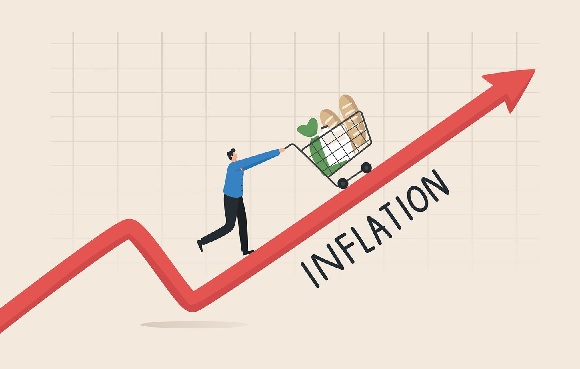
Why central banks care about inflation
The Easter festive season ended last weekend, and for me, it was one of the best celebrations I have observed over the past decade.
This is because I had the opportunity to observe Good Friday, which was marked on April 3, 2026, in Accra, and had to leave on Saturday, April 4, for the Kwahu Business Forum, a national platform that brings together captains of industry, bankers, insurers, investors and everyone interested in business and related matters.
Particularly, I was excited to meet friends I hadn't met in years at Kwahu, taking part in the planned social activities to mark the Easter season while keeping an eye on business opportunities.
This was the typical mix of business and pleasure!
But in all of this, there was one particular situation that made the most impression on me. And this was about a discussion that took place at the sidelines of one of the business roundtable discussions.
On the sidelines of this important event, a group of "friends" had engaged in a discussion on what the difference between a central bank and a commercial bank was. Yes, that was their interest. And I heard some interesting suggestions too.
And why was I interested in their conversation? For many reasons, but primarily because almost 10 years ago, in this column, I tried to explain some key tasks that central banks undertake, drawing a clear distinction between the public good function of the central bank and the commercial interests of central banks.
This was the September 23, 2016, edition, and under the headline, "Beat inflation, spur growth". I explained why price stability was a catalyst for growth.
Who is responsible for maintaining prices low and stable? The central bank!
I thought my job was done on the distinction between a central bank and a commercial bank, but taking that trip up the mountain reminded me of the need to keep reemphasising the message. So I am back at it again!
But inflation shouldn’t be new to you if you have followed this column for a while.
Time and again, I have had to look at issues surrounding inflation because it affects almost everything, as far as economics is concerned. But do you really believe that? Well, you should because it’s the truth!
And the basis is as follows: As a measure of time-based price movements, inflation plays a major part in both household and business planning.
If you can estimate or anticipate an expected level of price movement over a period, you will be able to plan or allocate your resources in an effective manner so as to derive the most benefits. Of course, all things being equal.
Yes, the average man, that is the “economic actor”, should have a better understanding of the economic environment when inflation is held in check, meaning, low and stable. This way, planning is less stressful as deviations wouldn’t be too drastic.
What then is the case when the opposite happens, that is, when inflation is considerably out of control?
Obviously, it would be difficult to plan effectively when you cannot estimate with some degree of certainty the direction of the general price level.
So, practically, if you planned to spend 100 cedis on an item and there is a 10 per cent increase in price at the time of purchase, it means that you have to pay more than what you planned to spend if you still want that particular item.
That will throw your budget out of gear and cause a readjustment in order to realign all your expenditures. In a very tight economic environment, a little price increase can cause serious problems for the low-income family.
Let me also point out here that a price increase or decrease does not affect only the individual, as it does affect business and government.
Whereas the example above will suffice for businesses and households, the example of the impact of inflation on the government can be far more complex.
Using the example above, assuming that the individual involved in experiencing this sort of situation lives in country A and that he is a civil servant or even a private sector employee.
When workers realise the debilitating effect of inflation on their household income- real income- they would ask for more money from the government of country A or the employer to compensate for the loss in value.
The government, most likely, would respond by increasing wages and salaries to compensate for the elevated cost of living.
Now, if the government of country A is running a deficit national budget (where it literally does not have enough revenue to cover all expenditure and cannot increase taxes further), it means that it has to find other ways of raising money to finance the deficit.
In the absence of donor funds and other patient cash from development partners, country A may have to resort to borrowing.
Borrowing for consumption will only increase the national debt stock of country A, and since the money borrowed was not channelled into productive ventures that could generate enough cash for repayment, it means that country A, if that should continue, could build its national debt to unsustainable levels.
Ah, I hope you have followed the drift thus far! This is the primary effect of inflation on individuals, households and governments.
For this reason, governments all over the world always plan to ensure that the general price level is stable to reap the suite of benefits price stability brings.
Most central banks play that role on behalf of the government. As independent institutions, central banks and monetary authorities are charged with the mandate of maintaining price stability with an eye also on promoting economic growth.
As you can see, inflation "steals" from you, and by robbing you of cash, it prevents you from meeting your financial obligations and reducing your standard of living.
So, when central banks and monetary authorities commit to spending more money to bring inflation down to a low and stable level, it is because they want to improve livelihoods by protecting incomes and savings.
That is why central banks care for you!
