
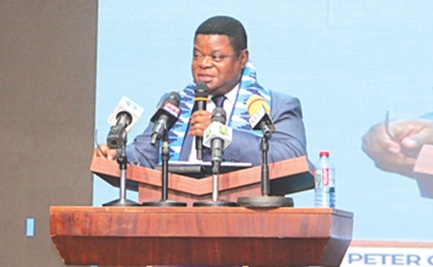
A former Director of the Institute of Statistical, Social and Economic Research (ISSER), Prof. Peter Quartey, has proposed a Public-Private-Partnership (PPP) model in educational financing to leverage private capital, expertise and innovation to expand access and improve outcomes.
He said Ghana could no longer rely primarily on traditional donor funding and must, therefore, explore innovative, outcomes-oriented financing mechanisms that maximise impact and create sustainable partnerships among government agencies, international organisations and private foundations to address persistent education financing challenges.
Prof. Quartey made the proposal at a public lecture organised by the Wesley Grammar School, in collaboration with its alumni association (WESGOSA), to commemorate its 70th anniversary celebration.
The two-week celebration, centred around the theme, "Reminiscing 70 years of holistic Methodist education: The role of stakeholders in embracing the new technology for the future," is set to culminate on Saturday with a durbar in Accra.
Financing secondary education
Prof. Quartey, an alumnus of the school and one of two speakers at the lecture in Accra last Wednesday, focused on "Financing secondary education in Ghana: A public-private partnership."
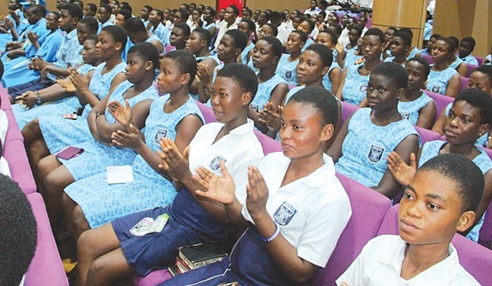
The students
He said Ghana fell below the global education spending benchmark of between 4.0 and 6.0 per cent of GDP or between 15-20 per cent of the total national budget.
According to the former director of ISSER, Ghana's educational funding, which depended on volatile sources such as petroleum revenues and the general budget, was unsustainable.
Under his PPP proposal, he suggested that the government should develop long-term contracts in which a private partner would design, build, finance, and maintain the school's facilities, while the government paid overtime and retained control of pedagogy.
Better still, he suggested that the government could enter into a Build, Operate and Transfer (BOT) arrangement with a private developer, under which the private developer would build the facility, operate it for an agreed number of years and transfer it to the state permanently.
Era of AI
For her part, the immediate past Pro Vice-Chancellor, University of Cape Coast, Prof. Rosemond Boohene, also an alumnus, addressed the audience, mainly students, members of the alumni association and top brass of the Methodist church on the topic: "Educated to innovate: Artificial intelligence, entrepreneurship and the future of work."
She encouraged the students to move from merely knowing or gaining knowledge to actively doing or practising.
"We are entering the era of the bazaar.
And the question that will define our success or failure is whether our educational system is still designed to build cathedrals in a world that now operates like a bazaar," she said.
Prof. Boohene said AI amplified intellectual strength and handled the heavy lifting of data processing, pattern recognition and routine generation, freeing the minds for higher-order thinking.
Answering the vexed question of whether AI would replace or help humans in the future, she told the students to be encouraged, as it would rather enhance the future of work.
For instance, she said doctors would no longer rely solely on memory for diagnoses but would instead consult AI differential diagnosis tools, then use their bedside manner to communicate with the patient and make a final, holistic decision.
The former Pro VC said the new digital era would no longer be between those who had access to the internet and those who did not, but between those who could command and orchestrate AI and those who were commanded by it.
