
Commemoration of World Engineering Day: GhIE embarks on awareness float to promote smart engineering for sustainable future
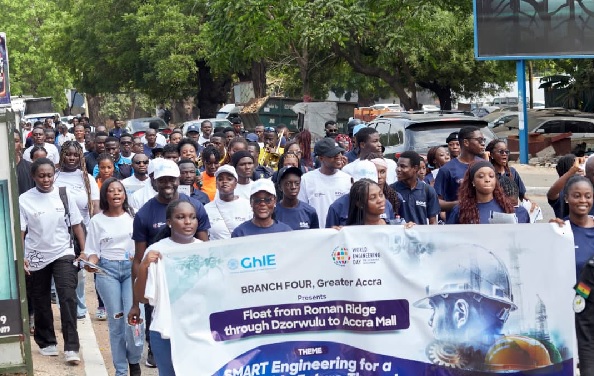
The Ghana Institution of Engineering (GhIE) has marked the 2026 World Engineering Day for Sustainable Development with a public awareness float aimed at highlighting the importance of engineering in the country’s development.
The commemorative float also forms part of activities by the GHIE to raise public awareness about the importance of engineering and inspire national commitment and promoting the role of innovation and digitalisation in building a sustainable future.
The public sensitisation walk, which brought together engineering practitioners and students from various educational institutions in Accra, started from Roman Ridge and passed through Kawukudi, the 37 Military Hospital, and Opeibea before ending at the Accra Mall at the Tetteh Quarshie Interchange.
Participants included engineering students from the University of Ghana, Regent University, Ghana Communication Technology University, Regional Maritime University, and Accra Telecom University.
Notable among the attendees were the Chairperson of the Ghana Institution of Engineering for the Greater Accra Region, Ing. Frank Kofi Pinto and the President of Women in Engineering (WinE) Ghana, Ing. Jane Naki Tetteh-Anowie.
Adopting modern technologies
In a message to commemorate the day, the President of GhIE, Ing. Ludwig Annang Hesse, noted that this year’s theme, “Smart Engineering for a Sustainable Future through Innovation and Digitalization,” underscores the urgent need for engineers to adopt modern technologies and forward-looking solutions to address national challenges.
In the statemnet which was read on his behalf by Ing. Frank Kofi Pinto, he explained that Ghana faces pressing issues including rapid urbanisation, climate change, infrastructure deficits, energy transition, water and sanitation challenges, food security concerns, and the growing influence of artificial intelligence.
According to him, these challenges require innovative engineering approaches that combine technology, sustainability, and strategic planning.
"Engineering is more than structures and systems; it is stewardship. It is about building resilient infrastructure, deploying clean energy technologies, strengthening transport and water systems, improving waste management, and expanding digital connectivity while protecting the needs of future generations. Sustainable development must remain the foundation of our professional practice."

Ing. Hesse emphasized that engineering plays a vital role in nation-building through the development of resilient infrastructure, clean energy systems, improved transportation networks, effective waste management, and expanded digital connectivity. He urged engineers to embrace tools of the Fourth Industrial Revolution such as artificial intelligence, data analytics, automation, renewable energy technologies, and smart systems.
The GhIE President also called on engineers to prioritize continuous professional development, research collaboration, and mentorship of young professionals while maintaining high standards of ethics, safety, and accountability in their work.
National asset
He further appealed to government and industry leaders to treat engineering as a strategic national asset by investing in STEM education, research infrastructure, local manufacturing, and digital ecosystems to strengthen Ghana’s economic growth and technological independence.
"As we mark World Engineering Day 2026, let us recommit ourselves to building a Ghana where infrastructure is intelligent, industry is innovative, communities are sustainable, and technology serves humanity," he said.
Encouraging young Ghanaians pursuing engineering careers, Ing. Hesse said their creativity and innovation would shape the country’s future in areas such as smart cities, green industries, digital healthcare, agritech, and climate adaptation.
"To young Ghanaians aspiring to become engineers: you are pursuing a noble profession. Your creativity and courage will shape Ghana's future whether in smart cities, green industries, digital healthcare, agritech, or climate adaptation. Stay committed to excellence," he added.
Promoting professional standards
For his part, Ing. Frank Kofi Pinto, explained that the walk was also meant to address concerns about unqualified individuals undertaking engineering-related work, which often damages the reputation of the profession when projects fail or fall below standards.
He mentioned that many landmark infrastructure projects in Ghana, such as major interchanges and motorway developments, are the result of the expertise and dedication of certified professional engineers. These examples, he said, demonstrate the significant contributions engineers make to the country’s development.
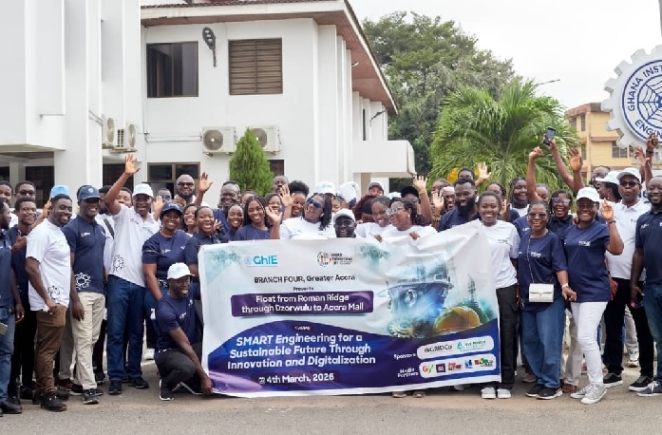
He said the event also emphasized the importance of nurturing future engineers through student chapters in universities.
He said by engaging students early and instilling strong ethical values and professional discipline, the institution hopes to ensure that upcoming engineers uphold high standards when they enter the profession.
Encouraging more women
President of Women in Engineering (WinE) Ghana, Ing. Jane Naki Tetteh-Anowie, called for more girls to pursue careers in science, technology, engineering, and mathematics (STEM), highlighting gradual progress in female representation within the engineering profession.
She noted that engineering has historically been a male-dominated field, but consistent advocacy and mentorship initiatives are gradually increasing the number of women entering the profession.
According to her, female membership within the Ghana Institution of Engineering has grown from about 8 percent to nearly 10 percent in recent years.
She explained that WinE Ghana actively mentors young students—from primary school through university—who are interested in STEM, guiding them toward engineering careers and helping them develop confidence in mathematics and science.
Ing. Tetteh-Anowie emphasized that engineering is achievable for any girl who is determined and encouraged young women to pursue science and mathematics without fear, stressing that the profession offers opportunities to contribute significantly to national development and innovation.
"We are happy that we are celebrating our achievements because over the period engineering has been a male-dominated field but then over time there have been progress increasing numbers and if we want to use this opportunity also to advocate that more women should come into the field."
"So there's some progress from the advocacies that we've been doing and working with the university students, working with the secondary school students and even the primary students. Yes, what I want to put across is that if every girl wants to put her mind to do engineering, it is possible. We are here to show that it is possible," she said.
She also added that women engineers are committed to showcasing their capabilities and playing a stronger role in shaping the future of engineering and development in the country.
