

The Driver and Vehicle Licensing Authority (DVLA) has suspended the planned rollout of new vehicle number plates from January 2, 2026.
The Chief Executive Officer of the DVLA, Julius Neequaye Kotey announced this at a press conference in Accra on Wednesday [Dec 24, 2025].
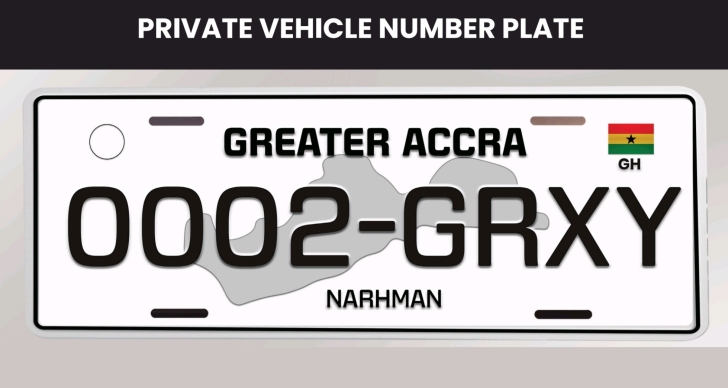
The move follows the pending approval of the new process by Parliament.
A proposed amendment to the Road Traffic Regulation, 2012 (L.I. 2180), which specifies the contents and format of vehicle number plates in Ghana, is still before Parliament and has not yet been approved.
In a press statement dated December 24, 2025, the DVLA explained that while Parliament amended the Road Traffic Act, 2004 (Act 683), the specific provisions in L.I. 2180 were not passed before Parliament went on recess on Friday, December 19, 2025.
“Until the legislative requirements are fully settled, we are unable to proceed with the rollout of the new RFID-embedded licence plates,” the DVLA said.
The DVLA in August 2025 announced a plan to abolish displaying the year of registration on vehicle number plates from January 2, 2026.
Ghanaian vehicle number plates have been using the current system since January 2009, which features a two-letter region code, followed by a four-digit numeric code, and a two-digit year code.
The new system, according to the Chief Executive of the DVLA, Julius Neequaye Kotey, was instead going to identify vehicles by the region in which they were registered, for example, "Greater Accra" written on top of the plate, followed by the vehicle's unique four-digit number and a code showing the zone within which the vehicle was registered.
For example, a vehicle registered within the Adenta zone in Greater Accra will have "AD" code at the end of the four-digit unique number, replacing where the year of registration, for example, "25" would have been displayed.
The new plates were also going to be designed to incorporate Radio Frequency Identification (RFID), to help promote traceability and also help with electronic toll system.
What happens to DP and DV plates from Jan 2, 2026?
The DVLA announced that vehicles currently using DP stickers and DV plates can continue to do so in 2026 until further notice.
“Owners of vehicles with DP stickers [Drive from Port] and DV plates [Defective Plate] may continue using them until a time limit is communicated by the Authority,” the statement added.
Related article: Vehicle Embossment Association files injunction at high court to restrain DVLA over planned rollout of new vehicle number plates
In the meantime, the Vehicle Embossment Association of Ghana (VEMAG) has filed an injunction at the High Court in Accra, asking that the DVLA be restrained from rolling out a digital or any new vehicle number plate registration system beginning January 2026.
The suit was filed by BEMENCO Embossment Ltd and 26 other plaintiffs, all members of the Vehicle Embossment Association of Ghana (VEMAG).
The injunction application was filed at the High Court on Monday (December 22, 2025), asking that the DVLA should be restrained from introducing digitalised vehicle number plates or any new registration plates until the court determines the merits of the case.
They are also asking that the DVLA should be prevented from implementing any alternative arrangement for the embossment and supply of vehicle number plates outside the existing framework involving the plaintiffs.
The plaintiffs are arguing that DVLA had awarded both manufacturing and embossment contracts to a single entity, an act which they termed as unprecedented and contrary to established practice.
VEMAG also arguing that DVLA had not been transparent in its approach in rolling out the new digital number plates. It is their argument that the current DVLA management has been unwilling to continue consultations, despite assurances previously given to embossers to prepare for the digital transition.
They also allege that the DVLA did not advertise for tenders nor obtain approval from the Public Procurement Authority to sole-source the contract, thereby violating the Public Procurement Act, 2003 (Act 663).
They described the decision as illegal, discriminatory and an abuse of administrative authority, particularly in overlooking dozens of Ghanaian-owned companies that have invested heavily in the sector.
Below is a full copy of the DVLA statement
UPDATE ON ANTICIPATED NEW LICENCE PLATE ROLLOUT PLAN
Background
Sometime this year, w e announced the introduction of new licence plate. We were motivated by the need to conform with modern technology for which reason w e wanted t o introduce Radio Frequency Identification (RFID) embedded plates to allow for traceability in order to promote road safety.
We were clear in our minds that two legal documents would have to be amended to make room for the successful roll out of the new licence plate. These are the Road Traffic Act, 2004 (Act 683) as well a s the Road Traffic Regulation, 2012 (L. I. 2180). Specificaliy, the L.I. 2180 provides the
specific on what must be contained on the licence plate.
Current situation
Parliament was able to carry through the amendment in the Road Traffic Act. However, the specific provisions requiring amendment in L.I. 2180 have not been successful before Parliament
went on recess on Friday December 19, 2025.
As a result, due to the fact that the L.I. 2180 amendments have not gone through, the Driver and Vehicle Licensing Authority (DVLA) announces to the general public the suspension of the impending rollout o f the new licence plate siated for January 2, 2026.
What happens from January 2 , 2026DVLA announces the extended use o f the current Departure from Port (DP) stickers as well a s DV Plates.
This means that anyone who has the D P sticker on their vehicle a s well a s a DV plate on their vehicle, could continue to use them u p to a time limit to b e announced by the Authority i n due course.
The Authority wishes to further inform the public that the new licence plate roll out plan will take effect as scon a s the legislative requirements are settled with.
We thank the general public for the constant support and ask for cooperation i n this regard.For further enquiry contact Customer Service Centre o n 0302746760.
Issued by Management
Writer's email:
Follow @enochfrimpong Follow @Graphicgh
