
In January 2026, Ghana’s inflation rate fell to 3.8 percent (See Table 1 below). Many people would naturally see this as good news.
Prices are no longer rising fast. Food, transport and basic goods feel more stable.
After years of high inflation, this seems like a relief.
But in economics, very low inflation can sometimes be a warning sign rather than a success story.
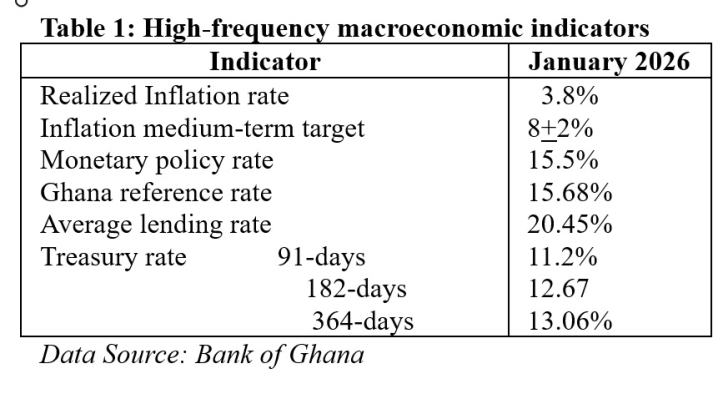
The Bank of Ghana’s medium-term inflation target is 8 percent, with an acceptable range between 6 and 10 percent in Table 1.
Therefore, monetary policy should ensure that inflation rates operate within this range.
When inflation falls below this range, it often means the economy is slowing down too much.
People are buying less. Businesses are selling less. Money is not moving as it should. This is exactly what the current numbers suggest.
Even though prices are low, interest rates remain very high. The Bank of Ghana’s policy rate is 15.5 percent, and banks lend to ordinary people and businesses at around 20.45 percent in January 2026.
This means loans are expensive with real returns of 16.65%. For the ordinary Ghanaian, this situation affects daily life in quiet but serious ways. Businesses do not expand, so jobs are not created.
Young people struggle to find work. Traders sell less because customers have limited money to spend. Even though prices are stable, incomes do not grow fast enough. Life may feel calm at the market, but opportunities are shrinking behind the scenes.
This is the direction the Ghanaian economy is taking. It is not growing strong. It is cooling down. Low inflation in this case is not coming from higher productivity or better local production. It is coming from weak demand. People simply cannot afford to spend as much as before.
This has important meaning for monetary policy, which is how the Bank of Ghana manages interest rates. When inflation is very high, interest rates are raised to slow spending.
But when inflation is too low, keeping interest rates high can do more harm than good. With inflation at 3.8 percent, current monetary policy rate of 15.5 percent is too restrictive. Money is too expensive.
The best antidote is to gradually reduce both policy rate and lending rates. This would make loans cheaper, encourage businesses to invest, and help create jobs.
It would also support spending and move inflation back toward the healthy target range. Keeping interest rates high for too long risks slowing the economy further and delaying economic recovery.
Government policy is also affected. Lower inflation can reduce the cost of government borrowing, which is helpful.
However, when the economy is weak, government revenue grows slowly. Taxes from businesses and workers do not increase much.
This limits what the government can do.
The solution is not reckless spending, but careful spending on things that create growth—such as roads, agriculture, industry and exports. These areas help people earn more and strengthen the economy over time.
Trade with other countries is also influenced. Low inflation can make Ghanaian goods cheaper and more competitive abroad. That can help exports.
But at the same time, imports may fall simply because people are buying less, not because local production is strong. This is not a healthy sign. It shows weak purchasing power in the country.
The main lesson from Ghana’s January 2026 figures is clear. Low inflation alone is not enough. The economy also needs affordable credit, growing businesses and rising incomes.
Stability should help people prosper, not hold them back. That is why low inflation, in this case, is not the end of the story. It is a signal that the economy needs help to move forward again.
The writer is an economist and a lecturer at Ghana Telecom University
