
Forest communities received only GH¢4.8m out of GH¢6.8bn in SRA payments over six years
Forest communities across Ghana received only GH¢4.8 million out of GH¢6.8 billion in Social Responsibility Agreement (SRA) payments due them between 2020 and 2025, with no explanation yet provided for the huge gap recorded on the country’s timber tracking portal, the Head of Programmes at Civic Response, Mr Albert Katako, has said.
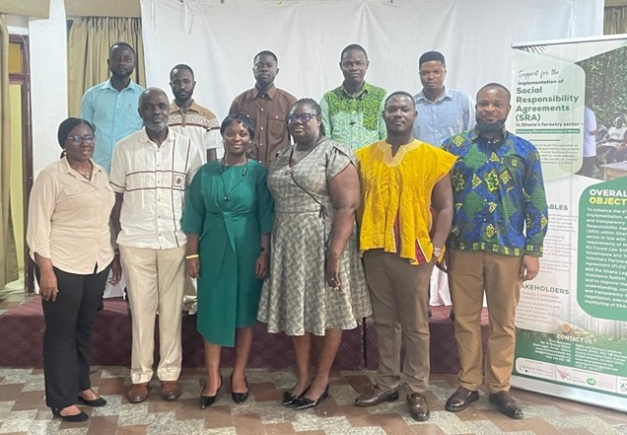
Mr Katako said this at an inception workshop held in Accra on Thursday, May 22, 2026, for a project titled “Support for the Implementation of Social Responsibility Agreements in Ghana’s Forestry Sector”.
The programme was organised by Civic Response in partnership with the Forestry Commission and the Rights and Advocacy Initiatives Network (RAIN).
He explained that the figures were taken directly from the SRA portal, which tracks amounts due to communities against what has actually been paid.
“The value of SRAs due to communities, looking at the total value, is 6.8 billion Ghana cedis. The value actually received by communities came to 4.8 million Ghana cedis. So there is a difference, but the portal does not show why this variation, why the difference is coming up,” Mr Katako said.
Mr Katako said the SRA remained the only direct benefit communities received from timber resources for local development projects.
“The SRA is the only benefit that goes to communities from timber value for the development of community social infrastructure,” he said.
Responding to questions from participants on the cause of the gap, Mr Katako said there was still no definite explanation, although some factors could account for the differences.
“It could be due to several reasons. Like we said, this is calculated when the yield is given to the timber company. Sometimes the timber company may not go and fell all the yield that was given to them. In that case, they do not pay all the balance of what should be paid. So these are some of the things that will result in the differences, but we do not have concrete explanations. So that is why we are doing this,” he said.
The workshop heard that timber companies currently do not have direct access to the portal to explain payment shortfalls. Forestry Commission district managers, who input the data, also do not have a section on the portal to record reasons for discrepancies.
Participants were told that the project would partly address that challenge through training and system improvements.
The workshop also heard that the SRA remained the only direct financial benefit available to forest fringe communities from timber harvesting, as royalties from forest resources are shared among landowners and traditional authorities.
Mr Katako said landowners received 25 per cent of royalties while traditional authorities received 20 per cent.
“For traditional authorities or landowners to be diverting or having control over SRA funds means that we are leaving the communities with nothing,” he said.
Mr Katako said the SRA also gave communities a role in forest governance and local decision making.
“SRAs give communities a voice in forest management processes, and they encourage participatory governance, where chiefs, youth groups, women, and local leaders are involved in negotiations and management,” he said.
Concerns were also raised about weak accountability among some SRA committees responsible for managing community funds.
“SRA committees receive the funding on behalf of the communities and implement their projects, but we noticed that there is very weak transparency and accountability to the various communities on what the funds are used for,” a project presenter said.
A representative of the Forestry Commission, Mr Bright Owusu Sekyere, told participants that a new enforcement measure had been activated within the Ghana Wood Tracking System, making SRA registration compulsory before timber entry permits could be issued.
“Without the SRA, the Ghana Legality Assurance System is not complete,” Mr Owusu Sekyere said.
He said the measure was already helping to improve compliance and monitoring.
“Because we are able to monitor what is going on, we believe that the communities are also receiving their benefits,” he said.
Mr Owusu Sekyere added that improved trust between communities and timber companies could help protect forest reserves.
“If you trust your company that they are doing their work and you also have your benefit that you are supposed to receive, you will help us to protect the forest better,” he said.
A representative of DevNet Systems, the technology company behind the Ghana Wood Tracking System, said the enforcement measure was already active across both natural forests and plantation areas.
“If you do not have an SRA at all, there is no way a company is receiving an entry permit,” the representative said.
“Once you are not compliant, automatically operations are seized within the system. You cannot get any documents being printed out for you, whether it is TIF, LOC, or anything,” the representative added.
The Forestry Commission said there were currently 477 active SRAs covering 560 out of about 1,000 timber allocations nationwide.
The one year project is funded by the European Union under the Forest Law Enforcement, Governance and Trade Voluntary Partnership Agreement programme with a budget of about 200,000 euros. It runs from April 2026 to March 2027.
Under the project, 280 frontline Forestry Commission staff and 20 timber company representatives will be trained on the legal and operational requirements of SRA implementation. Another 990 members drawn from 142 SRA committees will also receive training in transparency and accountability in the use of community funds.
Speaking on behalf of the Executive Director of RAIN, Mrs Doreen Asumang Yeboah, Frances said the project presented an opportunity to improve relations among stakeholders in the forestry sector.
“From 2012 when the Resource Management Support Centre of the Forestry Commission developed the first guidelines for SRA negotiation through 2017 when it was revived, there has been improvement in SRA implementation in Ghana,” she said.
“We are hopeful that this project will not just address the challenges to improve compliance, but strengthen relationships amongst stakeholders,” Frances added.
Participants at the workshop were also told that the SRA transparency portal under the Ghana Wood Tracking System could be accessed publicly without login details, although many community members across the country remained unaware of its existence and the information available on payments made to their communities.
