
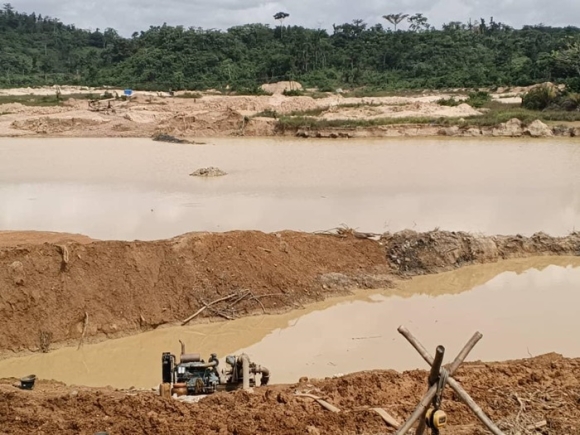
Galamsey:- hydra-headed monster
The insidious scourge of illegal mining, known locally as "galamsey," continues to tighten its grip on the country, presenting an escalating crisis that threatens environmental integrity, public health, and socio-economic stability.
Despite numerous government interventions to stem the tides, the environmental crime persists, leaving a trail of suffocating forest reserves, polluted water bodies, degraded farmlands, and fractured communities.
After almost 10 month’s monitoring and field visits to mining communities, the Daily Graphic observed that the current state of the menace is one of widespread environmental devastation, with major rivers such as the Pra, Ankobra, Bia, Birim, and Tano bearing the brunt of mercury and cyanide contamination, rendering them unsafe for human consumption and agricultural use.
A visit to Adankrano, near Kade in the Eastern Region, it was observed that illegal miners had wiped off swathes of arable land in the area, reducing it to a plethora of gaping pits that swelled with stagnant milky-brown water. Some of the pits were so close to the homes of the residents and yawning for lives to devour. The Chief of Adankrono, Nana Osabarima Sarpong Kumankuma II, said the escalating levels of illegal mining had brought hardships to the community.
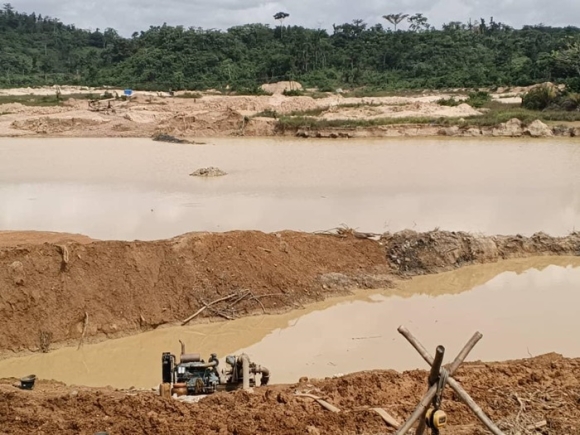
“Cocoa farms and oil palm plantations which serve as heritage from our forefathers and provide a source of livelihood for many people in this area have been destroyed by illegal miners. The Birim River which served as the source of water for our forefathers and the past generations, has been heavily polluted such that we cannot do anything with it any longer,” he said.
The mining laws
The Minerals and Mining Act, 2006 (Act 703) prohibits mining operations within 500 meters of lakes, reservoirs, or dams, and within 100 meters of rivers, streams, or watercourses.
Specifically, Section 108 (2) of Act 703 states: "A holder of a mineral right shall not conduct reconnaissance, prospecting, or mining operations within one hundred meters of any river, stream, or watercourse, or within five hundred meters of any lake, reservoir, or dam, or within such other distance as the Minister may, by legislative instrument, prescribe."
The rationale for these restrictions is against the backdrop that mining operations, particularly those involving excavation, processing, and waste disposal, can lead to significant sedimentation of water bodies. This sedimentation can reduce water quality, harm aquatic life by smothering habitats, and decrease the capacity of water bodies.
Additionally, the provisions were made in recognition of the fact that chemical pollutants used in mining, such as cyanide in gold extraction or heavy metals, can leach into water sources if operations are too close, posing severe risks to human health and the environment.
Galamsey inundation
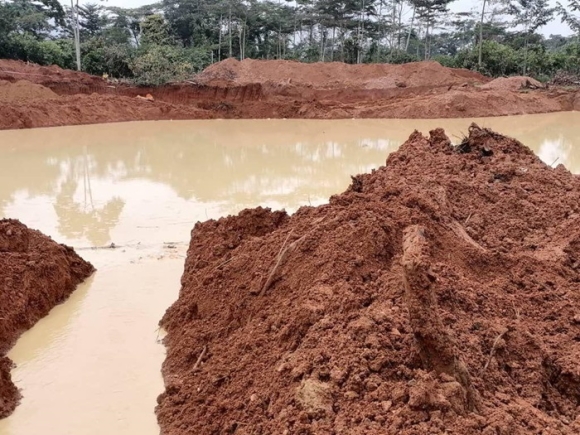
Contrary to the provisions Act 703, it was observed that illegal miners were actively mining in the belly of the Birim River, leaving it heavily polluted with Mercury, cyanide and other poisonous chemicals.
Apart from Adankrono in the Eastern Region, other mining communities in regions such as the Ashanti, Western, Western North, Central, and Bono and suffocating from the debilitating activities of illegal miners.
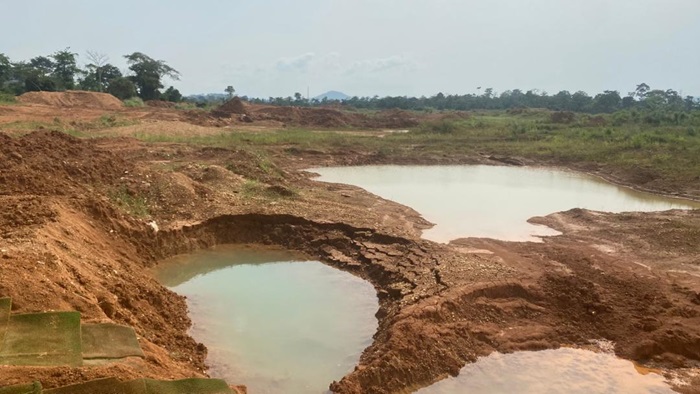
The illegal miners continue to invade forest reserves with their destructive activities with impunity, creating an imbalance in the ecosystem. As of December 15, this year, records at the Forestry Commission showed that 50 of the country’s 288 forest reserves had been impacted by galamsey at varying levels.
Health threats
A Forensic Histopathologist and former Head of Pathology at KNUST and Komfo Anokye Teaching Hospital (KATH), Prof Dr Paul Poku Sampene Ossei, revealed that at least 500 cases of spontaneous abortions among women in mining communities could be linked to high levels of heavy metals in the placenta caused by illegal mining (galamsey) activities.
Prof Sampene Ossei made the stunning revelation on JoyNews’ Newsfile on Saturday, September 27,2025, said the revelation came to light in an ongoing research involving over 4,000 placentas examined from different regions across the country.
“I have about 500 cases where women go to the hospital and abort their babies because of the concentration of these heavy metals in their placenta. The placentas are all contaminated, polluted with heavy metals” he disclosed.
He added that apart from pregnancy loss, the health impact of galamsey was dire as there were acute kidney diseases linked with water pollution from galamsey that were coming up.
“Children are also being diagnosed with chronic kidney disease. These are the realities we have to face,” he said. Again, he said birth deformities were increasingly being recorded in mining areas, though some doctors were hesitant to speak out publicly.
Economic impacts
In an interview with the Daily Graphic on September 2, this year, an economist at the University of Ghana Business School (UGBS), Prof. Godfred Bokpin, said the threats galamsey posed to water security in the country had huge economic implications.
The professor of Finance revealed that in 2023 alone, Ghana spent over $11 million importing water from Togo, Nigeria, Spain, UK, and other places.
“If you look at the data, in 2023 alone, Ghana spent over $11 million importing water from Togo, Nigeria, Spain, the UK, and other places. The pattern is clear where people are heading towards, and those who can afford will begin to gravitate towards water importation, and this is a threat to sustainable development” he said.
Prof. Bokpin stressed that the government’s quest to sustainably manage the country’s public debt would be meaningless if the environment continued to be destroyed through illegal mining.
“If a time comes when we have to make budgetary allocation to reclaim our waterbodies and lands that have been destroyed by galamsey, it will come down to imposing taxes on all citizens; and we are inching closer to crossing that red line,” he said.
Galamsey clampdown
Since the beginning of this year, the government has implemented a number of measures to deal with galamsey and restore sanity to the environment.
Key among these interventions are the tracking of excavators; setting up of the National Anti-Illegal Mining Operations Secretariat (NAIMOS), a special-purpose unit established to coordinate, monitor, and lead intelligence-led field operations against galamsey.
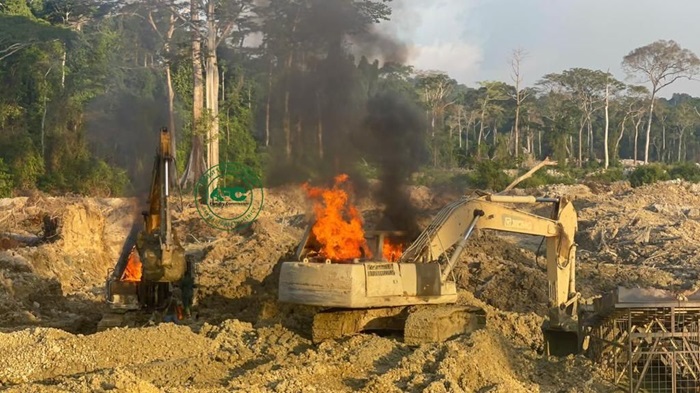
As of December 2, official statistics from NAIMOS showed that a total of 1,486 persons were arrested by security agencies in anti-galamsey operations this year. Within the period 443 excavators and 11 bulldozers used by illegal miners were confiscated.
The NAIMOS operations further led to the seizure of 86 pump action guns, 31 motorbikes, 14 vehicles, 1,200 pumping machines, and 36 Liquified Petroleum Gas (LPG) cylinders.
Way forward
The Executive Director of the Centre for Extractives and Development Africa (CEDA), an extractive sector policy advocacy entity, Samuel Bekoe, commended the government for setting up NAIMOS to spearhead the fight against galamsey.
“As CSOs in the extractive sector, at the end of the day, we want to see the forest rejuvenated; we want to see waterbodies cleaner; we want to see communities and farmlands safe from galamsey,” he stressed.
Mr Bekoe added that the mechanisms to fight illegal mining must be decentralised to the local level rather than limiting it to the operations of NAIMOS.
“Approaching the fight entirely from the national level has not yielded the desired results. The galamsey fight should be integrated into our governance key performance indicators. If you appoint someone as a metropolitan, municipal or district chief executive (MMDCE), part of their KPIs should be a reduction in galamsey in their district and an indication of how they have fought the menace,” he said.
