
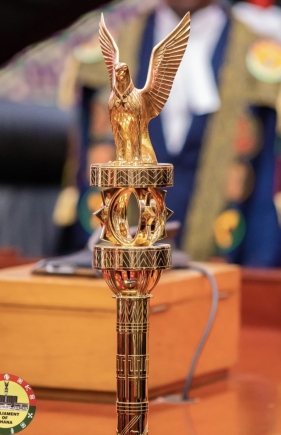
The Constitution Review Committee (CRC) has recommended that the size of Ghana’s Parliament be capped at its current level as part of sweeping reforms aimed at reducing the cost of governance and strengthening representative democracy.
The Committee explained that, the continuous expansion of Parliament over the years has placed a growing financial burden on the state without a corresponding improvement in legislative efficiency or representation.
“The Committee recommends that the size of Parliament should be capped at the current number to prevent further expansion and the associated fiscal strain on the public purse,” the report stated.
It explained that Ghana’s population growth and the creation of new constituencies had often been used to justify an increase in the number of Members of Parliament (MPs), but said that such expansions had significant implications for public expenditure, including salaries, allowances, infrastructure, and administrative costs.
The recommendation forms part of the CRC’s broader proposals under Parliament and Representative Democracy contained in its report titled “Transforming Ghana: From Electoral Democracy to Developmental Democracy,” which was presented to President John Dramani Mahama on Monday.
Reforms
In addition to capping the size of Parliament, the Committee proposed reforms to improve inclusion and accountability within the legislative arm of government.
Among these is a recommendation for Ghana to study and consider the introduction of a proportional representation system to complement the current constituency-based model.
“The Committee is of the view that proportional representation has the potential to improve inclusiveness, particularly for women, persons with disability, minorities, and smaller political groupings,” the report said.
The CRC further called for stronger internal independence of Parliament from excessive party control, stressing that lawmakers should be empowered to exercise oversight and legislative functions without undue partisan pressure.
“Parliament must be enabled to operate as an independent arm of government, capable of holding the Executive to account in the national interest,” the report said.
The Committee also recommended extending the term of Parliament from four to five years and aligning parliamentary elections with presidential polls. It argued that such alignment would reduce election-related costs and minimise disruptions to governance caused by frequent electoral cycles.
“Aligning parliamentary and presidential terms to five years will enhance policy continuity, reduce election fatigue, and promote more effective national planning," the report said.
Political participation
On political participation, the CRC proposed allowing dual citizens by birth to contest parliamentary elections, describing the current restrictions as discriminatory and inconsistent with Ghana’s democratic values.
“The exclusion of dual citizens by birth from parliamentary contests unjustifiably limits political participation and deprives the nation of valuable human capital,” the Committee observed.
The Committee argued that unchecked expansion of Parliament undermines efficiency and public confidence in the legislature.
"A continuously increasing Parliament, without corresponding improvements in productivity and accountability, imposes a significant financial burden on the state.”
The report also called for guaranteed public participation in the lawmaking process and the formalisation of private members’ bills to strengthen citizen engagement and legislative innovation.
The CRC’s recommendations are expected to undergo further consideration by government and other stakeholders, with some proposals requiring constitutional amendments and, potentially, a national referendum.
