
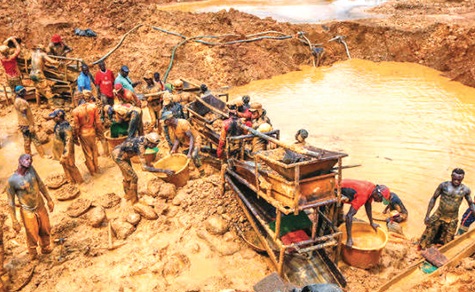
I have just read a book by a 19th-century British missionary, Reverend Dennis Kemp, entitled Nine Years in the Gold Coast, and published in London in 1898. Kemp notes traditional, small-scale, unregulated, indigenous gold washing and mining.
He comments on the environmental impact of what he refers to as the ‘primitive’ nature of the work compared to ‘modern’ European techniques.
The latter had begun a year earlier, in 1897, and informal artisanal mining continued alongside it.
Three-quarters of a century later, what we know today as galamsey was a growing problem when Jerry John Rawlings grabbed power via coup d’état.
According to Allotey Jacobs, former Central Regional Chairman of the National Democratic Congress, Rawlings ‘couldn’t do anything about [galamsey]’.
Nor, it seems, could subsequent administrations, including those of Kufuor, Atta Mills, Akufo-Addo and, during his first term, John Dramani Mahama.
Rawlings and galamsey
Although Rawlings introduced severe measures against corruption (such as the execution of former heads of state), he did not take effective measures to deal with illegal mining.
This may be a surprise given Jerry John Rawlings’ historical track record of seeking to enforce discipline, his pro-environment stance, and his ‘revolutionary’ approach to governance.
Why then did he not take a swift, decisive and uncompromising approach to deal with galamsey?
What might he have done? It is well known that Rawlings favoured swift, decisive actions over long-term bureaucratic solutions.
To attack galamsey, he might have deployed the Ghana Armed Forces to halt operations at illegal mining sites, seize equipment, and burn machinery.
He could also have taken direct action against foreign involvement.
Rawlings expressed strong views against foreign nationals (particularly Chinese) destroying Ghana's environment and water bodies, suggesting they should be deported while those Ghanaians aiding them should be severely punished. In addition, he could have sought to enforce strict discipline to restrict corruption within the security agencies that allows galamsey to thrive, apprehending both perpetrators and complicit officials.
Overall, his approach was to use intense, sometimes harsh measures to correct perceived moral wrongs in society, aiming to deter others through immediate, public accountability.
Galamsey and society
But he didn’t take these measures, and galamsey thrives today. Subsequent administrations issue new plans, programmes and measures to ‘deal with’ galamsey; none have proved successful.
Today, galamsey is destroying Ghana’s natural environment, severely undermining the quality of life of millions of Ghanaians living in galamsey areas.
The country’s decision-makers don’t live in galamsey-affected areas: Accra doesn’t have an illegal mining problem and drinking water there is safe to consume. Is it a case of ‘out of sight, out of mind’?
Or, ‘I don’t see the problem daily so I don’t think it needs dealing with’?
No, that is not the reason. Small-time galamseyers incur the public wrath of societal leaders – both secular and religious – and the government is pleased to announce when a group of miners are arrested and their equipment seized.
But what of the people who employ the galamseyers: the latter are typically young, otherwise unemployed, men with no other realistic source of income, given Ghana’s chronic problem of youth unemployment.
The bottom line: some among Ghana’s elites benefit mightily from galamsey, and it is not in their personal financial interest to stop it.
The price of gold on Monday, February 2, was $4,750 an ounce, down from $5,400 last week.
The price of gold remains high because of geopolitical uncertainty, strong central bank buying, and a weaker US dollar.
The price is likely to continue to be historically high, with some technical analyses suggesting it is poised for further gains.
Galamsey’s journey
Illegally mined gold from Ghana is primarily smuggled out of the country through clandestine networks and sold on international markets, with the United Arab Emirates (Dubai) and India being major destination countries.
China is also a possible destination.
Within Ghana, local buyers and traders purchase the gold (often for cash) at or near the illegal mining sites.
The traders collect the gold and smuggle it out of the country, often via Togo and Burkina Faso, avoiding official export channels, taxes, and royalties.
Once the gold reaches its international destination, it is often refined and mixed with legally sourced gold, which launders its illicit origins and makes it virtually impossible to trace to specific illegal mines in Ghana.
This ‘laundered’ gold then enters the global supply chains of various international companies and is sold to consumers worldwide, including in the form of jewellery in markets such as India.
Galamsey thrives in Ghana despite the measures of successive governments to combat it.
It flourishes because of corruption at all levels of society.
Until or unless environmental protection is a real governance priority – not merely something that politicians find it expedient to pay lip service to once in a while – it will continue to rip the life out of Ghana’s once green and pleasant land.
The writer is Emeritus Professor of Politics, London Metropolitan University, UK
