
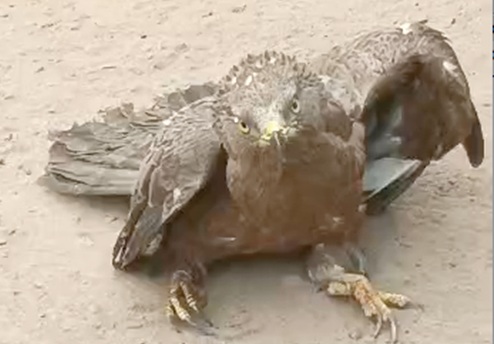
Late last month, a bird known as kite (call it ‘Anomapa’ for purposes of this story) flew more than 3,000 miles across continents to Ghana.
The bird was found wounded and was rescued by a 32-year-old farmer, Ebenezer Lativi, at Assin Breku Kwame Ankra in the Assin North District in the Central Region, and handed over to agricultural officials.
However, the kite, Anomapa, eventually died three days after at the Kumasi Zoo where it was receiving attention.
This unfortunate incident could have been prevented if the communities were enlightened on the different bird species and their importance to the ecosystem.
Kites
Kites are a subset of hawks with smaller claws, round heads and long tapering wings.
They look like falcons, and used to be categorised as falcons, but recent reexamination has put them back in the hawk/eagle guild.
Mysterious
Without much information on migratory birds, locals who found the bird had insisted it was a mysterious bird possibly with spiritual powers, and therefore sent to cause mayhem to the people.
The bird was found shot and wounded before residents realised it was linked to scientific research.
Even with its ring, an identification on its foot, residents still argued it was a spiritually mysterious bird.
Eventually, after good reasoning and with the identification as a stronger evidence, they handed the bird over to agricultural officials for medical aid.
The incident has since attracted widespread attention, raising questions about migratory birds, wildlife conservation and the presence of internationally tagged species in communities within the Assin North enclave in the Central Region of Ghana.
The identification band
The metal band on the bird's feet bore the address “Museum Science, 1000 BRUSSEL”, the website www.ring.ac, and a unique identification code H220252, confirming its association with the Brussels Museum of Natural Sciences.
Farmer account
The farmer who found the bird stated that he noticed blood stains on leaves on his farm and was immediately alarmed.
Upon further search, Mr Lativi said he discovered the bird bleeding profusely and struggling to survive.
He retrieved the injured bird and was shocked to find a metal ring attached to its leg.
He said a closer inspection of the ring revealed inscriptions linking the bird to an international scientific research programme.
The unexpected discovery sparked fear and curiosity among some residents, with rumours circulating that the bird could be spiritual in nature.
"I never imagined a bird could travel that far and that it was part of an international scientific study, Mr Lativi stated, describing the discovery as mysterious and unsettling.
He explained that he immediately took the bird home and informed officials of the local assembly.
Following this, a directive was issued by the District Chief Executive for the bird to be sent to local veterinary officers for treatment and proper care.
Research
The Wildlife Conservationist and Site Manager of the Sakumono Ramsar Site, Paul Asimeng, said migratory birds were an important part of the ecosystem.
Speaking in an interview with the Daily Graphic, he explained that the inscription “BRUSSELS” on the ring confirms that the bird was scientifically tagged under an international research programme, and therefore had no spiritual connotations.
Mr Asimeng explained that bird ringing, also known as banding, was a scientific method that involved attaching a lightweight, uniquely numbered metal ring to a bird’s leg to study migration routes, lifespan and population trends, with minimal and temporary stress to the bird.
He stated that the technique was a vital wildlife conservation tool used worldwide.
Meanwhile, the Royal Belgian Institute of Natural Sciences has been informed about the discovery and death.
Migratory, importance
According to the World Bird Database (last modified in 2025), Ghana has 771 bird species, with 38 of them globally threatened and one newly introduced species.
Mr Asimeng said migratory birds had specific routes they used, and that the Assin area could be one of such routes.
He said those birds flew long distances and usually arrived at their destinations weak and exhausted.
He indicated that education on such birds and their activities was limited, especially in Ghana, resulting in the loss of some very important species in the ecosystem.
Mr Asimeng pointed out that vultures, which were crucial to the ecosystem, clearing up carcasses to bring sanity into the ecosystem, were almost extinct.
He said the birds helped sustain ecosystem health, acting as key pollinators, seed dispersers and natural pest controllers that protected agricultural productivity while maintaining biodiversity.
"The ecosystem is like a chain; when you take one piece out, you affect the whole cycle," he stated.
"From rodents, to snakes to birds, they all are an important part of the ecosystem and ensure balance on the whole," he added.
He advised residents to be on the lookout and report such birds to the nearest veterinary office or the Forestry Commission for aid.
He indicated that intensified education on such birds and the ecosystem in general would be increased to reduce such incidents.
Day
The 2026 World Migratory Bird Day would be celebrated on the theme: "Every Bird Counts –Your Observations Matter!"
The campaign focuses on the vital role of community/citizen science in tracking and conserving migratory bird populations.
It highlights how individual sightings and data contribute to global conservation efforts.
To keep the balance in the ecosystem, our guiding goal must be "live and let live”.
