
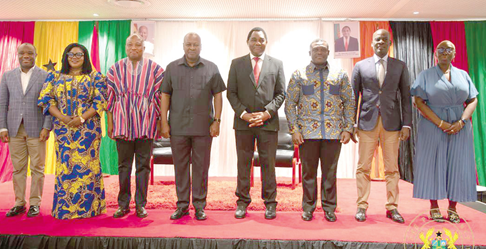
Ghana and Zambia have agreed to move beyond champagne relations into impactful joint ventures, leveraging their private sectors to deepen industrialisation, increase trade and create sustainable jobs.
The two leaders used the state visit to announce a detailed sector-specific economic partnership, placing the private sector at the centre of a renewed bilateral relationship.
This new direction was revealed by President John Dramani Mahama and President Hakainde Hichilema during consecutive addresses at the Ghana-Zambia Business Dialogue in Lusaka yesterday, the final day of President Mahama’s official visit to Zambia.
Break from the past
Speaking at the dialogue, President Mahama said the engagement was a break from the past.
“This state visit has not been your usual ceremonial champagne drinking, you know, food eating and signing bilateral agreements, and that's it,” he told the gathering of business leaders and officials.
He said after fruitful government-to-government talks, the two leaders agreed to move “beyond just the normal permanent joint commission discussions and enhance the relations between Ghana and Zambia to the level of an enhanced economic development partnership.”
He stressed that the business forum was the anchor, allowing the private sector to “have the opportunity to hold discussions, network, have roundtables.”
President Mahama outlined areas where each nation could learn from the other, using specific examples.
He lauded Ghana’s advanced FinTech sector but stated, “I realise that Zambia is far ahead of us in terms of reforms in the energy sector.”
He shared a personal story of his solar-powered farm to illustrate the point: “I produce more power than my farm needs. We don't have the regulation to pay you for any excess power that you produce.”
He calculated that under a system such as Zambia’s, his farm would have earned roughly $70,000 over two years.
“And so the Zambian lesson would be a very good model for us to look at,” he concluded, proposing a study tour for Ghana’s energy ministry.
President Mahama thanked President Hichilema for a pragmatic gift: “President Hichilema has given me one tonne of maize seed. And so this year I'm not going to buy maize seed for my farm.”
The private sector as the engine
President Hakainde Hichilema passionately reinforced the call for an economic pivot.
“The President of Ghana and I are very clear that Ghana’s economy, the Zambian economy must run at a faster speed and you, the business colleagues, must be at the forefront of this and no one else,” he said, and urged businesses from both countries to invest and form joint ventures.
He directly responded to President Mahama’s energy example, offering collaboration.
“President Mahama was telling me that his farm produced excess electricity from solar, but he's putting it to the grid for free, for free.
I said no, Mr President, you are losing a lot of money there.
Do the reforms, and we're happy to support Ghana.
This is not a joke. This is serious.”
To catalyse trade, President Hichilema proposed a swift, practical measure: “Maybe we need to quickly get the import list of Ghana; import, export list of Zambia, and immediately we start comparing notes.”
He argued this would help cure the “disease of Africa not doing business with itself.”
Foundations for integration
The visit has already yielded key enabling agreements, including a visa waiver for ordinary passport holders and a bilateral air services agreement, both designed to facilitate the movement of people, goods and capital.
The dialogue concluded with a shared vision where government action enables private enterprise.
As President Mahama stated, “Government will provide the enabling environment, but it is the private sector that must build the factories, take the risks, and create the jobs.”
The event marks a definitive shift in Ghana-Zambia relations, moving from historical solidarity and political diplomacy to a detailed roadmap for mutual economic gain, with its success to be measured, in President Mahama’s words, “not by communiques, but by thriving enterprises, growing exports, and improved livelihoods of our people.”
