
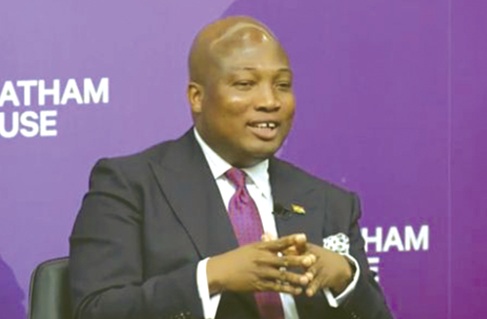
Ablakwa calls for international cooperation in West Africa terrorism fight
The Minister of Foreign Affairs, Samuel Okudzeto Ablakwa, has called for international commitment in the fight against terrorism and violent extremism in West Africa.
Speaking at a side event of the Conference of Commonwealth Ministers of Foreign Affairs at Chatham House in London last Monday, the minister indicated that it was about time the UN adopted the resolution seeking international financial support and troops to combat terrorism in West Africa.
Mr Ablakwa reiterated that threats of terrorism should not be viewed as solely an African problem, as they have broader implications for the international community.
“We have always made the point that this requires international cooperation.
The international community should not leave this. It's not an African problem because terrorism taking root is a threat to the entire global community,” he said.
Influence of Middle East conflict
The minister expressed concern about the conflict in the Middle East, warning that it could potentially lead to terrorist elements from the region advancing towards Africa.
He stated that this situation called for Africa to be extra vigilant regarding the movement of terrorist organisations, especially towards the Sahel.
‘’What is happening now in the Middle East will only worsen the situation.
As you push out the terrorists and dismantle those you don't want nearby, they will be forced to relocate.
Should we allow Africa to become a safe haven where they can feel secure, grow, and continue launching attacks on all of us?” he asked.
ECOWAS effort
The minister, however, refuted claims that ECOWAS was weak, describing the claims as “exaggerated theories”, asserting that “ECOWAS is still strong and buoyant”.
As part of a new initiative to combat terrorism in West Africa, he said a number of the ECOWAS member states have launched a Coalition of Willing States, also known as the Accra Reset Initiative, to address the increasing threat.
The initiative, he said, had received positive responses from the Alliance of Sahel States (AES), comprising Mali, Burkina Faso and Niger, which were warming up to security cooperation with the US and ECOWAS countries.
Mr Ablakwa affirmed that the new framework, which had received the AU's blessing, would see 1,600 troops deployed for hot pursuit operations, adding that the coalition had also convened a meeting of special envoys to the Sahel to strategies on neutralising terrorists.
The minister lauded President John Dramani Mahama’s effort to serve as a bridge between the Alliance of Sahel States (AES) and the ECOWAS, which had had bad blood prior to his return to office in January last year.
Framing
Mr Ablakwa underscored the need to rightly define the insecurity in the region, warning against generalising it as a religious war, although some religious undertone could be mentioned.
He emphasised that the effort was a fight against violent extremism, banditry and organised crime, requiring a multi-sectoral approach.
Therefore, it must be properly framed to bring all parties on board in the fight against terrorism.
The minister cited that in the recent attacks in Burkina Faso, which killed eight Ghanaians, five of the victims were Christians and the other three were muslims; emphasising that the terrorists cared less about the religion of their victims.
