
Africa must protect its internet protocol domains — Sam George
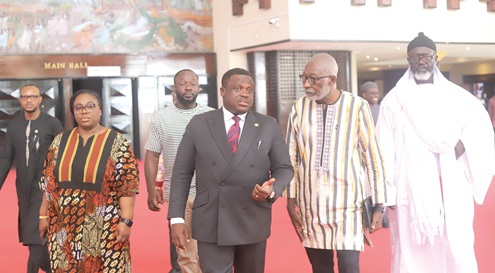
The Minister of Communication, Digital Technology and Innovations, Samuel Nartey George, has urged African countries to ensure their Internet Protocol (IP) resources are protected and remain under African control to secure the continent’s digital future.
He said this was necessary to safeguard national digital identity, strengthen economic independence, and prevent the outsourcing of strategic internet infrastructure.
“Africa’s Internet Protocol version 4 (IPv4) and Internet Protocol version 6 (IPv6), which assigns unique numerical addresses to devices, enabling them to communicate and exchange data over the internet and private network resources, must remain African.
“We cannot mortgage our country code top-level domains for any price.
These are strategic assets, and we must be mindful of what we do,” Mr George said.
The minister, who is also the Member of Parliament for Ningo Prampram, said this at this year’s Africa Domain Name System (DNS) forum in Accra.
The two-day forum on the theme: “Resilience of the DNS in Africa,” was organised by Africa Top Level Domains Organisation (AFTLD), in collaboration with Internet Corporation for Assigned Names and Numbers (ICANN), Africa Registrar and the Ghana Domain Name Registry.
Protection
The minister said the country’s digital identity strategy had been anchored on promoting the .gh namespace and securing critical internet infrastructure.
“The .gh domain is our real digital identity and every .gh registration is a declaration that we are here, we are open to business, and we are proudly Ghanaian,” he added.
Mr George said the government was working with the Office of the Registrar of Companies (ORC) to ensure that all newly registered businesses automatically received a .com.gh domain.
Infrastructure resilience
On infrastructure security, the minister said the country’s experience with last year’s major internet outage caused by the near-simultaneous cutting of four of the country’s five subsea cables had reinforced the need to strengthen routing security and DNS resilience.
He called for the deployment of enhanced Domain Name System Security Extensions (DNSSEC), improved abuse-mitigation systems and stronger coordination with operators, regulators and law-enforcement agencies.
The minister also encouraged African companies to embrace their national digital identity rather than relying solely on foreign commercial domains.
Technical capacity
Internet pioneer Professor Nii Narku Quaynor said Africa’s most pressing challenge was its limited technical capacity to operate, maintain and secure critical DNS infrastructure.
He explained that advanced DNS technologies required a deeper engineering competence than most African operators currently possessed.
Prof. Quaynor said the latest ICANN DNS study revealed that Africa accounted for only 4.4 domain names per 1,000 people, compared with a global average of 45 per 1,000, adding that “we are not yet stakeholders in our own digital ecosystem.”
He said Africa’s weak market penetration makes it difficult to build infrastructure for users who had not yet embraced digital identity and urged African internet-governance institutions to assess their own resilience.
Three-layer approach
The Co-founder of Domain Name Services, Neil Dundas, emphasised the importance of building resilience in Africa's DNS infrastructure through a three-layer approach — platform resilience, trust resilience and market resilience.
He explained that platform resilience involved ensuring that services were available, fast, and correct when the network was stressed, while trust resilience required abuse and risk analytics, predictable response and visible trust indicators.
Market resilience involves strengthening the value proposition of country code top-level domains (ccTLDs) and IPs, and making them locally relevant and competitive.
