Battling climate odds to feed families: The hidden struggle of Bono’s rural women farmers
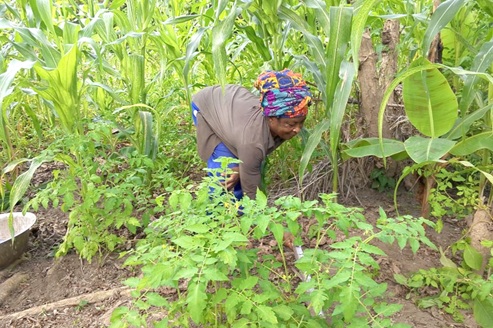
Under the scorching mid-afternoon sun at Fetentaa in the Berekum West District of the Bono Region, 42-year-old Akua Appiah bends over rows of okro plantation, carefully pulling stubborn weeds from the dry, cracked soil with bare determination.
Sweat trickles down her face as the harsh heat presses down on the land, yet she moves patiently from one row to another, clearing weeds to protect the fragile plants she hopes will sustain her family.
Undoubtedly, the dry spell has made farming extremely difficult, but Mrs Appiah conducts farming activity with enthusiasm, refusing to abandon the crops she depends on.
Armed with a machete, she spends long hours under the scorching sun clearing weeds that compete with the plants for the little moisture left in the soil.
Extra sacrifice
Without access to irrigation facilities or affordable credit, every stage of farming requires extra effort and sacrifice.
Still, Mrs Appiah returns to the farm day after day, driven by the hope that the harvest will help sustain her household.
“If the crops fail, everything fails, school fees, food and hospital bills,” she said quietly, pausing briefly before continuing her work under the scorching sun.
Mrs Appiah’s determination mirrors the resilience and passion of many rural women across the Bono Region who remain committed to farming despite prolonged drought and rising temperatures.
For them, tending their farms is more than a daily routine; it is a lifeline they refuse to abandon, as they depend on farming to support their households despite increasingly harsh weather conditions.
Women in agriculture
In many rural communities where employment opportunities are scarce, women have turned to agriculture and agribusiness as a means of survival.

One of the rural women busily working on her plantain and coconut farm
In the region, one of the country’s major food baskets, women traditionally take charge of vegetable farming, including during the dry season when water becomes scarce.
Nearly half of all farmers in the region are women, producing food not only to feed their families but also to pay school fees, hospital bills and other essential household expenses.
Statistics from the Ministry of Food and Agriculture (MoFA) indicate that women constitute about 48 per cent of the region’s agricultural workforce, underscoring their central role in food production even as climate change steadily erodes their productivity.
Despite their contribution, many women, including single mothers, cultivate less than two acres of land, often without irrigation systems, access to formal credit or secure land ownership.
Many also rely on rain-fed agriculture, which is increasingly disrupted by erratic rainfall and prolonged dry spells.
In the region, where the dry season stretches from November to April and temperatures frequently exceed 35 degrees Celsius, farming, particularly the vegetable industry, has become both a lifeline and a high-risk gamble.
Threat to food security
The Chief Executive Officer (CEO) of the Global Media Foundation (GloMeF), Raphael Godlove Ahenu, warned that the challenges confronting women farmers in the region reflected a broader threat to food security across the country.

Sarah Mensah, mulching her okro plants to protect her investment
He said with a large portion of Ghana’s food production coming from smallholder farmers, including women, declining rainfall patterns, rising temperatures and limited access to irrigation were increasingly placing pressure on rural livelihoods.
Mr Ahenu said unless investments were made in irrigation infrastructure, climate-resilient farming methods and financial support for smallholder farmers, the country risks reduced vegetable production and rising food prices in the coming years.
He added that the existence of gender-induced socio-cultural barriers frustrated female farmers in the region and called for the removal of those barriers.
Despite these challenges, rural women continue to brave the harsh conditions each year to cultivate vegetables such as tomatoes, okro, pepper, cabbage and garden eggs.
Investigation
A Daily Graphic investigation has revealed how rural women across the region are navigating the harsh intersection of climate change, poverty and gender inequality, producing crops, especially vegetables, during the dry season not merely for trade but to sustain their families in an increasingly unpredictable climate.
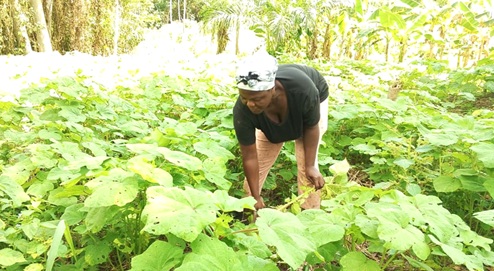
Akuaa Appiah, weeding around her okro plantation
Many wake before sunrise to search for water to irrigate their crops, while others mulch their farms to conserve soil moisture.
Women who do not farm near riverbanks have adopted drought-resistant practices to help their crops survive the extreme heat.
The water struggle
Another female farmer, Azara Yenukwa, is also struggling to keep her farm alive during the harsh dry season.
Standing beside a narrow stream that has almost dried up, she told the Daily Graphic that water scarcity had become one of the biggest challenges confronting vegetable farmers in the area.
“Some years ago, the stream flowed throughout the dry season, but now it dries up quickly.”
“When that happens, we have to walk long distances to fetch water for the crops,” she said.
Mrs Yenukwa, a single mother of two, cultivates tomatoes, pepper and okro on a half-acre plot which provides food for her family.
She said the rising cost of farm inputs, particularly fertilisers and improved seeds, had made vegetable farming increasingly difficult for smallholder farmers.
“Sometimes we want to expand the farm, but we don't have enough funds,” she said, adding that even fertilising a small portion of land had become expensive.
Despite the challenges, Mrs Yenukwa said she was determined to continue farming because it was the only reliable source of livelihood available to her family.
“If I stop farming, how will I feed my children? This is the only work I know,” she said.
Unpredictable venture
Another farmer at Jinijini, Sarah Mensah, said changing weather patterns had made farming increasingly unpredictable.
She explained that dry seasons had become longer and hotter over the years, making it increasingly difficult to sustain crops, particularly vegetables.
Ms Mensah, who grows okro, plantain and coconut, said extreme heat during the dry season often causes crops to wither before maturity, resulting in significant financial losses.
“When the heat becomes too much, the crops dry up even if you water them.”
“Sometimes all the work we do for months goes to waste,” she said.
Farming for survival
For 44-year-old farmer Alimatu Sadia, dry-season farming presents both opportunity and struggle.
Speaking to the Daily Graphic on her two-acre vegetable farm at Japekrom in the Jaman South Municipality, she said income from vegetable production had become an important source of support for her household, helping her husband meet the needs of their five children.
“Vegetable farming can help many families,” she said, urging unemployed women, particularly the youth in rural communities, to venture into the sector to improve their livelihoods.
Despite its potential, Mrs Sadia said the industry was increasingly threatened by persistent pest and disease attacks, which often destroyed crops and reduced yields.
She appealed to the government to roll out initiatives to support female farmers with farm inputs such as fertilisers and pesticides to enable them to protect their crops and increase production.
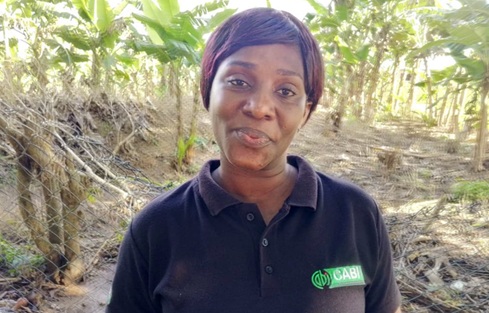
Felicia Asabea Boadu, Bono Regional Women in Agricultural Development Officer at the MoFA
According to her, the high cost of agrochemicals has forced many farmers to resort to traditional methods that offer limited protection.
“Sometimes I use ashes on infected crops because I cannot afford chemicals,” she explained, admitting that the method was often ineffective.
Mrs Sadia said with adequate government support, she could expand her current two-acre vegetable farm to about four acres, a move she believed would significantly increase production and improve her family’s welfare.
Farming risks
For agricultural experts, the struggles unfolding on these small vegetable farms reflect broader climate shifts that are forcing farmers to rethink how and where they cultivate during the dry season.
The Regional Women in Agricultural Development (WIAD) Officer at the MoFA, Felicia Asabea Boadu, said changing weather conditions had made dry-season vegetable production increasingly risky.
She explained that vegetable farming during the dry season could only be sustained where farmers had access to reliable water sources such as rivers, wells or dugouts.
“Because of the current weather conditions, it is advisable to farm around reliable water bodies,” she said.
To help farmers cope with moisture stress, Ms Boadu advised them to adopt climate-smart practices such as mulching.
“When dried weeds or plant residues are spread over the soil, it helps retain moisture for the vegetables.”
“But even with mulching, the success of the crops still depends largely on soil conditions and the availability of water,” she stated.
Ms Boadu stressed that irrigation remained the most reliable option for sustaining vegetable production during prolonged dry periods.
She, however, said most smallholder farmers, particularly women, lacked access to irrigation facilities and therefore depended largely on natural water bodies.
Association
Beyond water access, Ms Boadu encouraged women farmers to form associations to strengthen their bargaining power and improve their chances of receiving support from development partners.
She explained that organised farmer groups could purchase farm inputs in bulk, reducing costs for members.
Conclusion
If the country is to protect its food security and support the millions of families who rely on smallholder female farmers, it is imperative to invest in irrigation systems, provide affordable farm inputs, and empower women through training and organised farmer groups.
This will ensure that the determination of women like Akua Appiah and others does not become a daily struggle against impossible odds, but a pathway to a more secure and prosperous future.
Writer's email: