
C/R agencies intensify anti-violence education at School for Deaf, Blind
A platform of key public institutions within the Central Region has stepped up efforts to combat sexual and gender-based violence, taking an inclusive education campaign to the Cape Coast School for the Deaf and Blind.
The platform of institutions, the Essential Services group spearheaded by the Ministry of Gender, Children and Social Protection, dubbed an Essential Service Package, brings together regional representatives from the Ghana Health Service, Ghana Police Service, Commission on Human Rights and Administrative Justice, Judicial Service of Ghana, National Youth Authority and Planned Parenthood Association of Ghana to promote sexual and reproductive health rights among communities.
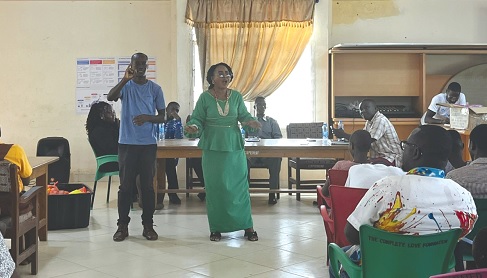
The visit to the school was to educate students on their rights and the need to report abuse.
Technology and abuse
The Central Regional Director of the Department of Gender, Children and Social Protection, Richlove Amamoo, also noted the emerging forms of abuse, particularly those facilitated by technology.
She expressed concern over the increasing misuse of mobile phones and social media platforms to exploit young people.
“Some people take advantage of trust and record private moments, only to use them later as a tool for blackmail,” she said.
“This is abuse, and it must be reported.”
From the health sector, Rosemond Yeboah-Sarpong of the Ghana Health Service noted that many abuse cases occur within familiar environments, sometimes involving relatives.
Gains made
Speaking at the event, a focal person on UNFPA activities at the Central Regional Coordinating Council, David Allan Paintsil underscored the region’s progress in tackling teenage pregnancy, noting that the Central Region, which once ranked first in the country, had now dropped to 12th position.
“This shows that the interventions are working, but we cannot relax,” he said. “Our goal is not to move down the ranking.”
He stressed that protecting young people, especially vulnerable groups such as students with disabilities, required collective responsibility, and urged them to report abuses early.
DOVVSU
The Domestic Violence and Victim Support Unit (DOVVSU) Coordinator, Chief Inspector John Asare Bediako of the Ghana Police Service, emphasised that sexual abuse was not limited to girls.
“Boys are also victims, but many do not speak up,” he said.
He assured students that all cases would be handled with strict confidentiality, adding that victims’ identities would be protected throughout investigations and court proceedings.
“From the judicial perspective, Phyllis Quartey of the Judicial Service of Ghana reiterated that the courts remained committed to prosecuting offenders, especially in cases of defilement.
Expanding on inclusion and empowerment, Emmanuel Jones of the National Youth Authority urged the students to reject any sense of limitation or inferiority.
Mr Jones further pointed to government initiatives such as apprenticeship and skills development programmes, urging the students to take advantage of such opportunities to build their future.
Concerns
Students, however, raised concerns about barriers they face in seeking justice and health care, such as the lack of sign language interpretation in courts, which makes reporting difficult, while others highlighted challenges encountered at health facilities after incidents of abuse and the involvement of third parties during reporting processes.
At the end of the session, 24 final-year students preparing for the Basic Education Certificate Examination (BECE) were presented with mathematical sets, pencils, erasers and rulers.
