
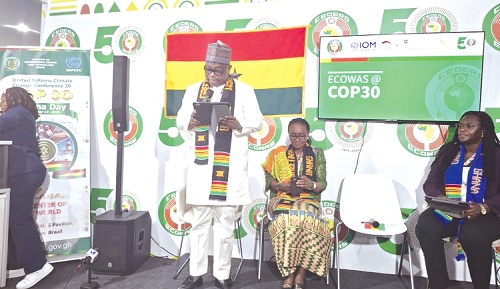
Collaborate to address climate crisis - Minister to global stakeholders
The Minister of State in charge of Climate Change, Alhaji Issifu Seidu, has called for stronger collaboration between state and non-state actors to help address the global climate crisis.
He said the devastating impact of climate change across all sectors meant that working in silos was no longer an option for countries.
"It is crucial that we unite, act and demonstrate to the world our determination to fight climate change. When we work together, we can confidently declare that our nations and people are important, and that we are choosing a prosperous and climate-secure future," he said.
The minister made the call at the Ghana Day Event held at the ECOWAS Pavilion at the Conference of the Parties (COP30) of the United Nations Framework Convention on Climate Change (UNFCC) at Belem in Brazil.
The Ghana Day event was used to showcase some of the efforts the country has made over the years to fight climate change.
Alhaji Seidu said climate change remained a priority for the government, with the overarching agenda being to contribute to halting the climate crisis that was destroying both lives and livelihoods.
He underscored the need for stakeholders to work together in a coordinated manner towards building resilience in communities and the economy by planting trees, investing in renewable energy and promoting sustainable practices.
Alhaji Seidu added that while local action was being taken to tackle the climate crisis, countries that were heavy emitters must keep their promise to pay for the emissions they made.
Again, he called on the heavy emitters to take steps to decrease their greenhouse emissions.
"We cannot risk passing the tipping point; hence, our call to major emitters to align their nationally determined contributions to achieve the 1.5 degree Celsius targets.
"That is not to say that developing countries, including Ghana, will not do anything," he said.
Ghana efforts
Touching on Ghana’s climate efforts, he said the country had submitted updated, enhanced, and ambitious nationally determined contributions (NDCs) last year while also taking steps towards translating the NDCs into ground action by mobilising the needed investment for implementation.
He said Ghana had developed policies such as the agriculture long-term strategy, the national electric vehicle strategy, the national energy transition framework and investment plan and the climate prosperity plan.
He also said the government had invested more than $200 million in the Greater Accra Resilient Integrated Development (GARID) project to tackle perennial flooding in the city.
Additionally, he said the government had invested €3.8 million in climate risk transfer (drought index insurance) and an additional $670 million in seven sea defence projects across the country's coastline.
The minister also highlighted the operationalisation of the energy transition framework in COP27 and the signing of a bilateral cooperation agreement on Article 6.2 with the governments of Switzerland, Sweden and Singapore as some of the climate actions taken thus far.
Inadequate funds
Alhaji Seidu noted that the scope of support for global adaptation efforts was inadequate to address the problem at hand.
He said there was a need to accelerate the support quickly.
"It is imperative that the Global Goal on Adaptation be operationalised and that, among other things, the Adaptation Fund be strengthened to provide the most vulnerable nations with sufficient assistance to carry out our adaptation initiatives," he said.
Regarding the new collective quantified goal on climate finance post-2025,” he said, adding that the country’s position was that "it must adequately respond to the needs of the most vulnerable countries, learning from the experience of the unfulfilled $100 billion goal."
Climate interventions
For her part, the Chief Executive Officer (CEO) of the Environmental Protection Authority (EPA), Prof. Nana Ama Browne Klutse, said the government was rallying efforts for climate interventions, especially in the areas of adaptation, mitigation, loss and damage, the use of technology and capacity building.
"Our negotiating agenda is anchored in Ghana's third nationally determined contribution, becoming our updated pathway to cut emissions," she said.
Prof. Klutse added that the negotiations were also focused on energy transition, cleaner transport, waste management and transparency systems.
"We know negotiations only matter if they translate into lives improved. Ghana's national adaptation plan is meant to protect people, food systems, cities and ecosystems," she added.
