
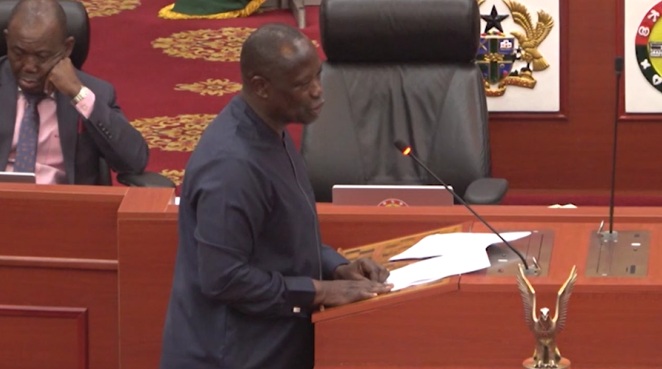
Parliament has ratified a mining lease agreement between the Government of Ghana and Barari DV Ghana Limited for the extraction of lithium and other minerals at Mankessim in the Mfantsiman Municipality of the Central Region.
The ratification paves the way for the commercial exploitation of the mineral resource, a move expected to position Ghana as a key player in the global lithium market.
The 15-year lease, which covers an area of 42.63 square kilometres, is renewable in accordance with the Minerals and Mining Act, 2006 (Act 703).
Under the agreement, the government negotiated a 12 per cent free carried interest in the company, higher than the standard 10 per cent applicable to other mining firms in the country.
Additionally, the company is required to allocate one per cent of its annual revenue to a community development fund to support communities affected by its operations.
The agreement, presented to the House by the Minister of Lands and Natural Resources, Emmanuel Armah-Kofi Buah, on December 19 last year, was subsequently referred to the Committee on Lands and Natural Resources for consideration and report.
Ghana stands to benefit
Justifying the agreement, Mr Buah said Ghana would derive maximum value from a revised fiscal regime that links royalties to international market prices.
He explained that the newly introduced sliding-scale royalty system would enable the country to earn higher revenues when commodity prices increase.
Comparing the new agreement with one previously introduced under the New Patriotic Party (NPP) administration, he noted that the earlier arrangement had a fixed growth and sustainability levy.
“We now have flexibility as there is a new provision that says that the company shall pay to the government of Ghana all other fees, levies and charges as provided under applicable laws.
“Under the old agreement, such provision was fixed at one per cent, but in the new agreement, there is flexibility to allow the government of Ghana to pluck in anytime there is that opportunity."
He added that while the previous agreement provided for a fixed royalty rate of 10 per cent, the new regime allows for up to 12 per cent based on the sliding scale.
“We wanted to be sure that under this mining lithium will not come to add to the destruction of roads, and we have inserted that within six months of ratification of the lease agreement, the company will undertake a feasibility study for the construction of a jetty, barge and a mini-port system at Saltpond or an adjacent suitable location.
“We think that for the people of Ewoyaa and other communities who have waited for almost three years, this is an important day for them because a lot will happen in these communities when this project takes off,” he said.
Minority rejects agreement
Despite the ratification, the Minority Caucus strongly opposed the deal, raising concerns over transparency and the financial assumptions underpinning the agreement.
The Minority Leader, Alexander Afenyo-Markin, said while the caucus supported lithium development in principle, it could not endorse an agreement based on what he described as unverified projections and a flawed regulatory framework.
He argued that the current arrangement could yield lower royalties compared to the previous deal rejected by the then opposition.
“Ghana's lithium endowment is a generational asset and the terms on which it is leased will outlast this Parliament and will define the revenue, employment and community development benefits that flow to Ghana for the duration of the mine's life,” he said.
Concerns over royalty regime
Mr Afenyo-Markin explained that under the new sliding-scale system, lithium royalties range from five to 12 per cent depending on international prices.
He noted that at a benchmark price of $2,250 per tonne — the reference point during earlier negotiations — the new regime would yield a seven per cent royalty, lower than the previous fixed 10 per cent.
“Under the government's own new framework, that same price of $2,250 falls in the 7 per cent band.
“In other words, the sliding scale delivers a lower royalty than the fixed rate that existed when the deal was first made, at precisely the price level used as the reference point for that deal.
“This is not an improvement on the NPP's terms,” he said.
Call for further scrutiny
The Minority Leader further criticised Parliament for proceeding with the ratification despite unresolved concerns regarding the underlying legislative instrument.
He also raised issues about the reduction of the Growth and Sustainability Levy from three per cent to one per cent.
“The government's stated rationale was that the Growth and Sustainability Levy (GSL) increase from one per cent to three per cent was originally introduced to compensate for the absence of a windfall tax mechanism and that the new sliding-scale royalty regime now performs that function,” he said.
He urged Parliament to delay the third reading of the bill to allow for a comprehensive cost-benefit analysis.
“The government has not presented Parliament with a consolidated net revenue analysis, and Parliament cannot responsibly ratify this lease without understanding what Ghana is, on balance, actually gaining,” he added.
Viability and transparency questions
On the revised terms, Mr Afenyo-Markin said the government’s position was influenced by claims from Atlantic Lithium that falling global prices had affected project viability.
However, he cited independent analysis suggesting otherwise.
“This is not a sound basis for the exercise of Parliament's ratification function under Article 268,” he said.
He insisted that Parliament must be furnished with a comparative revenue analysis before approving such agreements.
“Parliament cannot assess the value of this agreement in isolation from its companion legislative changes,” he stated.
Environmental concerns raised
A former Finance Minister, Dr Mohammed Amin Adam, also criticised the environmental safeguards in the agreement, describing them as inadequate.
He warned that lithium mining posed significant environmental risks, including water pollution, soil degradation and waste generation.
He called for stricter measures, including an environmental bond and a dedicated mitigation fund.
“They must set up environmental mitigation fund so that a certain percentage of the revenue from the sale of the product will be put into the fund to be used to mitigate against any disaster when it occurs,” he said.
Dr Amin Adam further proposed increasing the community development fund from one per cent to three per cent of annual revenue.
“This will not be enough if you mark it against the enormous negative footprint production could bring to our communities,” he suggested.
