
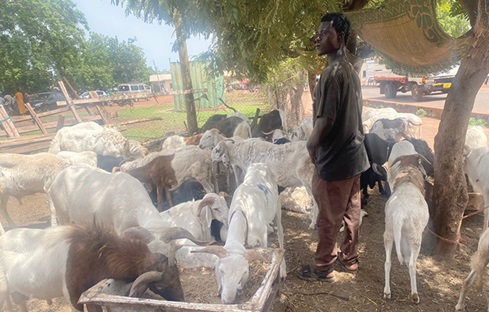
Eid-ul-Adha: Animal traders anticipate last-minute sales boom
Prices of livestock are experiencing mixed outturns in markets in Tamale, Kumasi and Accra ahead of this year’s Eid-ul-Adha celebration, which climaxes tomorrow.
While there is said to be a slight reduction in the prices in markets in Kumasi, those in Tamale have seen marginal increases, while those in Accra have seen a major spike.
Of most concern for marketers in Tamale, however, is the seeming low patronage, with many hoping for a surge in last-minute purchases before the festival.
A visit by the Daily Graphic to animal markets and selling points in Aboabo, Lamashegu, Kukuo and Shishegu showed relatively slow business activity, particularly in the sale of rams, compared to the same period last year.
Despite the slow sales, traders remain optimistic that demand will improve on the eve of the celebration, explaining that many customers often delay purchases due to work schedules or a lack of space to keep the animals before the festival.
According to the traders, some customers were currently buying animals for social functions such as naming ceremonies, funerals and weddings, while only a few were purchasing specifically for Eid ul-Adha.
Rising prices
A ram seller at Aboabo market in Tamale, Mohammed Hudu, attributed the situation partly to the poor market for farm produce, saying many farmers were unable to raise enough money to buy animals for the celebration.
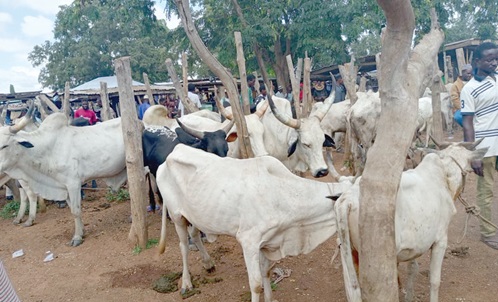
A cattle selling point at Aboabo in Tamale
He explained that animals purchased from surrounding communities and markets were expensive, compelling sellers to increase prices in order to make a profit.
“This year, things are difficult. Many people would like to buy animals, but they cannot afford them because they are unable to sell their farm produce,” he said.
Another trader at the Kukuo market, Alhassan Sulemana, also complained about low patronage.
According to him, many prospective customers would only enquire about prices but would leave without making purchases after hearing the cost of the animals.
“We are recording low sales compared to previous years. Most people here are farmers, and their produce is not being patronised,” he said.
Another seller, Mohammed Baba Kamil, explained that prices depended on the size and colour of the animals.
He said while rams sold between GH¢300 and GH¢1,500 during last year’s Eid ul-Adha celebrations, prices had increased significantly this year.
According to him, small and medium-sized animals currently sell between GH¢850 and GH¢1,500, while bigger rams range from GH¢1,500 to GH¢3,000.
Significance of sacrifice
The Assistant Leader of Masjid Hassan in Tamale, Adam Shahanun, explained that Eid ul-Adha begins on the 10th day of Dhul-Hijjah, the final month of the Islamic calendar, and would continue for three days.
He said the Eid prayer was very important to Muslim faithful, adding that those who were unable to perform the sacrifice on the first day could do so on the second or third day of the celebration.
He described Eid ul-Adha as a festival of sacrifice, during which Muslims, who could afford it, were expected to slaughter acceptable animals such as sheep, goats, cows or camels and share the meat with the poor, friends and neighbours.
Mr Shahanun explained that the sacrifice symbolised piety and obedience to God rather than the shedding of blood itself.
“It is neither the flesh nor the blood that reaches God, but our consciousness and devotion to Him,” he stated.
He, therefore, urged Muslim faithful to follow the prescribed Islamic guidelines for the sacrifice in order to obtain the full spiritual reward.
Price hike
At Avenor in Accra, a livestock trader, Abdul Nasiru, said business this Eid season had seen higher prices compared to last year, mainly because fewer animals were entering the country from neighbouring countries due to border restrictions.
He said, for instance, sheep that previously sold for around GH¢4,000 now sold at between GH¢5,000 and GH¢5,500.
He explained that sheep remained the most popular animal purchased during Eid-ul-Adha because they were commonly used for the sacrifice.
Although customers were still buying animals despite the price hikes, he emphasised that bulk purchases had reduced significantly because many buyers could no longer afford to purchase in large quantities.
Other traders shared similar sentiments.
Baba Alhassan and Moro Ayariga explained that business activity had not fully peaked yet because many customers traditionally buy animals closer to Eid prayers on Wednesday.
They attributed this year’s rising prices to a shortage of animals entering the country from countries such as Burkina Faso, Niger and Nigeria.
The sellers even revealed that many animals were brought into the country through unofficial border routes, making supplies difficult this year.
“In Ghana, we don’t rear animals.
We only say we do, but we don’t. Most of the animals are coming from across the border. And with this season, some of them have to be smuggled into the country.
There seems to be a ban on their movements from these countries,” Mr Alhassan said.
They stressed that demand currently outweighed supply, leading to customer complaints over high prices, but were they still expecting strong sales as Eid approached?
Kumasi
In Kumasi, prices of livestock have dropped slightly ahead of the 2026 Eid-ul-Adha celebrations, largely due to the appreciation of the Ghana Cedi against major international currencies.
The recent strengthening of the Ghana Cedi against major trading currencies, including the United States Dollar, British Pound, Euro and the CFA Franc, has significantly influenced livestock market prices.
A visit by the Ghana News Agency (GNA) to the Kumasi Abattoir revealed a sharp increase in the number of livestock brought into the market ahead of the celebrations.
As of May 21, 2026, more than 5,000 animals had been received at the facility, compared to about 3,000 recorded during the same period in 2025.
Traders attributed the increase to preparations towards the Eid festivities, which usually witness heightened demand for sacrificial animals.
The Financial Secretary of the Livestock and Cattle Dealers Association at the Kumasi Abattoir, Hassan Yakubu, said the stronger Ghana Cedi had reduced the cost of livestock imports, resulting in lower market prices.
He explained that a cow, which sold for about GH¢30,000 last year, was now selling between GH¢20,000 and GH¢25,000, while those previously sold at GH¢15,000 were currently going for around GH¢10,000.
He expressed optimism that the reduction in prices would enable more Muslim families to participate in the sacrifice this year.
According to him, prices of rams now start from GH¢1,500 compared to GH¢2,500 during the same period last year, making them more affordable to consumers.
Mr Yakubu stated that although Burkina Faso and Niger had closed their borders to livestock exports to neighbouring countries, the situation was not expected to significantly affect supply in Ghana.
He said Ghana currently had adequate livestock stock to meet the growing demand during the festive season.
The Production Manager at the Kumasi Abattoir, Michael Tonghani, said the increased supply of livestock would help the facility meet consumer demand during the celebrations.
He assured the public of the abattoir’s commitment to maintaining high standards of hygiene and safety in meat processing.
