

Ensuring food security: Conservationist proposes Climate-Smart Agriculture
The Director of A Rocha Ghana and conservationist, Dr Seth Appiah-Kubi, has stated that Climate-Smart Agriculture has emerged as a transformative approach that integrates innovative practices and technologies to sustainably increase productivity, build resilience and reduce greenhouse gas emissions.
He said by harnessing these innovations, societies could better ensure food security while advancing climate and development goals.
He said the use of advanced technologies such as satellite imagery, drones, and loT sensors enabled farmers to apply water, fertiliser and pesticides with greater efficiency, adding that mobile-based climate advisory platforms provided localised weather forecasts, pests alerts and market information, helping farmers make informed decisions, as these innovations reduced resource waste, enhanced yields and lowered production costs, making farming more resilient to climate shocks.
Dr Appiah-Kubi was speaking on the topic “Environmental Management and Food Security: Threats and Opportunities for Developing Economy” as part of activities marking the fifth anniversary of the University of Environment and Sustainable Development (UESD) at Somanya in the Yilo Krobo Municipality in the Eastern Region.
Food security
Dr Appiah-Kubi, who was the keynote speaker, noted that indigenous people and rural communities often relied on diverse local species for nutrition, medicine and cultural practices but biodiversity loss eroded these traditional food systems, reducing access to a wide variety of nutrient-rich foods.
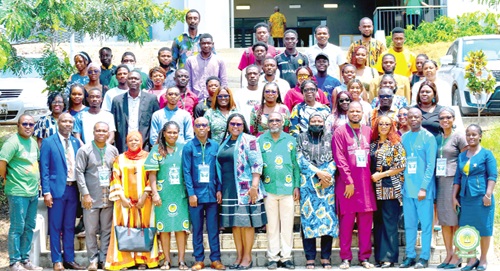
Participants in the event
That, he said, contributed to dietary simplification, which often leads to malnutrition and rising rates of non-communicable diseases linked to poor diets, adding “protecting biodiversity therefore supports not just food quantity, but also food quality and cultural food heritage.”
He said despite these threats to global food security, “Opportunities exist in innovations such as climate-smart agriculture, agroecology, circular economy, nature-based solutions and locally-grown mitigation applications.”
He explained that breeding and deploying drought-tolerant, flood-resistant, and heat-resilient crop varieties were vital for maintaining productivity under extreme conditions.
He said, livestock innovations, such as improved feed additives that lowered methane emissions and better disease management, ensured sustainable meat and dairy production, stressing “these advances strengthen both food availability and nutritional security.”
Nature-based solutions
He emphasised that nature-based solutions, though sometimes criticised for their lack of scalability, remained one of the most effective approaches to dealing with the triple planetary crises of climate change, pollution and biodiversity loss, all of which have dire negative consequences on food security, adding “mangrove ecosystems are, for instance, living shields against climate change, pollution and biodiversity loss.”
Dr Appiah-Kubi said Asase Ye Valley, a farming community, was struggling with declining harvests as their soil grew tired from the application of many chemical fertilisers and rivers were polluted from pesticide run-offs, while crops were increasingly vulnerable to pests and disease, resulting in farmers being frustrated as a result of less fertile land.
He, however, explained that along the line, a group of young farmers decided to do something different.
“They studied sustainable environmental management practices and convinced the community to make a collective change.”
“They began by restoring the soil. Instead of relying solely on synthetic fertilisers, they introduced crop rotation, composting and the use of natural manures.
Cover crops such as legumes replenished nitrogen in the soil. Slowly, the earth regained its richness.”
“Within a few years, Asase Ye Valley transformed. The soil was alive, producing crops rich in flavour and nutrients. Farmers harvested abundant vegetables, grains and fruits that were healthier than ever.”
“Because of the fertile soil and balanced ecosystem, crops required fewer external inputs, saving money and ensuring long-term sustainability,” he concluded.
The Vice-Chancellor of UESD, Prof. Eric Nyarko-Sampson, stated that the conference formed part of the university’s strategic plan to create opportunities for the faculty members and other colleagues from academia to present their research output to influence policy, contribute to their professional growth and make the university more viable.
