


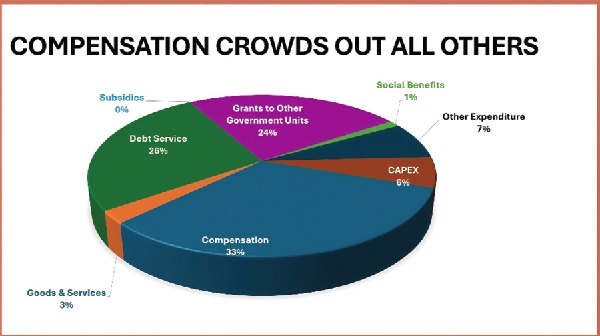
THE country spent 44.8 per cent of its non-oil tax revenue on public sector wages in 2025, significantly exceeding the ECOWAS-recommended threshold of 35 per cent.
The Minister of Finance, Dr Cassiel Ato Forson, who disclosed during a Government-Organised Labour Dialogue, said the picture underscored a severe fiscal constraint facing the country.
In a presentation at the high-level meeting between President John Mahama and Organised Labour, the Finance Minister outlined the growing pressure of the public sector wage bill on government finances.
He revealed that out of a total tax revenue of GH¢183 billion realised in 2025, statutory obligations — including transfers to District Assemblies Common Fund (DACF), the Ghana Education Trust Fund (GETFund), the National Health Insurance Levy (NHIL) and debt servicing — consumed GH¢122.1 billion, leaving only GH¢61.9 billion available for any other public expenditure.
However, the government’s wage bill alone amounted to GH¢78.9 billion, creating a financing gap that forced the state to borrow approximately GH¢17 billion to meet salary obligations.
Dr Forson explained that the combined burden of wages, debt servicing and statutory transfers exceeded total tax revenue, effectively crowding out other critical expenditures.
He warned that under the current fiscal conditions, the government lacked the financial space to adequately invest in essential infrastructure such as schools, hospitals and roads.
The Finance Minister added that while fair remuneration remained a constitutional obligation, the current trajectory of public sector compensation posed a significant structural risk to fiscal sustainability and service delivery.
He stressed the need for careful management of wage growth alongside broader fiscal reforms to restore balance and create room for development spending.
Disagreement
However, the government’s framing of the issue has drawn sharp criticism from the Trades Union Congress (TUC).
Dr Kwabena Nyarko Otoo, Deputy General Secretary of the TUC, argued that the Finance Minister’s presentation unfairly vilified public sector workers.
In an interview with the Graphic Business yesterday, Dr Otoo maintained that wages were not the primary cause of the country’s fiscal woes, suggesting the government’s accounting was selective.
“The narrative given by the Finance Minister was that after paying statutory payments, he is left with a gap of GH¢17 billion, but he turned it the other way around; is it a case of giving public sector workers a bad name in order to hang us. That narrative he has indicated is not fair to workers,” he stated
Dr Otoo reminded the government that organised labour had shown restraint in recent years, accepting a 10 per cent base pay increase against the wishes of its members in 2025 and a nine per cent increase in 2026 to accommodate the government’s own recruitment drives for nurses and teachers.
He pointed to a contradiction in the government’s position, stating that in the same dialogue, plans to recruit 40,000 security personnel were announced while lamenting that salaries were being funded by debt.
“If you tell us you are borrowing, then in the same speech you say you are now going to recruit 40,000, there’s something that doesn’t add up,” he said.
The labour leader argued that the core problem was not an excessively high wage bill but a chronically weak revenue base.
He noted that public sector compensation as a percentage of Gross Domestic Product (GDP) has actually fallen, from around 11 per cent 15 years ago to 5.64 per cent in 2025, according to the Minister’s own data.
“Our wage bill is not too high, in my view, but the real problem is that our revenue base is too weak, every country in the world borrows; America borrows, Japan borrows. We can expand our revenue base,” he stated.
Curbing corruption
Dr Otoo called for a collaborative approach, urging the government to plug revenue leakages caused by corruption and over-invoicing, and to take concrete steps to broaden the tax net, particularly in the informal sector.
“We don't want a situation where one party throws figures at the other, and we are not too sure about the authenticity of those figures, we all need to sit and understand what the figures are. Collectively, we can then move on to define a framework that ensures that we get more revenues, and the nation doesn't need to borrow all the time,” he stressed.
Dr Otoo added that stronger social dialogue is essential to map out a sustainable strategy that balances fiscal discipline with fair compensation for workers.