
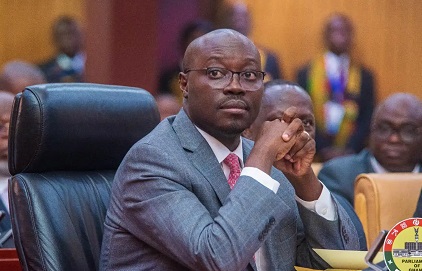
Finance Minister unveils 2026 strategy - VAT overhaul drives economic reset
The government will enter a decisive phase of economic reset this year with an uncompromising policy to preserve stability, entrench debt sustainability, sustain growth and deliver prosperity that every Ghanaian can feel, the Minister of Finance, Dr Cassiel Ato Forson, has declared.
He said having achieved a lot on the macroeconomic and real sectors last year, this year would be “an era of discipline, reform and delivery.”
In an exclusive interview with the Daily Graphic, the Finance Minister outlined five pillars of the country’s macroeconomic strategy.
They are fiscal discipline and debt sustainability; a resilient and inclusive growth model; deep structural reforms; stronger social protection and sound monetary and exchange rate policy.
Dr Forson said the sweeping policy agenda would begin with a significant simplification of the Value Added Tax (VAT) system to ease the burden on businesses and households.
VAT reforms
The government has abolished the COVID-19 Health Recovery Levy and ended the controversial de-coupling of the Ghana Education Trust Fund (GETFund) and the National Health Insurance Levy (NHIL) from the main VAT, allowing businesses to now claim them as input taxes.
Furthermore, the standard VAT rate has been reduced from 21.9 per cent to a flat 20 per cent.
In a major relief for small enterprises, the VAT registration threshold has been drastically raised from GH¢200,000 to GH¢750,000.
The zero-rating on locally manufactured textiles has also been extended to 2028, and VAT on mineral prospecting has been scrapped.
This means that while local textiles manufacturers will not be charged VAT, any such tax suffered by the company could be reclaimed as input tax, hence freeing their working capital.
“This is a new deal for businesses and households,” Dr Forson said, positioning the reforms as a catalyst for his wider five-pillar macroeconomic strategy.
To safeguard revenues, Dr Forson said the Finance Ministry was deploying a robust digital enforcement regime.
“This includes new tools to tax cross-border digital transactions by non-resident platforms, the full rollout of Fiscal Electronic Devices for real-time transaction tracking, and a novel VAT Reward Scheme to incentivise consumer receipt collection,” he stated.
Beyond VAT, Dr Forson outlined a stringent fiscal framework for the year.
He said the government was committed to maintaining a primary surplus of at least 1.5 per cent of Gross Domestic Product (GDP), driven by an aggressive Medium-Term Revenue Strategy and digital systems to expand the tax base.
He pledged to cut waste, cap non-essential expenditures, and rationalise earmarked funds to create space for growth-enhancing investments in infrastructure, agriculture and agribusiness.
“Our fiscal policy is anchored on discipline, credibility and growth,” Dr Forson stressed, adding that strict controls would be enforced to prevent arrears, while prioritising social spending on programmes such as the Livelihood Empowerment Against Poverty (LEAP), National Health Insurance Scheme (NHIS), School Feeding and free secondary education would be protected.
Key structural reforms to lock in this discipline include the full integration of Ghana Electronic Procurement System (GHANEPS) into the financial management system, sustained payroll cleansing and the implementation of all recommendations from recent arrears audits.
Value for Money Office
Meanwhile, a landmark institutional change for 2026, according to Dr Forson, was the immediate establishment of an independent Value for Money Office.
The new body, granted significant powers, will act as the permanent guardian of public spending, certifying major projects, enforcing cost benchmarks and demanding measurable results from all government ministries and assemblies.
Dr Forson told the Daily Graphic that the comprehensive policy direction was designed to build an economy powered by productivity and innovation.
“This is the new policy direction for Ghana,” he stated, asserting that the mix of tax relief, digital enforcement, rigid expenditure control, and new accountability institutions marked a fundamental shift towards a disciplined and inclusive recovery.
