
Fishers to formalise unions to protect rights, promote sustainable fishing
General Agricultural Workers' Union (GAWU), an affiliate of the TUC Trades Union Congress (TUC), has moved to formalise unions in the fisheries sub-sector to assist them in accessing decent jobs and asserting their worker rights.
The formalisation of the unions in the sector will enable them to access credit from financial institutions, technical assistance, and other state support that would help them to improve their livelihoods for players.
This came to light at the first National Fishers Conference organised by GAWU to serve as a platform to deepen dialogue on how labour rights can support environmentally sound and socially responsible fisheries management.
The conference was held on the theme: “Enhancing Sustainable Fisheries through the ILO Fundamental Principles and Rights at Work (FPRW)”.
It brought together fishers and fish workers from across the country, fisheries associations, academia, civil society organisations, traditional authorities, formal fish producers, development partners and representatives of the International Labour Organisation (ILO).
Speaking at the conference last Wednesday, the Secretary-General of TUC, Joshua Ansah, called on fishers across the country to formalise their unions.
That, he said, was the most critical step to protect their rights and achieve sustainable fishing, which would benefit them, the sector and the country as a whole.
Rationale
Mr Ansah stressed that organisation through trade unions remained the foundation for dignity, advocacy, and decent work in the fisheries sector.
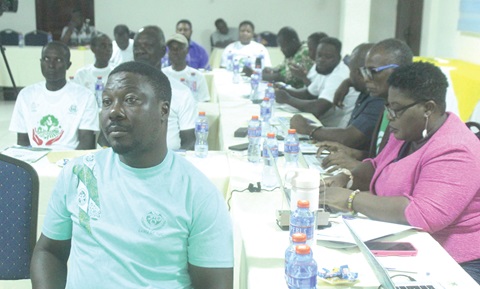
Participants in the National Fisheries Conference.
"Organised labour provides structure, legitimacy, and protection for fishers who remain invisible despite the sector's importance to the economy," he said.
Mr Ansah also explained that belonging to formalised unions would enable fishers to speak with authority and get deserved benefits.
"If you want an organised people, if you want people who have a voice, if you want to meet people who can say things right and rightly, then you must belong to a union,” he said.
Rights, decent work
Mr Ansah also linked unionisation directly to the conference theme on sustainable fisheries, which focused on the application of the International Labour Organisation Fundamental Principles and Rights at Work.
He cited illegal fishing practices, climate change, child labour and poor working conditions as threats that had left many fishers exposed and voiceless.
“Sustainable fisheries are not only about managing fish stocks; they are about safeguarding livelihoods, ensuring social justice, and protecting human dignity,” Mr Ansah said.
Fighting child labour
Touching on the persistent issue of child labour in fishing communities, particularly in coastal and inland areas, the General Secretary of GAWU, Andrews Addoquaye Tagoe, said trade unions were playing a key role in national efforts to eliminate the practice.
He disclosed that the TUC was part of the national steering committee implementing Ghana’s National Plan of Action on child labour, with clearly defined responsibilities for the government, employers and workers.
Within the agricultural sector, Mr Tagoe said, unions had over the past two decades piloted several initiatives, including the establishment of child labour-free zones using integrated, area-based approaches.
“When we organise fishers and bring them together, we can confront child labour directly, because the children involved are their own children,” he said.
Sharing a personal experience from a training session with fishers in the Volta Region, the chairman??? recounted how many fishers expressed hope that their children would become professionals such as journalists, doctors, lawyers and security officers.
However, he said a walk around the community revealed a stark contrast, with children working at the lakeside while classrooms were empty.
“That was when we realised that for these dreams to be achieved, the children must move from the lakeside to the classroom,” he said.
He explained that through collaboration with local unions, community leaders, chiefs, district labour officers and child protection committees, unions helped communities take ownership of the change needed to return children to school.
Objective
Mr Tagoe said the ultimate objective was to ensure that fish consumed in the country was produced without child labour and under decent working conditions for adults.
“We are working to make every fish we consume in Ghana free from the sweat of any child,” he stated, adding that such efforts were also critical to improving Ghana’s image internationally.
He said that issues related to child labour had, in the past, contributed to Ghana being placed on international watch lists, affecting market access.
“GAWU is working with government to ensure that we move away from these challenges so that our image internationally will be good,” he said.
